
Briggs & Stratton
Briggs & Stratton PowerProtect 22kW
Briggs' PowerProtect 22kW has one spec nobody else in the class matches: NGMax tuning delivers the full 22,000 watts on natural gas — no derate — where Generac's 22kW drops to 19.5kW and Kohler's 20kW to 18kW. If your home runs on NG, that's effectively a size-class upgrade for free. The commercial-grade Vanguard 993cc V-twin (Briggs' premium engine line) drives it, the aluminum enclosure is rated for 186-mph hurricane winds, and the 7-year parts/labor/travel warranty beats the standard 5-year offers. So why isn't it everywhere? Owner threads point to the thin dealer network, slower parts distribution since Briggs' 2020 bankruptcy and KPS acquisition, and low retail visibility — Lowe's is the main storefront. At 68 dBA normal / 64 dBA idle-mode it's mid-pack for noise.
Specifications
Highlights
What owners like
- ✓No NG derate — 22kW on either fuel, unique in class
- ✓7-year parts, labor, and travel warranty
- ✓Vanguard 993cc commercial engine with strong 45kVA starting
- ✓Enclosure rated for 186-mph winds
- ✓16-second weekly quiet test barely disturbs anyone
- ✓Usually undercuts Generac 24kW package pricing
Common complaints
- ✗Dealer and service network is the thinnest of the majors
- ✗Parts availability has been slower since the KPS acquisition
- ✗68 dBA normal operation is mid-pack, not quiet
- ✗Few retailer reviews — smaller installed base to learn from
- ✗Transfer switch extra on this SKU
Owner Insightssummarized from Reddit and owner forums
The PowerProtect 22kW is the spec-sheet outlier that natural-gas homeowners keep discovering late in their research: NGMax means it delivers all 22,000 watts on NG, while the Generac 22kW they were about to buy drops to 19.5kW and Kohler's 20RCA to 18kW. That's effectively a free size-class upgrade for the majority of buyers who run natural gas, and it comes attached to Briggs' commercial-grade Vanguard 993cc V-twin rather than a consumer engine. The buyers skew analytical - people who compared NG columns instead of sticker numbers - plus hurricane-belt homeowners drawn to the 186-mph-rated aluminum enclosure and a 7-year warranty that covers parts, labor, and travel, two years longer and broader than the Generac or Kohler paper.
The ownership record is where you need both eyes open. Happy owners sound genuinely happy - one long-termer describes over a year of sports-car reliability, another had it pick up an 8-hour outage without a hiccup - and the Amplify system managing up to 32 prioritized circuits from the app is the most capable load management in the class. But the unhappy reports are specific and concerning: a May 2025 install whose weekly self-test failed most weeks while Briggs stonewalled the warranty claim, and a stuck gas shut-off solenoid that caused a no-start two days into a blackout. Layer on Briggs' rough corporate customer-service reputation since the 2020 bankruptcy and KPS acquisition, slower parts flow, and a dealer map that thins out fast beyond metro areas, and the pattern is clear: the machine is well-engineered, but if you land a lemon, the support experience depends heavily on the quality of your local servicing dealer rather than the mothership. Since Lowe's and Home Depot are the main storefronts, vetting that installer-servicer is on you.
Best for natural-gas homes doing the watts-per-dollar math - at $6,037 for the unit you're getting more usable NG power than a Generac 24kW bundle while spending less, plus the longer warranty. Cross-shoppers almost always weigh it against the Generac Guardian 22/24kW (bigger network, weaker NG numbers, 5-year warranty) and the Kohler 26RCA (24kW on NG but well north of this price). The honest decision rule from owner threads: if you have a solid Briggs servicing dealer within range, the PowerProtect is arguably the best NG value in standby power; if you don't, the Generac's network is worth more than the extra watts.
What owners like
- +Every one of the 22,000 watts survives the switch to natural gas - no other air-cooled unit in the class can say that
- +7-year warranty covers parts, labor, AND travel - the travel coverage is the part rural owners appreciate most
- +Vanguard 993cc V-twin is Briggs' commercial engine line, not the consumer stuff on their portables
- +Amplify load management prioritizes up to 32 circuits from the app - four to eight is the norm elsewhere
- +Aluminum enclosure with Dura-Zen coating shrugs off coastal air, and the 186-mph wind rating is real hurricane-country engineering
- +At 465 lb it's the lightest unit in the class - simpler pad, easier placement
- +One long-term owner's verdict: performs like a new sports car, over a year in
- +64 dBA idle-mode drops the weekly exercise to Cummins-level quiet
Common complaints
- −One May 2025 owner reports the weekly test failing most weeks and getting no traction with Briggs on the warranty claim
- −A stuck gas shut-off solenoid caused a failed start during a 48-hour blackout for another owner - fixed, but at the worst possible moment
- −Briggs corporate customer service draws brutal reviews on warranty claims across product lines
- −Dealer coverage is metro-and-suburban; rural buyers can be a long way from certified service
- −Parts distribution never fully recovered its pre-2020-bankruptcy speed
- −Buying through Home Depot or Lowe's means sourcing your own installer - there's no dealer holding your hand
- −Monitoring is mid-transition from legacy InfoHub to the newer EnergyTrak app, and owners on the old platform feel it
- −Low market share means fewer independent techs have ever worked on one
Common Questions
Does it really make full power on natural gas?
How does the 7-year warranty compare to Generac and Kohler?
What problems do owners actually report?
What's the monitoring app situation?
Is it quiet?
Should I buy it from Home Depot or a dealer?
Related units
More from Briggs & Stratton →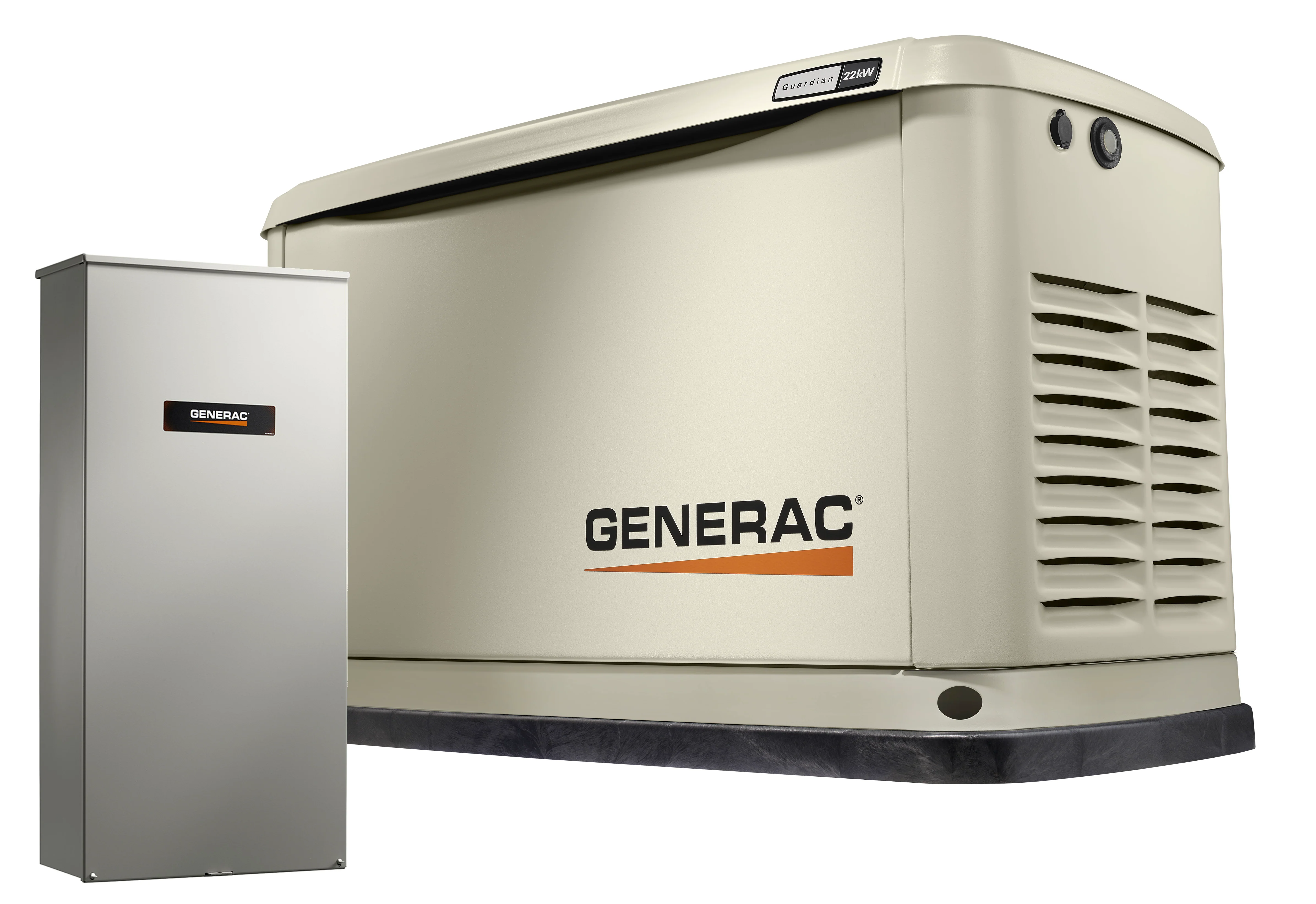
Generac
Generac Guardian 22kW
For years the best-selling home standby generator in America, and the sheer volume of owner reviews shows why: the 22kW carries most whole homes — two AC units with load management — and every electrician and gas fitter in the country has installed one. The G-Force 1000 engine and 67 dB noise level are unremarkable but proven; owners report units sailing through week-long outages after hurricanes. The flip side of ubiquity is that the complaint threads are equally deep: Evolution controller replacements, dealers backlogged after storms, and Generac support that owners describe as polite but powerless. The newer 24kW (7209/7210) has largely replaced it at similar money, but the 7042 remains widely stocked, slightly cheaper, and the known quantity — a big deal when your installer has done fifty of them.

Cummins
Cummins QuietConnect RS20A
The RS20A is what owners buy when the nightly drone of a 70 dB generator is a dealbreaker: Cummins holds it to 65 dB at 23 feet — dishwasher territory — while still starting a 5-ton air conditioner and managing four loads with its built-in intelligent load control. The same QSJ999G V-twin as the RS13A runs harder here, delivering 20kW on propane and 18kW on natural gas, and it ships cold-weather-ready to 0°F out of the box. Owner reviews read like Kohler's best: uneventful, reliable, quiet enough that neighbors ask if it's running. The trade-offs also mirror the RS13A — sparse residential dealer coverage makes pre-purchase service planning essential, stock frequently slips to pre-order, and the app is functional but bare-bones. For sound-sensitive neighborhoods it's arguably the class benchmark.

Kohler
Kohler 20kW RCA
The 20RCA is Kohler's volume whole-house unit and the direct rival to Generac's 22/24kW, built around the bigger CH1000 V-twin. Its party trick is 41kVA of motor-starting capacity — owners regularly confirm it starts a 5-ton AC without dropping the rest of the house, which smaller-surge competitors need load-shedding modules to manage. The RDC2 controller has a strong reliability reputation, and long-term owners (this platform has been around for years) report exceptionally boring, dependable service — the best compliment a standby can get. Trade-offs are the familiar Kohler ones: 18kW on natural gas, 70 dB at full-speed operation is on the loud side, OnCue Plus monitoring trails Generac's app, and you may wait longer for both the unit and a certified installer depending on your region.

Kohler
Kohler 14kW RCA
Kohler's answer to the Guardian 14kW, and the one owners pick when they've read enough Generac controller threads. The commercial-grade CH740 V-twin uses hydraulic valve lifters — no break-in, no valve adjustments — and the corrosion-proof aluminum enclosure holds up in coastal salt air where painted steel rusts. It punches above its class on motor starting with 33kVA of surge capacity via PowerBoost, so a 4-ton AC is realistic. Owner sentiment is consistent: the hardware feels a grade above Generac, but the dealer network is thinner, lead times run longer, and the OnCue Plus monitoring app is dated and clunky compared to Mobile Link. Note the honest ratings: 14kW on propane but 12kW on natural gas, and 69 dB in normal operation is louder than the spec-sheet skim suggests.

Generac
Generac Guardian 18kW
The 18kW is the value pick in the Guardian range on a dollars-per-kilowatt basis — same 816cc G-Force 800 twin as the 14kW, tuned for 18kW on propane and 17kW on natural gas, at only a few hundred dollars more. Owners in hurricane and ice-storm country consistently report it carrying a whole modest home including a 3-ton AC without drama, and the G-Flex variable-speed exercise keeps the weekly test tolerable at 65 dB. The ownership caveats are pure Generac: the Evolution 2 controller is the component that fails, dealers are the only sanctioned path for warranty work, and owners recommend buying the battery and cold-weather kit up front rather than discovering they're extras on install day. If you're between the 14 and this, most owner advice says spend up.
Generac
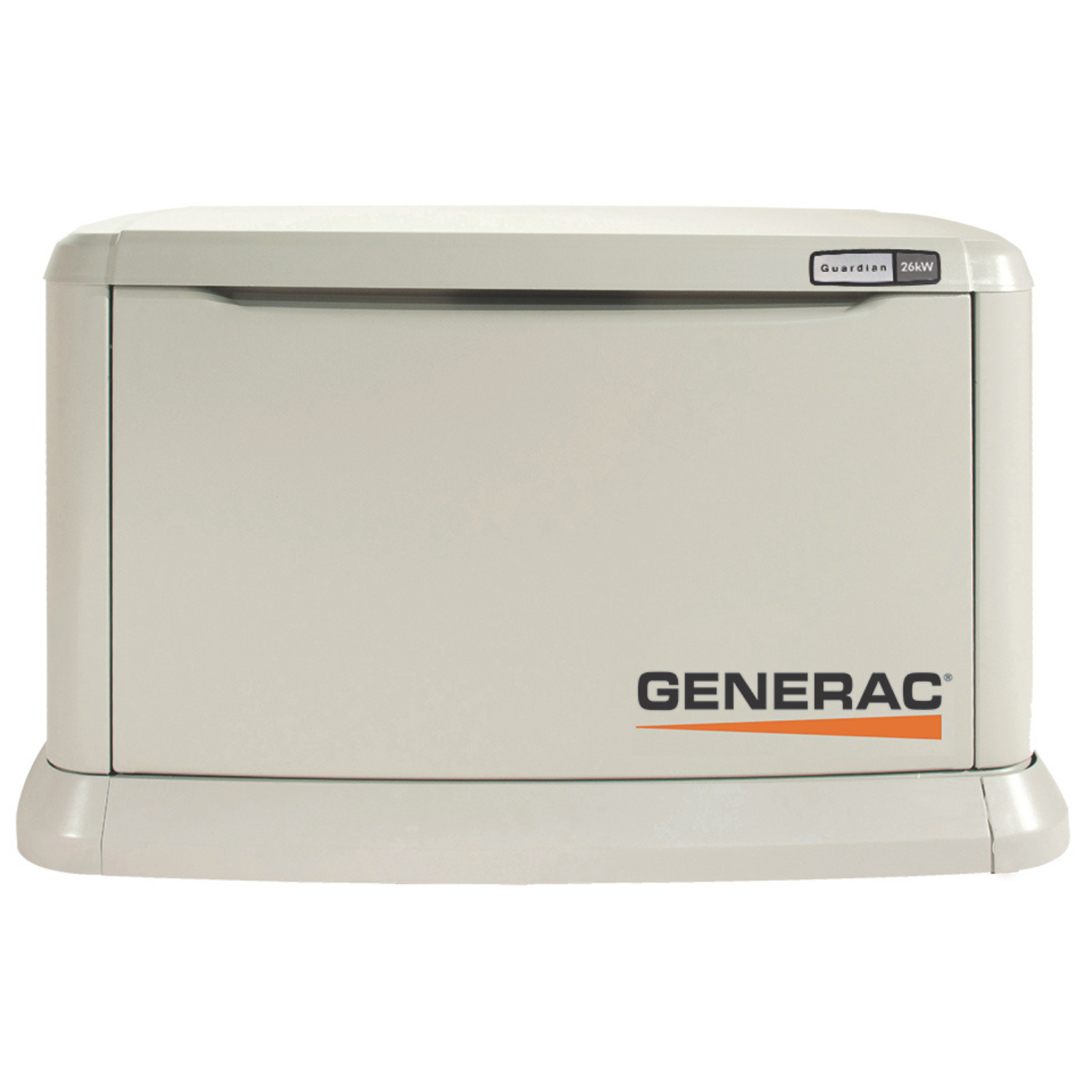
Generac Guardian 26kW
The biggest air-cooled generator Generac makes, and the one owners of large homes buy to avoid stepping up to liquid-cooled money. 26kW on propane (22.5kW on natural gas) with a redesigned alternator delivering 230 LRA of starting grunt means dual 5-ton AC setups are realistic with load management. It's 'smart grid ready' and runs the same Evolution 2 controller and Mobile Link stack as the rest of the line — which cuts both ways, since the controller is also the line's most-reported failure point. Owners praise the density (Generac claims 68% less space than comparable output) and the familiar service ecosystem; the grumbles are the usual dealer-dependent warranty service, the meaningful NG derate, and 67 dB of noise that a big home's yard absorbs better than a small lot does.