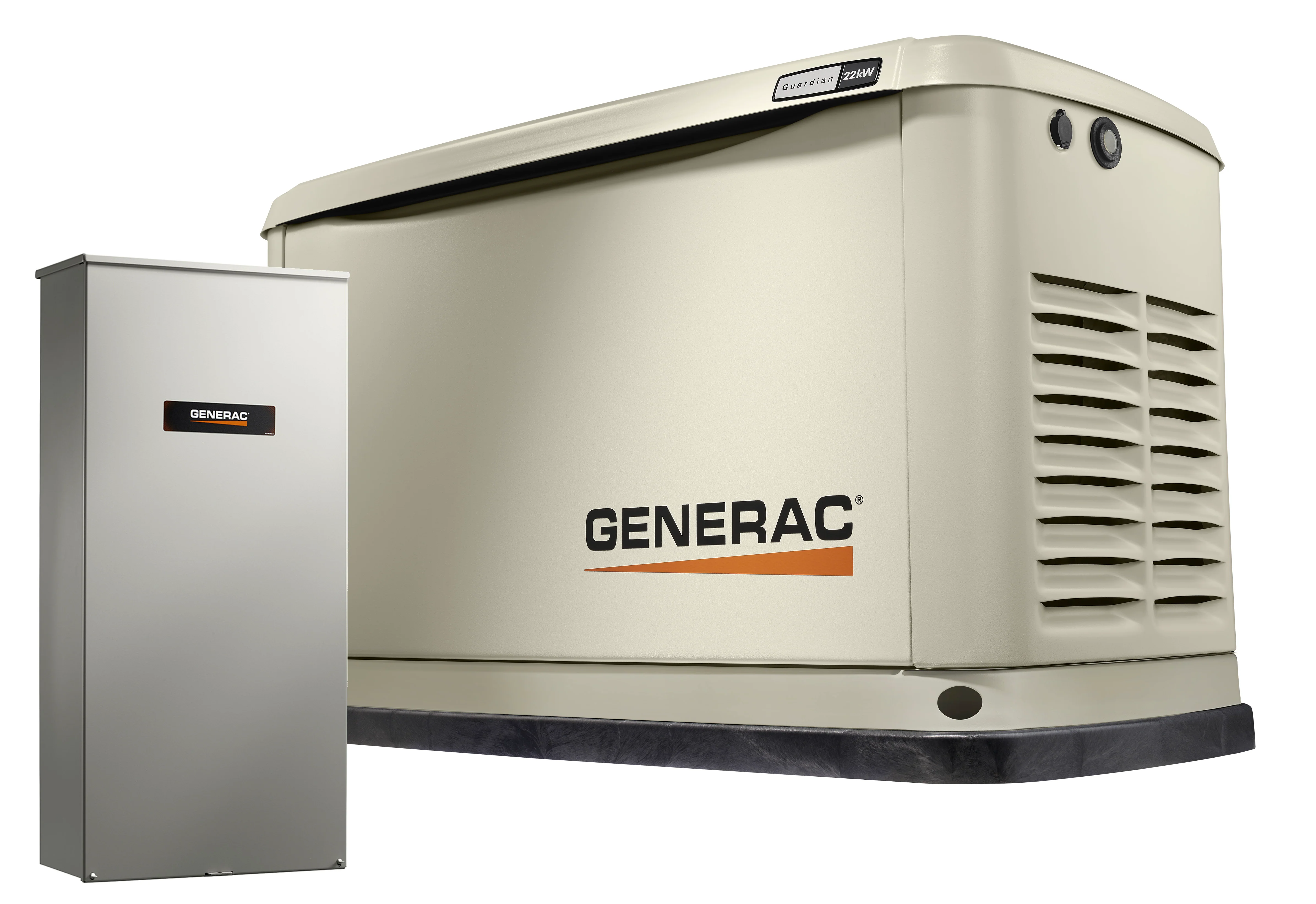
What size whole house generator do I need?
For most homes the honest answer is 18-22kW measured on natural gas, not the propane rating on the box. Essentials alone — furnace blower, fridge, well pump, sump pump, lights, internet — fit inside 9-13kW. Adding one central air conditioner pushes you to 14-18kW; two AC compressors or electric heat puts you at 22kW and up. Size to your largest starting load, not your square footage: a 5-ton AC compressor's inrush is what strands an undersized generator, and no amount of floor space changes that.
How much does a whole house generator cost installed?
Budget roughly double the sticker. A $6,000 whole-house unit typically lands between $11,000 and $16,000 installed once you add the transfer switch, concrete pad, gas line work, electrical labor, permits, and inspection. Smaller 10-14kW essential-circuit setups come in around $8,000 to $10,000. The gas line is the wildcard — if the utility has to upsize your meter to feed the generator, that alone can add several thousand. Get at least three quotes, and get them before storm season, because post-storm pricing spikes are real.
Why does a generator make less power on natural gas than propane?
Natural gas carries roughly 10% less energy per unit volume than propane, so the same engine makes less power burning it. Manufacturers advertise the higher propane number. In practice a Generac 22kW makes 19.5kW on natural gas, a Kohler 20kW makes 18kW, and a Generac 26kW makes 22.5kW. Two units break the pattern: the Briggs & Stratton PowerProtect 22kW is tuned to hold all 22kW on natural gas, and the Cummins RS13A holds all 13kW. If your home runs on a gas line — most do — compare the natural-gas column and ignore the sticker.
Will a 22kW generator really run my whole house?
For most homes under about 3,500 square feet with one air conditioner, yes — comfortably, with the AC running. For larger homes with two compressors it works, but with load management: the controller sheds a second AC or an electric water heater for a few seconds while a big motor starts. That's normal and you rarely notice it. What a 22kW will not do is run two 5-ton compressors, an electric range, and an electric dryer simultaneously with no load shedding at all. If that's the requirement, you're shopping 24-26kW or liquid-cooled.
Generac, Kohler, or Cummins — which is most reliable?
All three are genuinely reliable engines, and the failure reports cluster around controllers and installers rather than the motors. Generac's advantage is ubiquity: the most units in the field, the most technicians who've serviced them, and parts availability everywhere — which matters more than spec-sheet differences when something fails during an outage. Kohler's advantage is build quality, notably the aluminum enclosures that survive coastal salt air and the higher motor-starting surge. Cummins sits between them on price and leads on noise. The installer you pick will affect your ownership experience more than the brand will.
How long does a whole house generator last?
Air-cooled standby generators are generally rated for 2,000 to 3,000 running hours, which for a home that loses power occasionally translates to 20 to 30 years — the weekly exercise cycle accumulates only about 10 hours a year. In practice, units get replaced because a controller board or transfer switch fails and parts stop being made, not because the engine wears out. Annual oil and filter changes are the single biggest factor, and skipping them is the most common way owners cut that lifespan in half.
Do I need a permit to install a whole house generator?
Almost certainly yes — typically both an electrical and a gas/mechanical permit, with separate inspections. This is not bureaucracy worth routing around: the inspection catches the bonding, clearance, and gas-sizing mistakes that you cannot see and that make the difference between a generator and a hazard. NFPA 37 requires 18 inches of clearance from the enclosure and 5 feet from openable windows and doors on most units. An unpermitted install is also the first thing a homeowner's insurer looks for after a fire.