
DuroMax
DuroMax XP13000EH
The 'Beast': 13,000 starting watts, a 500cc V-twin, all-metal construction, and a 50-amp outlet for around $1,300 makes this the biggest-hammer option in portable backup. Owners with heat pumps and well pumps buy it specifically because the MX2 switch lets you dedicate full power to 120V or split 120/240V, and thousands of reviews confirm it starts loads that stall 8kW units. DuroMax support actually gets better marks than Westinghouse's in forum comparisons. What the fans concede: it's LOUD (mid-to-high 70s dB real world), 234 lbs of steel, drinks propane fast (about 3 hours on a grill tank), and its non-inverter power has high enough THD that owners with sensitive electronics run a UPS or interlock only non-critical circuits. Fit-and-finish complaints — sticky chokes, cheap petcocks — appear but are usually solved with basic wrenching.
Specifications
Highlights
What owners like
- ✓Starts well pumps and heat pumps that stall smaller generators
- ✓MX2 switch dedicates full output to 120V when needed
- ✓All-metal frame and panel survive job-site abuse
- ✓50A, two 30A, and GFCI household outlets cover everything
- ✓Strong value at 8¢/starting-watt
Common complaints
- ✗Very loud under load — plan distance and sound walls
- ✗High THD non-inverter power; owners keep sensitive electronics off it
- ✗Propane runtime is only ~3 hours on a 20-lb tank
- ✗234 lbs — barely mobile on soft ground
- ✗Choke and fuel-valve fit-and-finish gripes are common
Owner Insightssummarized from Reddit and owner forums
The XP13000EH is what people buy when the question is torque, not refinement. The 500cc V-twin and 13,000 starting watts exist to slam well pumps, 4-ton AC compressors, and heat pumps into motion, and the owner base is heavily rural: well-and-septic homes, small farms, and shops where the alternative was a much more expensive standby unit. The signature party trick is the MX2 switch, which lets you dedicate the alternator's full output to 120V when you are running tools, or split it 120/240V when you are backfeeding a panel, and owners with unusual load mixes buy it for exactly that flexibility.
Day-to-day, it is a blunt instrument that rewards a little wrenching. Electric start is reliable warm but drags when cold, assembly involves an unattached negative battery wire and some awkward bolts, and the choke and petcock feel like the cost cutting happened everywhere except the engine and frame. Fuel behavior is the big planning item: on gasoline the 8.3-gallon tank gives about 8 hours at half load, but on propane it pulls roughly 1.35-1.6 gallons per hour, killing a 20-lb grill tank in about 3 hours, so serious propane users plumb into 100-lb cylinders or bigger. Power quality measured better than the spec-sheet fear, about 9 percent THD at half load rising to 15 percent near max, which explains why owners run furnaces and fridges happily but keep computers on a UPS. One documented gotcha: the 50A outlet's breaker has tripped in the low 40-amp range for some owners, so treat the last few hundred watts as headroom you do not have.
Best for rural and well-pump homes that need maximum starting torque per dollar and have somewhere to put the noise. Against the Westinghouse WGen9500DF it costs about $250 more and gives up the remote fob, but buys a V-twin, 500 more running watts, and the MX2 flexibility; against tri-fuel rivals it gives up natural gas entirely, which sends city-gas owners to the Firman T07571 or WGen11500TFc instead. Owners also cross-shopped the near-identical XP13000HX with CO shutdown and digital metering for a bit more money. If your critical load is a big motor and your budget stops around $1,300, the fan base is right: nothing else hits this hard for the price.
What owners like
- +The 500cc V-twin starts loads that stall single-cylinder 8kW units, the whole reason people buy it
- +One owner runs an entire house plus a 4-ton central AC with soft start, a real-world report that gets cited constantly
- +MX2 switch dedicates full output to 120V for job sites or splits 120/240V for interlock backup
- +Measured THD of about 9 percent at half load is cleaner than its reputation suggests
- +All-steel frame and cast parts shrug off truck-bed abuse that cracks plastic-heavy rivals
- +DuroMax phone support earns better marks than Westinghouse in side-by-side forum comparisons
- +Well-pump owners specifically report it filling 500-gallon tanks without breaker trips
- +Frequently drops to $899-$960 on sale, absurd money for 13,000 starting watts
Common complaints
- −Drinks propane at roughly 1.35-1.6 gallons per hour at half load, so a 20-lb grill tank lasts only about 3 hours
- −The 50A outlet's breaker trips well below 50 amps in owner testing, closer to a 43-amp real-world ceiling
- −THD climbs to about 15 percent at 90 percent load, so heavily loaded sensitive electronics still want a UPS
- −Electric start balks when cold, with the starter dragging until the engine warms
- −Assembly out of the box is fiddly: hard-to-reach bolts, an unattached negative battery wire, and missing accessories in some shipments
- −Sticky chokes and cheap fuel petcocks show up in the complaint file, usually fixed with basic wrenching
- −234 lbs of steel makes this a two-person or ramp-and-winch machine, full stop
- −Real-world noise lands in the mid-to-high 70s dB, noticeably angrier than the 74 dB spec
Common Questions
Will it start my well pump or central AC?
What does the MX2 switch actually do?
How fast does it burn propane?
Is the power clean enough for electronics?
What should I check before first start?
Can I actually pull 50 amps from the 50A outlet?
Compare the DuroMax XP13000EH
Related units
More from DuroMax →
Westinghouse
Westinghouse WGen9500DF
Probably the most-reviewed big portable on the internet — 24,000+ ratings averaging 4.7 — and the default r/Generator answer for 'cheap whole-house backup through an interlock.' 9,500 running watts on gasoline (8,500 on propane), a 50-amp outlet, remote-start key fob, and a 12-hour tank for around a grand is a spec sheet nothing else matches. Owners routinely run entire homes including central AC during hurricanes. It is not subtle: expect 75+ real-world dB, a 211-lb frame, and open-frame vibration. The complaint file is proportionate to the sales volume: occasional oil leaks and QC escapes out of the box, a Westinghouse support line that owners describe as slow to days-long, and carb gumming if stored wet. The current 'DFc' revision adds a CO sensor. Buy it, change the skimpy break-in oil early, and store it dry.
Firman
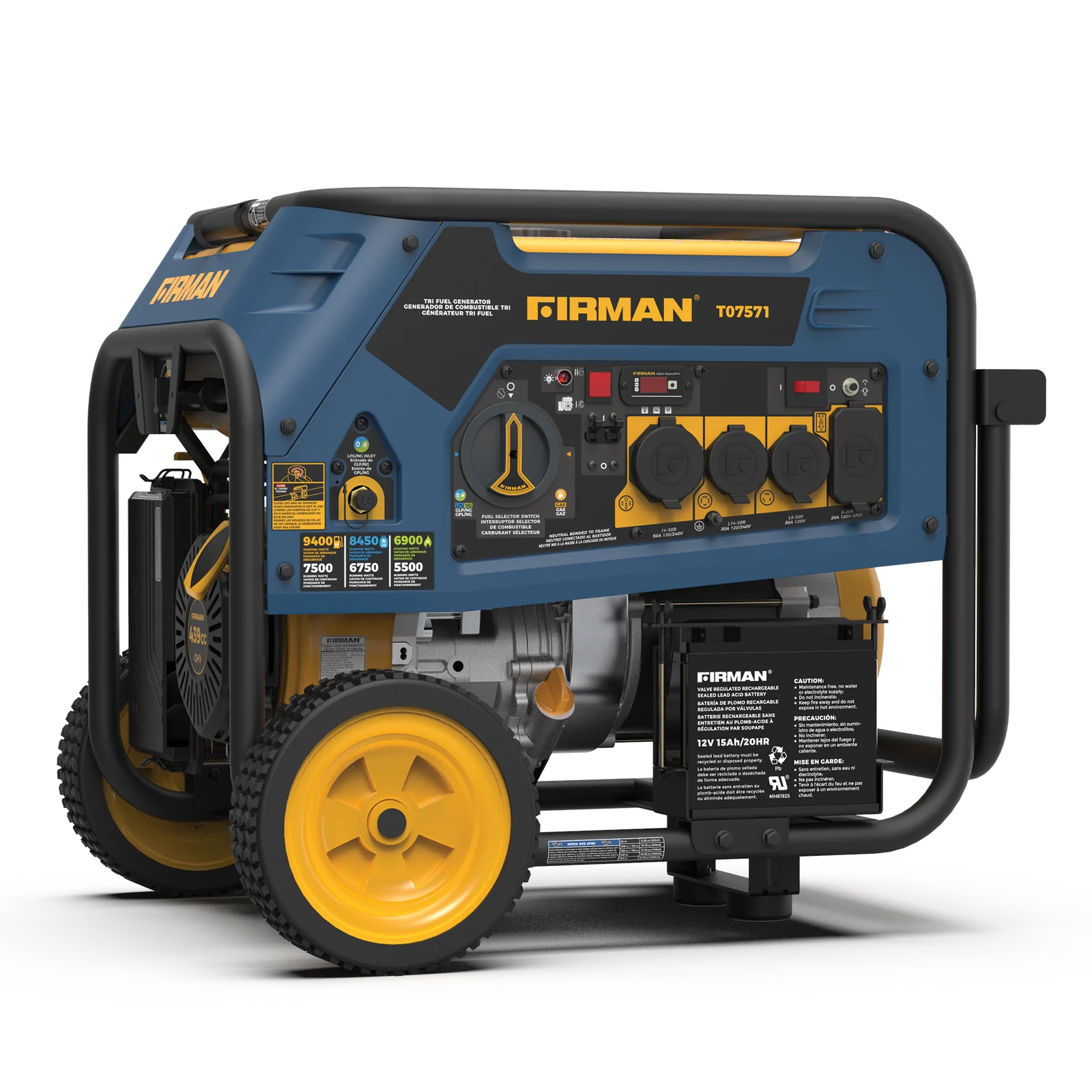
Firman T07571 Tri-Fuel
The Costco tri-fuel that made natural-gas backup a thousand-dollar proposition. The T07571 runs 7,500 watts on gasoline, 6,750 on propane, and 5,500 on natural gas, ships with both LP and NG hoses in the box, and has a 50-amp outlet — which is why r/Generator treats it as the default budget answer to 'I want to hook a portable to my gas meter.' Owners praise the honest hardware: electric start, 8-gallon tank, sturdy 213-lb frame, and a 3-year warranty that beats Predator's 90 days. The recurring complaints: Firman customer service is slow — weeks-long waits for warranty parts are the most common thread — NG output is a real 27% derate, it's a loud 74 dB open frame, and low NG line pressure causes surging just like every NG portable. Costco's return policy is frequently cited as the real warranty.
Generac
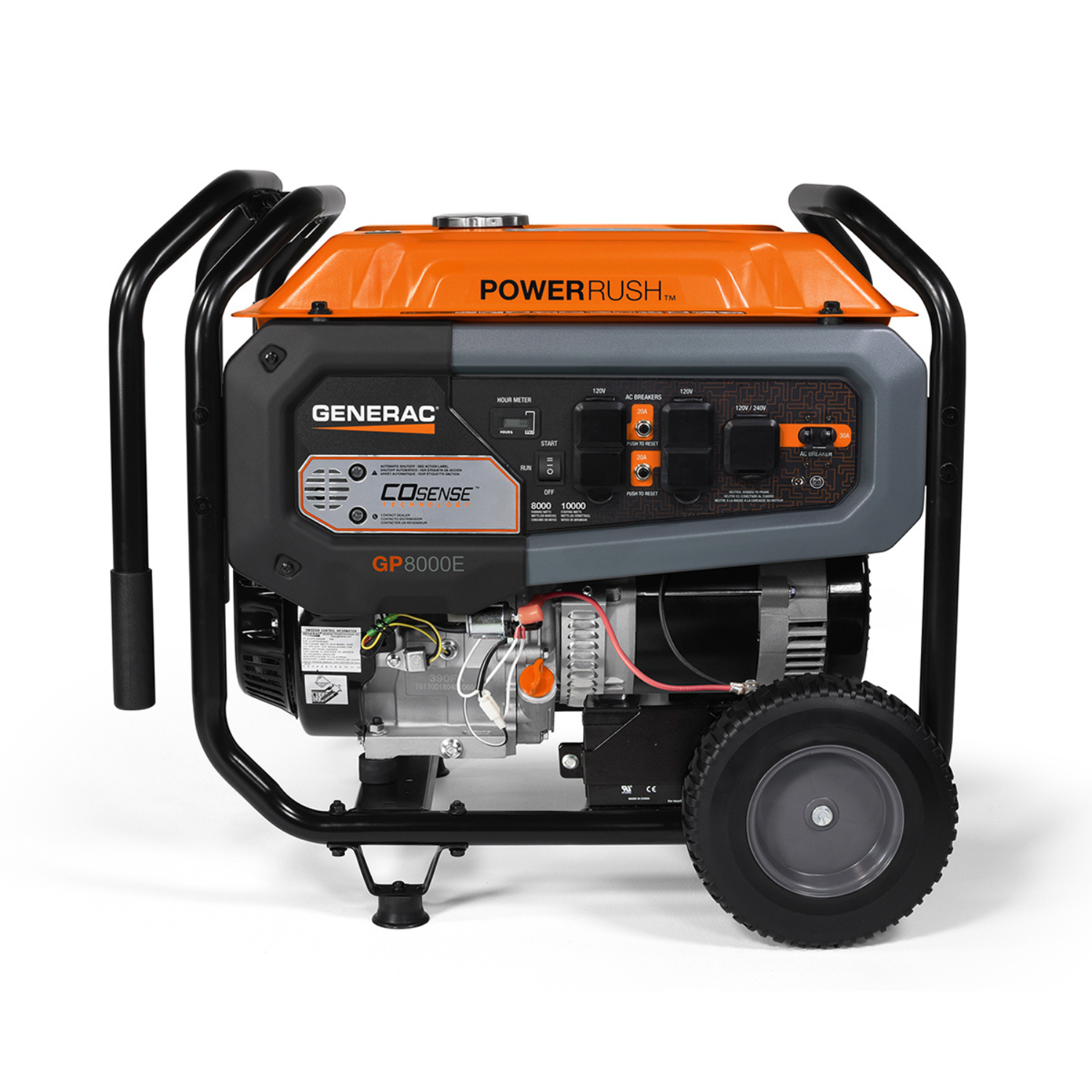
Generac GP8000E COsense
The big-box storm generator: when a hurricane is three days out, this is what's stacked on pallets at Home Depot, and that availability is genuinely part of its value. 8,000 running watts, 10,000 starting via PowerRush, electric start, COsense shutdown, and an L14-30R for interlock feeding — a complete storm kit under $1,000 from a brand every service shop knows. Owner reports are solid on power delivery: it carries fridges, window ACs, well pumps, and furnace blowers simultaneously. The honest ledger: it's an open-frame roarer (Generac publishes no dB figure; owners report it's loud), non-inverter power means owners keep sensitive electronics on a UPS, it's gasoline-only with a thirsty 420cc engine, and Generac portables were hit by recalls (2022 handle pinch; an April 2026 carburetor fuel-leak recall on certain GP units) — check your serial. Runs forever with oil changes, per multi-year owners.

Westinghouse
Westinghouse WGen11500TFc Tri-Fuel
The r/Generator power-user pick: hook it to your home's natural gas line through a quick-connect and you have effectively unlimited runtime without storing a drop of gasoline — the practical middle ground between a portable and a $12,000 standby install. On gasoline it makes a huge 11,500 running watts; the honest math is the NG derate to 9,500 running watts, still enough for most whole homes via the 50A outlet and an interlock. Remote start, CO sensor, and a 9.5-gallon tank round it out. Owner notes: NG performance depends on your line pressure — undersized gas plumbing causes surging and hard starts, the most common complaint thread — plus it's a 230-lb beast, mid-70s dB loud, and Westinghouse support remains the weak link. Registered owners report solid 3-year warranty coverage when they persist.

Champion
Champion 76533 3800W Dual Fuel
One of the best-selling generators ever made, and the archetype of the 'good enough for everything' budget dual fuel. Electric start, RV-ready TT-30R outlet, propane capability out of the box, and nearly a decade of owner history at around $550 — the review count across Amazon and Walmart is enormous and consistently positive. Owners run travel trailers, job sites, and essential-circuit extension-cord backup, and the 224cc engine has a reputation for starting after years of neglect (on propane especially, since there's no carb to gum). Known quirks from the threads: it's a 68 dB droner that campground quiet hours won't love, output on propane drops about 10%, there's no 240V so interlock users look elsewhere, the fuel selector and petcock feel plasticky, and cold-weather propane starts sometimes need a second try. Champion's phone support gets rare-for-the-industry praise.

Generac
Generac iQ3500
Generac's premium inverter was built to beat Honda's EU3000iS on paper — more starting watts, electric start, a PowerDial that combines start/run/stop in one twist, and a digital dashboard showing watts and runtime — and owner reviews suggest it largely succeeds at 50-52 dB. Job-site users like the steel enclosure; tailgaters like that it's genuinely conversation-quiet in economy mode. It starts 13.5k RV ACs and the 30A L5-30R twist-lock feeds RV adapters cleanly. The persistent owner complaints: 109 pounds with no wheels and only two handles — moving it solo is miserable and a wheel-kit is the first accessory everyone buys; the carburetor demands fuel treatment before storage; and a 2023-era recall on certain units (stator faults causing fire risk) rattled confidence, though current production is clear. At street prices near $1,250 it undercuts what the equivalent Honda cost by nearly half.