EcoFlow
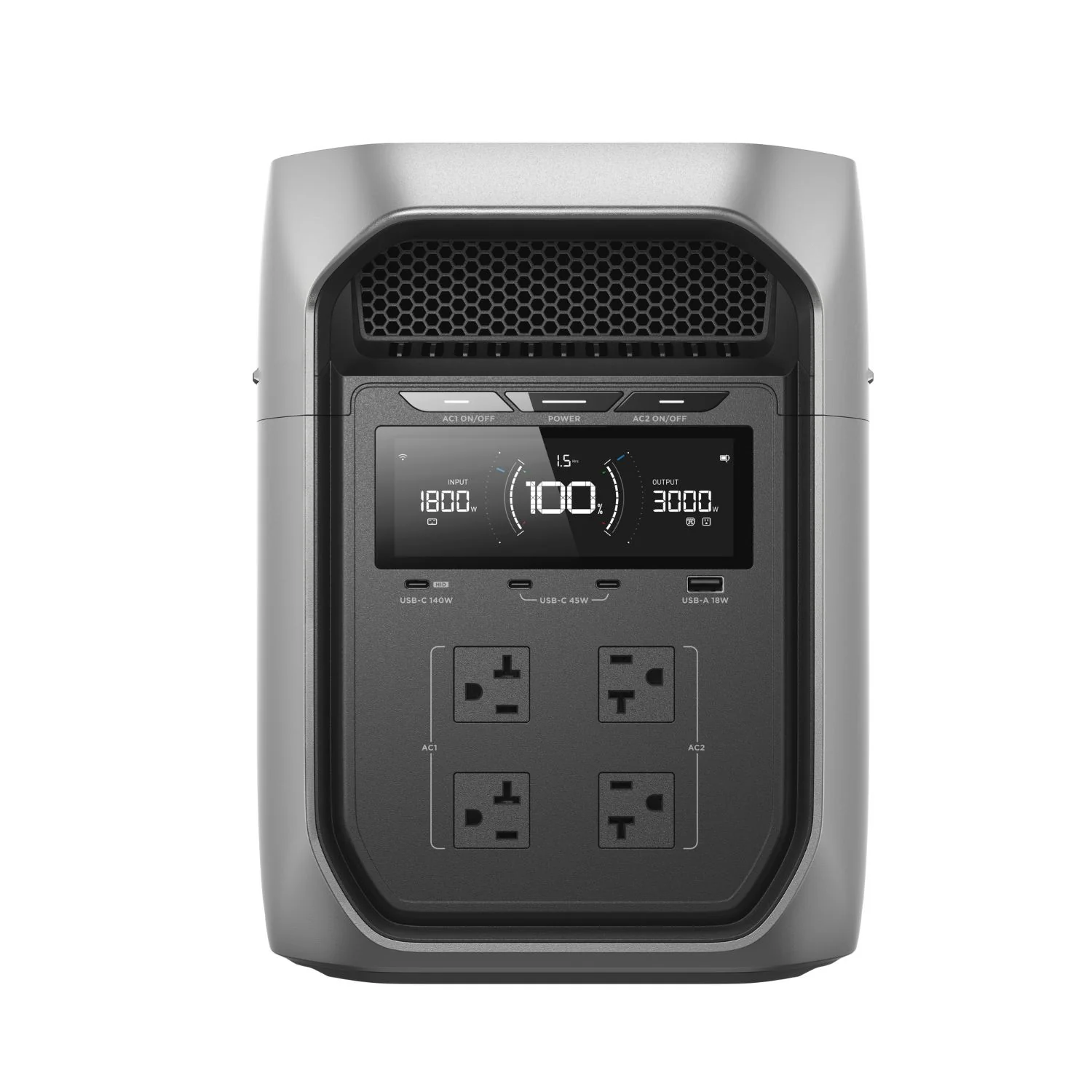
EcoFlow DELTA 3 Max Plus
The 2025-2026 refresh of EcoFlow's mid-size class and a current 'best for home backup' pick in several tested roundups. You get 2kWh and a 3000W inverter - enough to run a microwave and fridge simultaneously - at a price that undercuts the old Delta 2 Max's launch by hundreds. Owners like the practical stuff: 0-80% in about 68 minutes, X-Boost handling 3800W resistive loads, and expansion to 10kWh if backup needs grow. The dual side handles make the 49-lb carry manageable for one person. Quirks from owner threads mirror the rest of the Delta 3 line: fan spins up audibly during fast charging, idle drain means you shouldn't store it with AC output enabled, and the app occasionally loses Wi-Fi pairing until you power-cycle. Solid pick if 1kWh feels tight but 4kWh-class weight and price feel excessive.
Specifications
Highlights
What owners like
- ✓3000W continuous covers microwave + fridge + lights at once
- ✓2048Wh base expandable to 10kWh as needs grow
- ✓X-Boost runs 3800W resistive loads like heaters without tripping
- ✓Manageable 48.7 lbs with good dual handles - one-person portable
- ✓10ms UPS switchover, same as the pricier Delta Pro line
- ✓Aggressive street pricing near $1,000 for 2kWh + 3kW
Common complaints
- ✗Fan noise during fast charge is the top owner complaint
- ✗Idle drain with AC enabled slowly eats stored capacity
- ✗No 30A or 240V outlet - not transfer-switch friendly
- ✗App Wi-Fi pairing flakiness reported by multiple owners
Owner Insightssummarized from Reddit and owner forums
The DELTA 3 Max Plus occupies the slot most home-backup buyers actually need and few brands nail: 2kWh of LiFePO4 and a 3000W inverter in a box one person can still carry. It exists because 1kWh units tap out the moment a microwave or space heater enters the picture, while 4kWh-class machines cost and weigh double. The buyers showing up in owner threads are households planning around storm outages - fridge, network gear, a kitchen appliance or two - plus a growing contingent using it as an oversized UPS for home offices.
The ownership story is defined by how quiet it stays. Independent measurements put light-load fan noise in the mid-20s dB and even full-tilt loads only reach the low 40s - reviewers charging at the full 1800W rate said they had to stand next to it to hear anything. The sub-10ms UPS transfer checked out in testing, and 0-80% charging in about 68 minutes means a storm warning is all the notice you need. The flip side every owner learns: the inverter draws 22-27W just being on, which flattens the pack in roughly three days of idle standby, so you either leave it plugged in or religiously shut off AC output. App connectivity is the usual EcoFlow mix of capable and occasionally flaky, with a cloud account required for the good features.
It fits people who found 1kWh limiting but cannot justify 4kWh money or mass. The natural rivals are the Jackery Explorer 2000 Plus - which counters with wheels, a TT-30 RV outlet, and $999 sale prices but a slower switchover - and Anker's aging SOLIX F2000 at $799-999 with no UPS mode at all. Within EcoFlow, some buyers instead grab a DELTA 3 Plus with one extra battery (bundles near $1,033) for similar capacity in two smaller pieces. If sale timing cooperates, the Max Plus at $999-1,050 is arguably the best-rounded 2kWh box of the 2025-2026 generation.
What owners like
- +Fan noise measured in the mid-20s dB at light loads, climbing only to the low 40s near the full 3000W ceiling
- +Full-speed wall charging is barely audible from a meter away in decibel-meter tests
- +Sub-10ms UPS switchover held up in reviewer testing, not just on the spec sheet
- +Runs a microwave and a fridge at the same time with headroom left over
- +Up to 1000W of solar refills the 2kWh pack in roughly two hours of strong sun
- +Expansion comes in matching 2kWh chunks, so capacity grows in sensible steps to 10kWh
- +Same roughly 4,000-cycle LiFePO4 chemistry as EcoFlow's flagships
- +Sales regularly put it at or below a Jackery Explorer 2000 Plus while offering the faster UPS transfer
Common complaints
- −The inverter idles at roughly 22-27W, so standby with AC output enabled empties it in about three days
- −Full remote control and firmware updates route through an EcoFlow cloud account
- −Fast charging still wakes the fans - overnight top-ups call for the app's slower charge setting
- −1000W solar ceiling trails the 1600W the step-up Ultra Plus accepts
- −Expansion batteries cost a meaningful fraction of a whole second unit
- −X-Boost's 3800W trick only helps resistive loads - compressors and pumps still see a hard 3000W limit
- −No 240V output at any expansion level, so well pumps require stepping up to the Pro 3
- −Young product with a far thinner long-term reliability record than the Delta 2 Max it replaced
Common Questions
How long will it run a refrigerator during an outage?
Can I use it as a UPS for my desktop computer?
What solar panels work with it?
How does expansion to 10kWh work?
What is the difference between the Delta 3 Max and the Max Plus?
What charge level should I keep it at in storage?
Compare the EcoFlow DELTA 3 Max Plus
Related units
More from EcoFlow →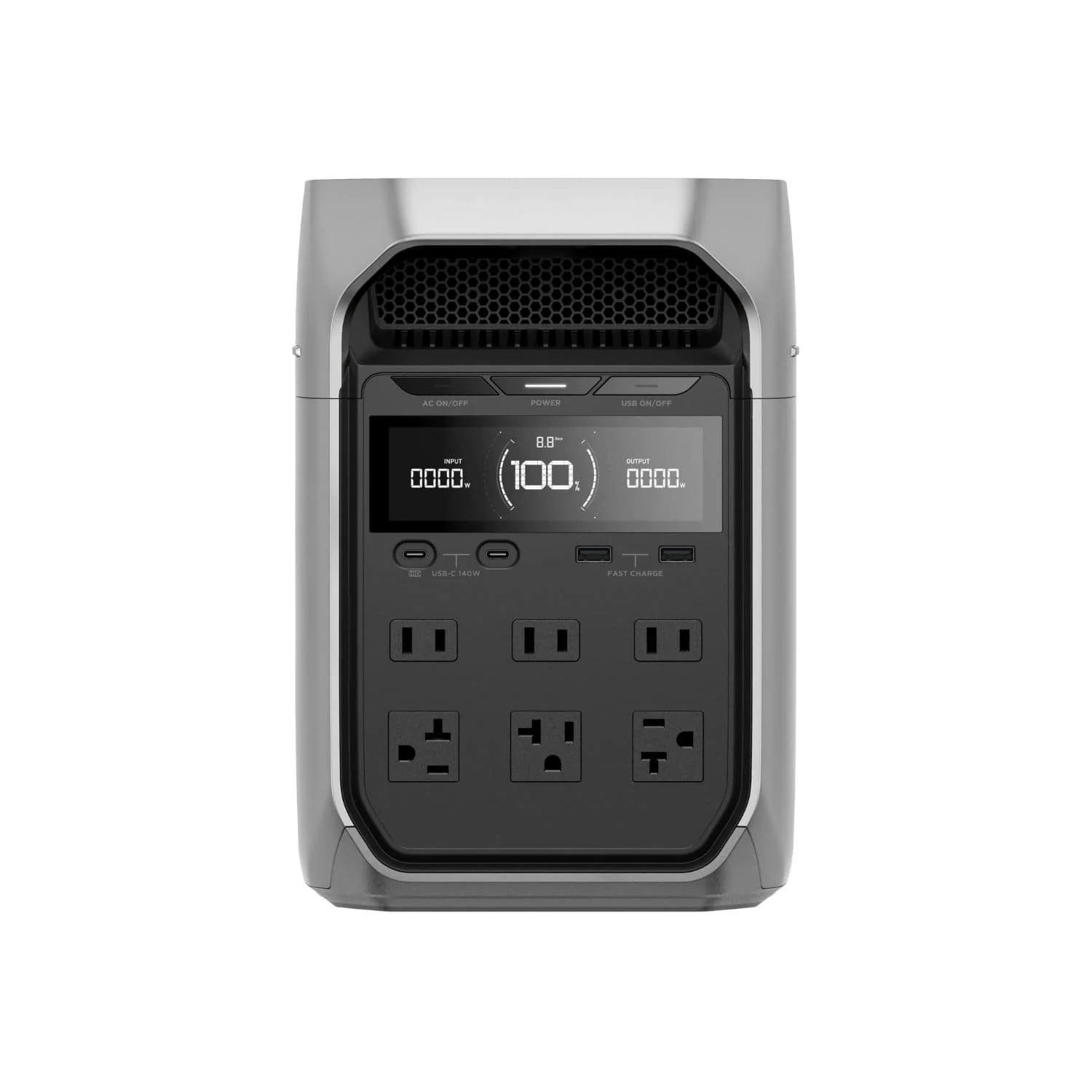
EcoFlow
EcoFlow DELTA 3 Plus
The default answer when someone asks r/portablepowerstations for a 1kWh backup unit. The killer feature owners rave about is the 10ms UPS switchover - people literally run NAS boxes, routers, and CPAP machines off it full-time and never notice an outage. It charges 0-100% in 56 minutes, which sounds like marketing until you watch it happen. Real-world quirks: the 30dB quiet claim only holds at idle - fast AC charging spins the fan up noticeably, so owners set a slower charge rate in the app at night. The app requires an EcoFlow account, which annoys the privacy crowd. X-Boost lets it fudge 2200W resistive loads (space heaters, kettles), but induction motors still trip it. Expansion to ~5kWh via extra batteries is handy, though the add-on packs cost almost as much as the unit on sale.
EcoFlow
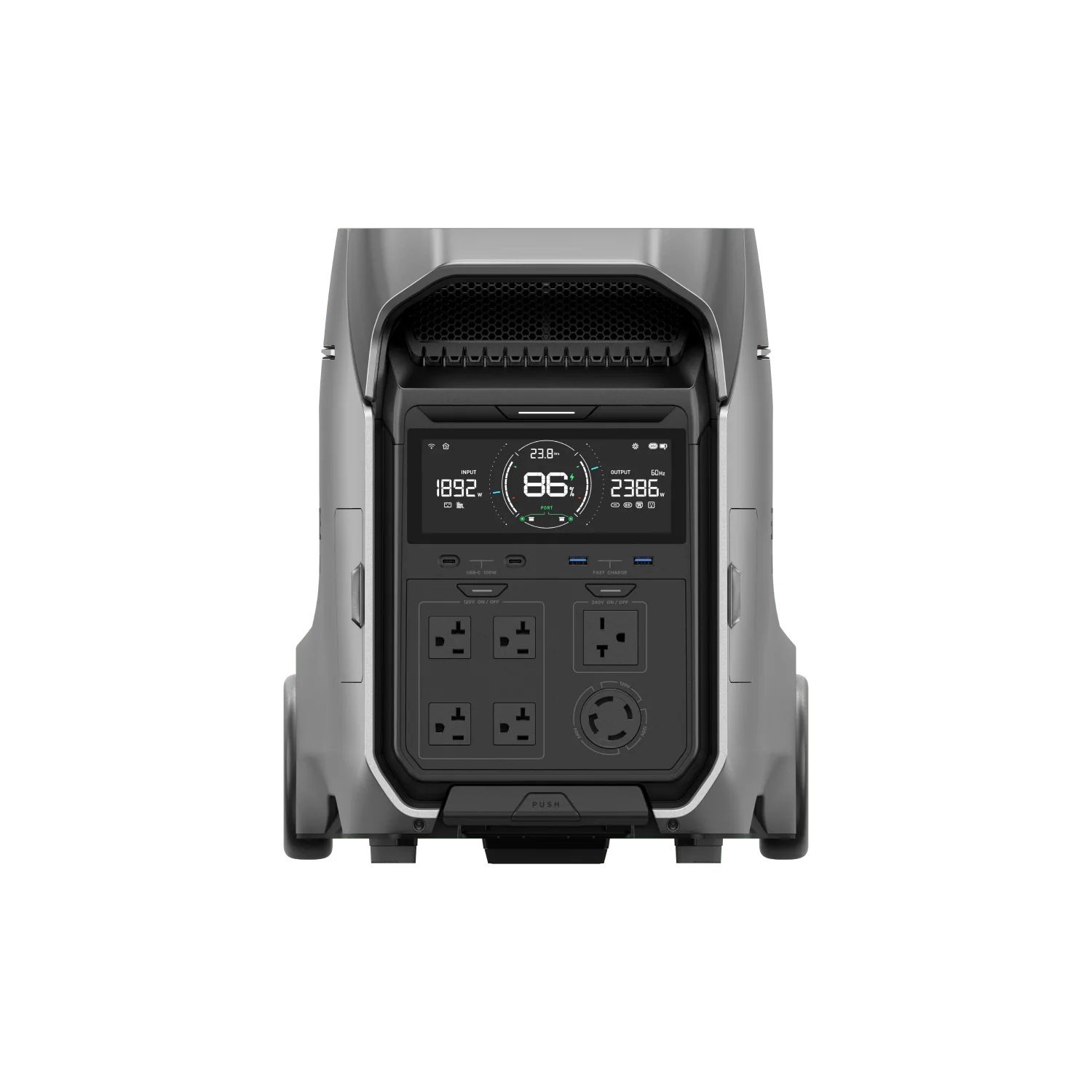
EcoFlow DELTA Pro 3
The single most-recommended whole-home-capable unit that still rolls on wheels. What sells it: 4000W with real 120/240V split-phase from one box, so it backfeeds a transfer switch and runs a well pump or mini-split without pairing two units. Owners consistently praise how quiet it stays at partial load (30dB claimed) and the 10ms UPS. The recurring complaint thread is idle drain - leaving AC output on burns tens of watts, so a 4kWh charge quietly evaporates over days if you use it as a dumb UPS without tweaking settings. It is 113 lbs; the wheels and handle work on pavement, not stairs. A few owners report warranty friction outside the mainland US, and early-firmware horror stories still circulate on Reddit, so update before first use. Street price has fallen from $3,699 to low-$2,000s, which changed the calculus versus F3800 Plus.
EcoFlow
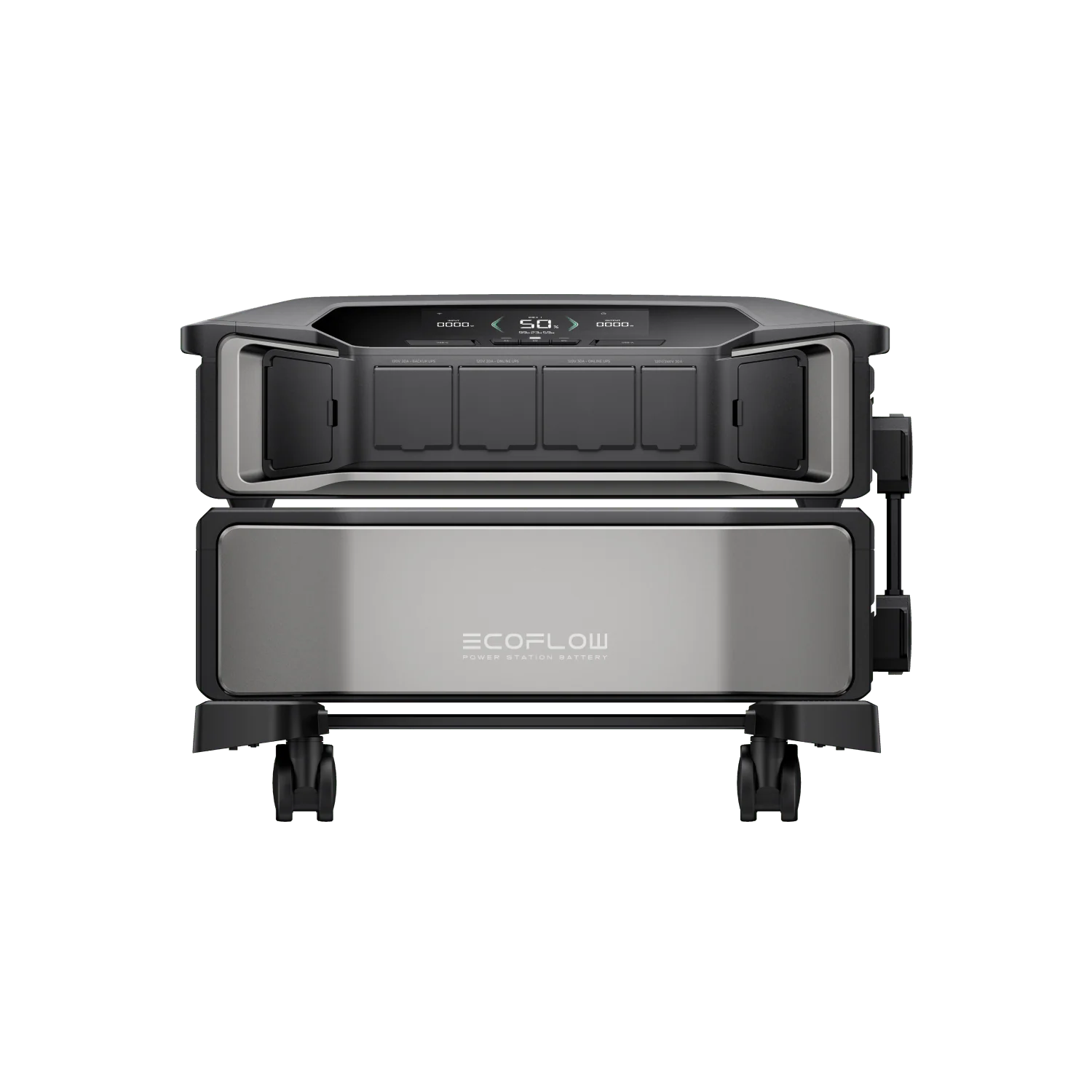
EcoFlow DELTA Pro Ultra
EcoFlow's modular whole-home flagship: a 7200W inverter head that stacks up to 15 batteries for 90kWh, or triples to 21.6kW output. Price shown is the inverter + one 6.1kWh battery; the Smart Home Panel 2 (roughly $1,500-1,900 more plus electrician) is what unlocks the automatic 10-circuit backup owners actually buy this for. Owner sentiment is mostly awe at capability with recurring gripes about the ecosystem tax - every accessory is proprietary and priced accordingly. Fan noise under heavy charge or load is louder than the marketing suggests, and at 164 lbs assembled you position it once and leave it. The 120A LRA rating starts most 3-ton air conditioners, which smaller stations simply cannot do. People cross-shop it against a Powerwall 3 install; the Ultra wins on no-permit portability, loses on per-kWh cost at scale.
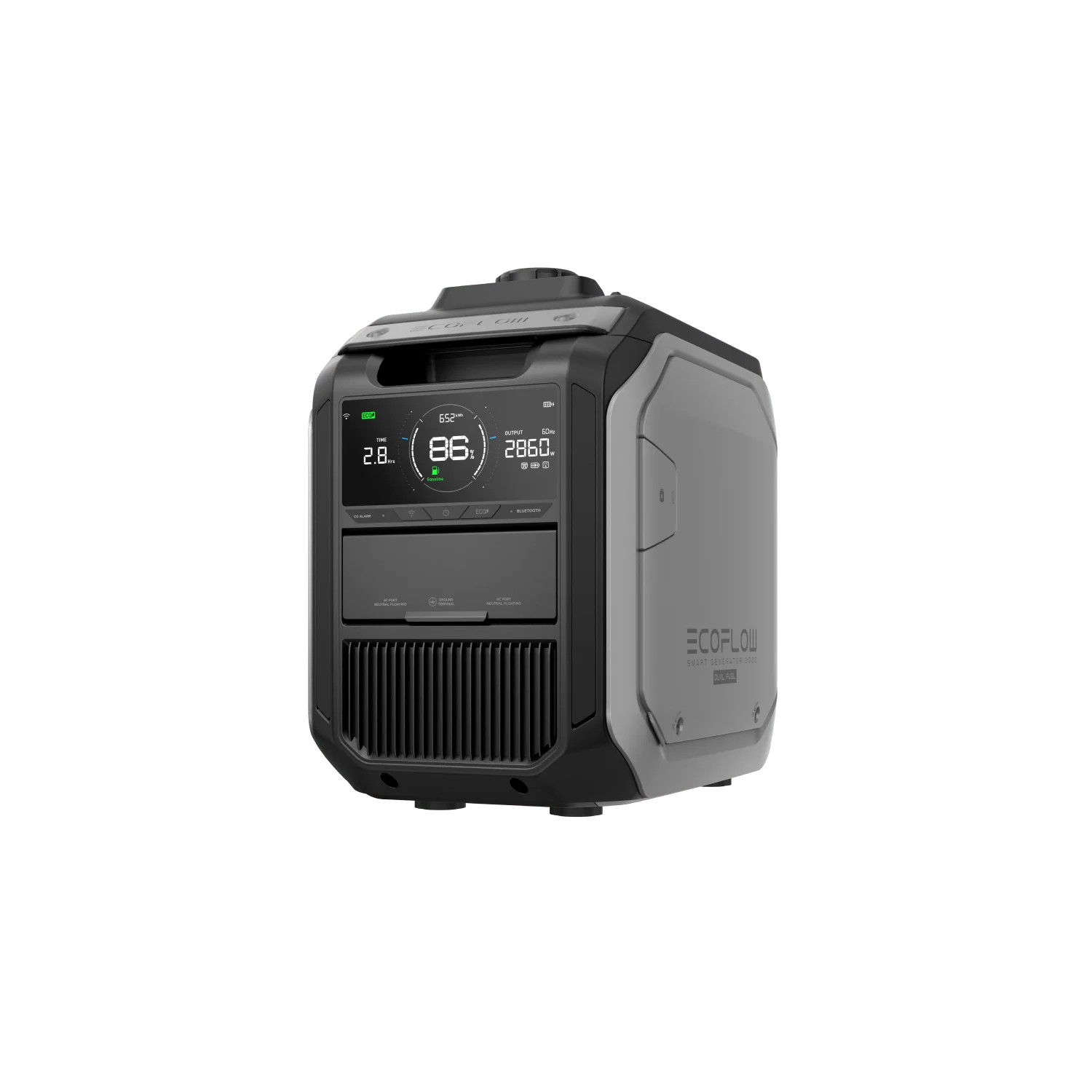
This isn't really a competitor to Honda — it's a range extender for EcoFlow's battery ecosystem, and that's exactly how owners use it. Paired with a DELTA 3 or DELTA Pro power station, it auto-starts itself when the battery drops below a threshold you set in the app, charges via high-efficiency DC (skipping the AC conversion loss), then shuts itself off — so the noisy, fuelly part of backup power runs as little as possible. It also works as a plain 2,000W dual-fuel inverter generator with app control and five start methods. Owner sentiment: brilliant inside the ecosystem, mediocre outside it — 69 dB is loud for 2,000 watts, the 1-year warranty is stingy, LPG output drops to 1,800W, and at typical pricing you can buy more raw watts elsewhere. As the automated gas backstop to a solar-battery setup, though, nothing mainstream matches it.
EcoFlow
EcoFlow OCEAN Pro
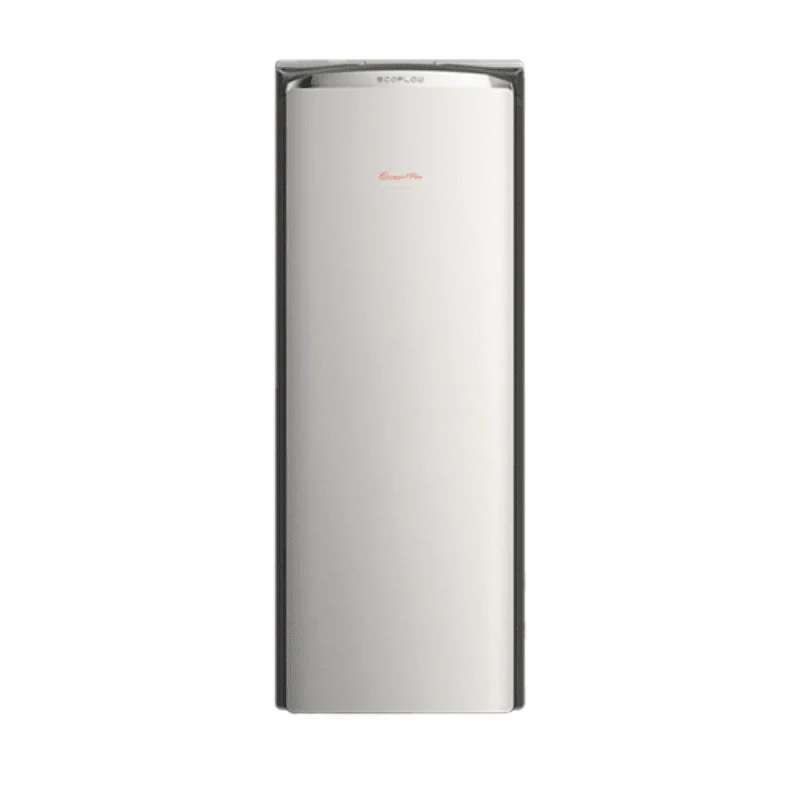
EcoFlow's 2026 leap from portable stations into permanently-installed storage, and on paper it's a monster: 10kWh IP67 modules stacking to 80kWh per inverter, a hybrid inverter platform rated to 24kW output with 205A LRA motor-start, 40kW of solar input, an integrated Smart Electrical Panel 40 and 11.5kW EV charger, plus a 15-year warranty that beats everyone except Enphase's on paper. Pricing is quote-only through certified installers - the price shown is an estimated installed starting system (inverter + battery + smart panel) based on early published system ranges; treat it as directional, not gospel. Because it launched this year, real owner history is thin: early impressions praise the AI-driven time-of-use optimization and the whole-ecosystem integration, while the obvious cautions are a brand-new installer network, unproven long-term support for installed products from a portable-power company, and unknown service logistics.

Anker's suitcase-style 2kWh veteran - launched 2022, still sold in 2026 because constant $799-999 deals keep it moving. The rolling-luggage design with a pull handle is the feature owners mention most; 67 lbs rolls fine but the top-mounted ports mean bending over a lot. SurgePad pushes it to 3600W briefly, and the TT-30 makes it a natural for smaller RVs. GaNPrime charging does 0-80% in 1.4 hours, which was headline speed in 2022 and is merely fine now. Owner threads flag its age honestly: no UPS mode (there's a delay on switchover), the display washes out in sunlight, solar input caps at 1000W, and the app is the older Anker platform with fewer controls. Reliability sentiment is strong though - lots of three-year owners with zero issues, and the 5-year full-device warranty is unusual for its generation.