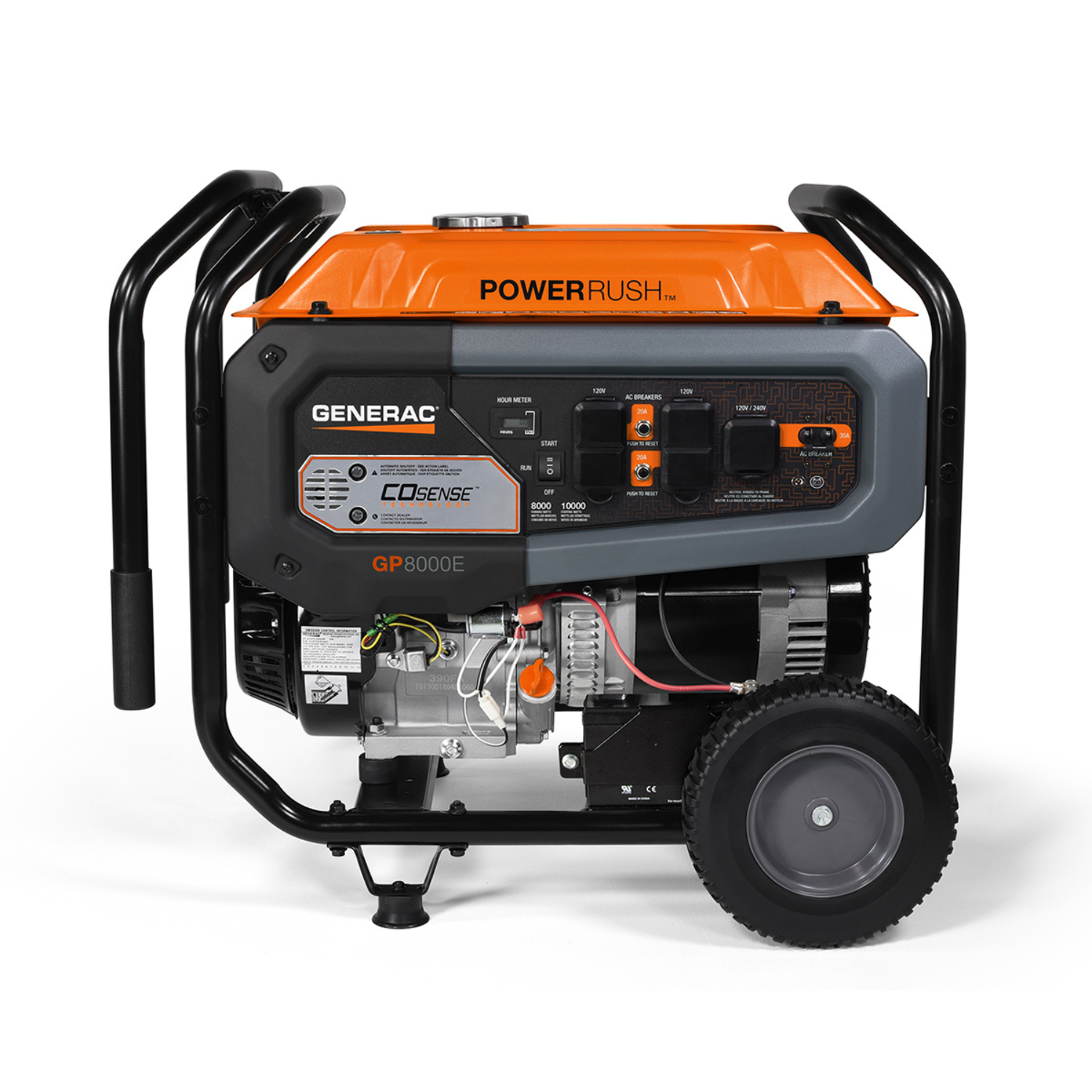
The GP8000E is the storm generator people end up owning, sometimes by accident: one was bought from Menards as an outage started, and another found one left in a building her husband bought. It earns its keep as a 240V house feed through an interlock, manual transfer switch or GenerLink meter collar, and owners report it running most of a house: everything but the AC, furnace and oven for one, multiple fridges and a 3.5-ton AC for another. An owner on a manual transfer switch ran theirs for six years before a winter no-start ended in a $400 carb rebuild and battery.
Wiring, power quality and storage come up most. It ships with a bonded neutral, and an owner feeding a GenerLink asked how to float it; someone who had floated a GP5500 explained the wire move, while another person said a setup that worked before and then stopped likely has a loose inlet connection instead. One estimate puts its THD near 6%, but two owners had UPS units refuse its power, and one bypassed them to run his gear directly. Owners with units that sat for years with gas in them were told to drain the tank and carb bowl and, at worst, clean the carb, and keeping the starting battery on a maintainer was recommended.
An 8,000-watt 240V feed for essential circuits is its job, for households that will start it monthly and keep the fuel fresh. Rivals raised include the Generac XT8500EFI, which one shopper found priced low for its EFI and low distortion, the Westinghouse WGen11500TFc for distortion under 5%, and the tri-fuel GP9500E. One shopper asked whether Costco's GP9200E has limited parts support as a warehouse-only model. At the other end, a 6-year owner tired of maintaining it for 20 hours of use a year and replaced it with an Anker Solix E10 battery system, and another weighed an EcoFlow Delta setup as the gas-free alternative.