
Generac
Generac iQ3500
Generac's premium inverter was built to beat Honda's EU3000iS on paper — more starting watts, electric start, a PowerDial that combines start/run/stop in one twist, and a digital dashboard showing watts and runtime — and owner reviews suggest it largely succeeds at 50-52 dB. Job-site users like the steel enclosure; tailgaters like that it's genuinely conversation-quiet in economy mode. It starts 13.5k RV ACs and the 30A L5-30R twist-lock feeds RV adapters cleanly. The persistent owner complaints: 109 pounds with no wheels and only two handles — moving it solo is miserable and a wheel-kit is the first accessory everyone buys; the carburetor demands fuel treatment before storage; and a 2023-era recall on certain units (stator faults causing fire risk) rattled confidence, though current production is clear. At street prices near $1,250 it undercuts what the equivalent Honda cost by nearly half.
Specifications
Highlights
What owners like
- ✓As quiet as anything in the 3,000W class, Honda included
- ✓Electric start and idiot-proof PowerDial controls
- ✓Data display shows load, fuel, and time remaining
- ✓Starts 13.5k BTU RV air conditioners
- ✓14-hour quarter-load runtime
Common complaints
- ✗109 lbs with no wheels — the #1 owner complaint
- ✗Carb needs religious fuel treatment before storage
- ✗Past recall history on early units shadows the model
- ✗No 240V output
- ✗Parallel kit is proprietary and pricey
Owner Insightssummarized from Reddit and owner forums
The iQ3500 is Generac's proof that you can out-Honda Honda on features if not on legend. It gets bought by two crowds: RVers who need real 13.5k-15k BTU AC-starting power without waking the campground, and tailgaters and job-site users who like that the steel-cased unit reads its own watts and remaining runtime off an LCD instead of making you guess. In owner tests with actual decibel meters it comes out the quietest 3,000-watt-class inverter available - reviewers say you can barely hear it in eco mode until the AC compressor drowns it out - which is remarkable given it also out-surges the Honda EU3000iS.
Day-to-day ownership is defined by one great pattern and two annoying ones. The great: owners who ran Hondas for years report the iQ starts their AC better, burns less gas at low demand, and fires promptly on the push-button start. The annoying: it's 109 lbs with no wheels, so nearly every owner buys a third-party wheel kit in the first month and grumbles that Generac didn't include one; and the fuel system is intolerant of neglect - the bulk of no-start complaints trace to stale gas varnishing the carb after storage, with a touchy low-oil sensor on sloped ground as a supporting act. Keep the start battery topped up between trips, run it dry before storage, and the reliability reports get boring in the best way - owners logging 120-plus and 300-plus hours without incident.
It's best for buyers who want EU3000iS capability - quiet 30-amp RV power - at roughly half of what the Honda historically cost, and who'd rather have electric start, an LCD dashboard, and the PowerDial than Honda's longer 20-hour runtime and dealer network. Cross-shoppers weigh it against the Predator 3500 ($450-700 less, 90-day warranty, similar watts) and Champion's 3400-3500W dual-fuel units (propane flexibility, louder); the ones who pick the iQ usually cite noise measurements and the 3-year warranty as the tiebreakers. At street prices around $1,250 it's the premium pick of the value tier rather than the value pick of the premium tier.
What owners like
- +Independent decibel-meter tests crown it the quietest 3,000-watt-class inverter, even if Generac's '40% quieter than Honda' claim oversells it
- +Owners run a 15k BTU RV AC plus fridge and microwave simultaneously without trouble
- +Starts RV ACs more gracefully than the Honda EU3000iS it targets, per owners who've used both
- +22 lbs lighter than the Honda EU3000iS
- +Sips fuel at low demand - 14 hours at quarter load beats most of the class
- +The 30A L5-30R plus two 20A outlets, USB ports, and a parallel port cover every RV hookup scenario
- +Push-button electric start that owners say fires promptly
- +Holds resale value - used units with 300 hours still fetch $850
Common complaints
- −109 lbs, two handles, zero wheels - the factory wheel-kit omission at this price is the single loudest complaint
- −Low-oil shutdown is touchy on unlevel ground, cutting the engine even with adequate oil
- −Stale fuel is its kryptonite - most no-start threads trace back to gas left in the carb
- −The start battery needs charging between trips or you'll be troubleshooting in the dark
- −Honda still wins runtime - the EU3000iS goes 20 hours at quarter load to the iQ's 14
- −A handful of owners report voltage fluctuation when heavily loaded across multiple outlets
- −No dual-fuel option, unlike Champion's competing 3,500-watt units
- −Generac dealer network treats portables as second-class citizens when warranty work is needed
Common Questions
Can the iQ3500 run a 15,000 BTU RV air conditioner?
Does it come with wheels?
Why won't mine start after sitting all winter?
How does it compare to the Honda EU3000iS?
Can I parallel two iQ3500s?
How quiet is it really at a campground?
Compare the Generac iQ3500
Related units
More from Generac →
Generac
Generac GP3300i
Generac's play for the Honda EU2200i shopper who balks at $1,200: 2,500 running watts (700 more than the Honda), PowerRush surge tech, USB ports, and COsense CO shutdown for roughly half the money, in a 60-lb suitcase. Owners use it for camping, tailgates, and charging batteries off-grid, and reviews are broadly positive about starting behavior and the extra headroom that runs a small AC or space heater the Honda can't. What the threads flag: Generac doesn't publish a noise spec — owners measure it audibly louder than the Honda, especially outside eco mode; eco mode can hunt/surge with cycling loads like fridges; the 1-gallon tank is small; and while the 3-year warranty is real, portable warranty service goes through Generac's dealer network, which prioritizes standby customers. A rational value pick if ultimate quiet isn't the goal.
Generac
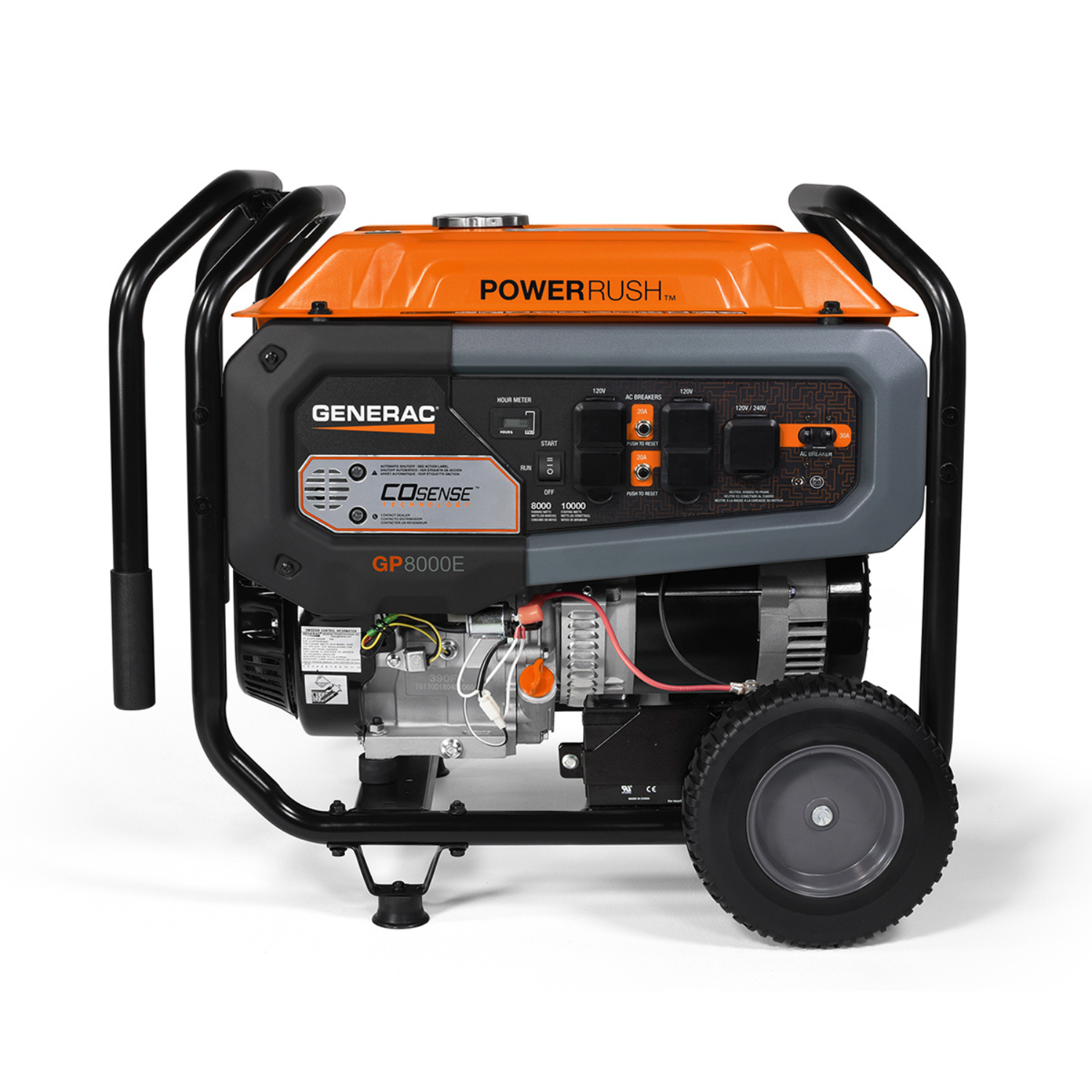
Generac GP8000E COsense
The big-box storm generator: when a hurricane is three days out, this is what's stacked on pallets at Home Depot, and that availability is genuinely part of its value. 8,000 running watts, 10,000 starting via PowerRush, electric start, COsense shutdown, and an L14-30R for interlock feeding — a complete storm kit under $1,000 from a brand every service shop knows. Owner reports are solid on power delivery: it carries fridges, window ACs, well pumps, and furnace blowers simultaneously. The honest ledger: it's an open-frame roarer (Generac publishes no dB figure; owners report it's loud), non-inverter power means owners keep sensitive electronics on a UPS, it's gasoline-only with a thirsty 420cc engine, and Generac portables were hit by recalls (2022 handle pinch; an April 2026 carburetor fuel-leak recall on certain GP units) — check your serial. Runs forever with oil changes, per multi-year owners.

Generac
Generac Guardian 10kW
The entry point to the Guardian line, and the one owners of smaller homes keep recommending because it bundles a 100-amp, 16-circuit transfer switch in the box. The 460cc G-Force 400 engine covers essentials — furnace, fridge, well pump, some lights — not whole-house AC, and owners are clear-eyed about that. At 61 dB it's the quietest Guardian, though people still report it's louder than they expected during weekly exercise. Owner threads praise years of flawless auto-transfers, but the recurring gripes are real: the battery, oil, and some setup parts aren't included, Evolution controller boards have a documented failure pattern, and warranty service depends entirely on how good your local Generac dealer is. Budget for install — most people pay more for wiring and gas work than for the unit.

Generac
Generac Guardian 14kW
The 14kW is the sweet spot Guardian for mid-size homes: it steps up to the 816cc twin-cylinder G-Force 800 engine, holds 14kW on both propane and natural gas, and will start a modest central AC with load management. Owners who sized it right describe multi-day outages where it just hummed along at 65 dB with the Quiet-Test weekly cycle keeping neighbors happy. The recurring themes in owner threads mirror the whole Guardian line: buy it for the dealer network and parts availability, not for the customer support experience — Generac corporate routes everything back to dealers, and controller/board warranty claims can drag for weeks. This 7223 SKU is the bare generator; pair it with a 100A or 200A switch, and get quotes, because installed cost typically lands at double the hardware price.

Generac
Generac Guardian 18kW
The 18kW is the value pick in the Guardian range on a dollars-per-kilowatt basis — same 816cc G-Force 800 twin as the 14kW, tuned for 18kW on propane and 17kW on natural gas, at only a few hundred dollars more. Owners in hurricane and ice-storm country consistently report it carrying a whole modest home including a 3-ton AC without drama, and the G-Flex variable-speed exercise keeps the weekly test tolerable at 65 dB. The ownership caveats are pure Generac: the Evolution 2 controller is the component that fails, dealers are the only sanctioned path for warranty work, and owners recommend buying the battery and cold-weather kit up front rather than discovering they're extras on install day. If you're between the 14 and this, most owner advice says spend up.
Generac
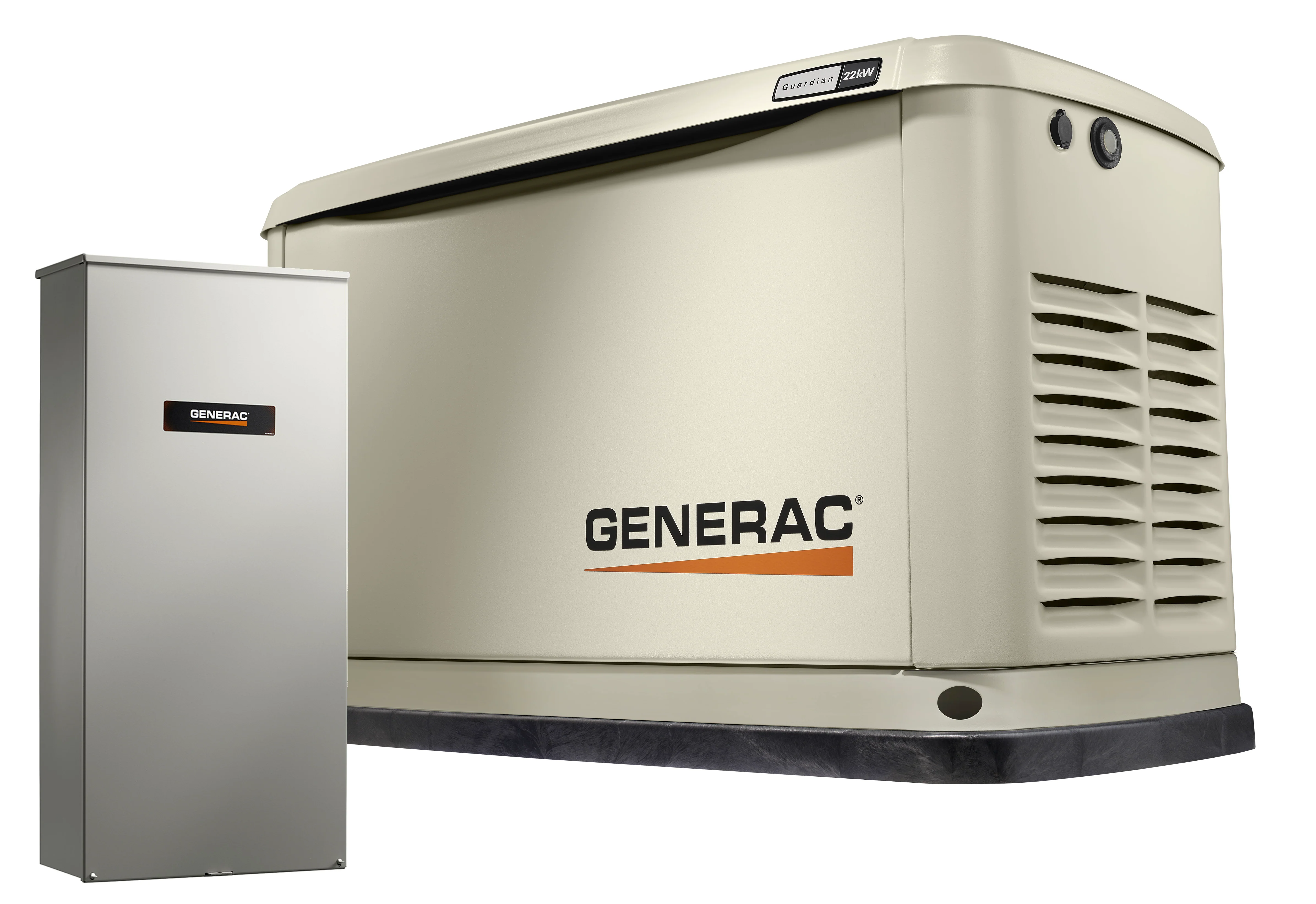
Generac Guardian 22kW
For years the best-selling home standby generator in America, and the sheer volume of owner reviews shows why: the 22kW carries most whole homes — two AC units with load management — and every electrician and gas fitter in the country has installed one. The G-Force 1000 engine and 67 dB noise level are unremarkable but proven; owners report units sailing through week-long outages after hurricanes. The flip side of ubiquity is that the complaint threads are equally deep: Evolution controller replacements, dealers backlogged after storms, and Generac support that owners describe as polite but powerless. The newer 24kW (7209/7210) has largely replaced it at similar money, but the 7042 remains widely stocked, slightly cheaper, and the known quantity — a big deal when your installer has done fifty of them.