
Honda
Honda EU3200i
Honda's first genuinely new generator in years, and the first in this size with fuel injection — the GX130 EFI means no carburetor to gum up in storage, which eliminates the single most common failure mode in owner forums. At 59 lbs it carries like an EU2200i but delivers 2,600 running watts and a 30A locking outlet, enough to start a 13.5k BTU RV air conditioner that the smaller Honda can't touch. Owners love the concept; the execution had teething problems — Consumer Reports and retailer reviews show a visible minority of one-star reports for stalling and hard-start issues on early units, and Honda's dealer-service response has been mixed. Most current-production owners report it running flawlessly and impressively quiet at 54-58 dB. It's expensive per watt, but it's the lightest path to real RV-AC power with EFI reliability.
Specifications
Highlights
What owners like
- ✓EFI eliminates carburetor gumming — the #1 small-generator killer
- ✓2,600W running starts 13.5k BTU RV ACs solo
- ✓Only 59 lbs — lightest in the 3,000W class
- ✓30A L5-30R outlet plus household duplexes
- ✓54-58 dB keeps campground neighbors friendly
- ✓CO-MINDER and Bluetooth monitoring standard
Common complaints
- ✗Early-production stalling and hard-start complaints are well documented
- ✗$2,600 is enormous money for 2,600 running watts
- ✗No 240V output despite the price
- ✗Dealer network handles warranty issues at dealer speed
- ✗1.2-gal tank means overnight runs need refueling or eco mode
Owner Insightssummarized from Reddit and owner forums
The EU3200i is the generator RV forums spent a decade asking Honda to build: EU2200i portability with enough watts to start the air conditioner, and fuel injection so it never needs a carb cleaning. It launched as the replacement for the 131-pound EU3000is, and at 59 pounds it cut that weight by more than half while adding Bluetooth monitoring and CO-MINDER. Buyers skew heavily toward travel-trailer and Airstream owners who were previously hauling two EU2200i units and a parallel cable just to run one 13.5k BTU AC.
The ownership story is mostly excellent with an asterisk. Current-production owners describe voice-level noise in the 54-58 dB range, one-pull starts, and 8-plus hours at light load from just 1.2 gallons - and because the GX130 is fuel injected, the stale-gas carb gumming that fills every other generator forum simply is not part of the conversation, though stabilizer in stored fuel is still smart. The asterisk is the early build run: stalling and hard-start complaints show up in a visible minority of retailer reviews, and dealer resolution was hit-or-miss in the first year. The other quirks are small - the 30A outlet is a locking L5-30R that needs a cheap adapter for RV cords, and it is recoil-start only, which feels stingy at this price.
Best for RVers and quiet-obsessed outage preppers who want one light unit that starts the AC and will still be worth real money in ten years. At around 2,600 dollars it is triple the price of a Champion 200988 and double an iGen4500, and forum cross-shopping usually comes down to exactly those two - or a pair of used EU2200i units. The honest calculus from owners: the Champion and Westinghouse do the same job for far less, but they weigh 100 pounds, have carburetors, and will not hold value the way a Honda does.
What owners like
- +Fuel injection ends the drain-the-carb storage ritual - owners let it sit months and it fires right up
- +Starts a Coleman Mach 13.5k BTU RV air conditioner solo, confirmed repeatedly in iRV2 and Airstream threads
- +59 pounds where the old EU3000is weighed 131 - one person lifts it into a truck bed
- +8.6 hours at quarter load from a tiny 1.2-gallon tank
- +Owners measure it quieter than the EU3000is it replaced, with the same voice-level character as the EU2200i
- +30A locking outlet means one adapter connects a 30A RV cord - no parallel kit required for AC power
- +Bluetooth app shows watts and runtime remaining from inside the rig
- +Two units can be paralleled for 50A rigs, a setup Airstream owners are already running
Common complaints
- −Early-production stalling and hard-start reports are real - a visible slice of one-star reviews, with mixed dealer diagnosis experiences
- −Recoil start only, which stings on a 2,600-dollar generator when an 800-dollar Champion has a key fob
- −The 30A outlet is an L5-30R, not an RV TT-30R, so budget for the adapter on day one
- −Honda was slow to offer its own parallel cable, pushing owners to third-party 50A kits
- −1.2-gallon tank means heavy loads drain it in barely 3 hours - overnight AC runs need a refill plan
- −Costs a full 1,000 dollars per usable kilowatt more than a Champion 4500 or iGen4500
- −No dual-fuel option, and EFI makes third-party propane conversion trickier than on carbureted rivals
- −New-model parts pipeline is thin; a warranty repair can mean weeks waiting on dealer backorders
Common Questions
Will it really start a 13,500 BTU RV air conditioner by itself?
How do I plug my 30A RV cord into it?
Does fuel injection mean I can skip fuel stabilizer?
What about the stalling complaints on early units?
Can I parallel two EU3200i units for a 50A RV?
Why is there no electric start at this price?
Compare the Honda EU3200i
Related units
More from Honda →
Honda
Honda EU2200i
The default answer to 'which small generator should I buy' for going on two decades. The EU2200i's GXR120 engine, 47-lb carry weight, and 48-57 dB voice-level noise make it the campground and tailgate standard, and the current version adds Bluetooth monitoring, CO-MINDER shutdown, and a fuel shutoff valve so you can run the carb dry before storage — a direct response to the gummed-carburetor complaints that dominate owner threads for every small generator, Honda included. Owners justify the price with resale value (used units hold 70%+ of MSRP) and start-on-second-pull reliability years in. The honest knocks: it's double the cost of credible clones, 1,800 running watts won't touch most RV air conditioners without a parallel second unit, there's no fuel gauge, and the early-generation recall history (2018-19 fire risk) still comes up in threads.

Honda
Honda EU7000iS
The generator hurricane-country homeowners aspire to: fuel-injected GX390 engine, 5,500 running watts with 240V output for a transfer switch, electric start, and noise levels (52-58 dB) so low that owners describe running it overnight outside bedroom windows. The EFI matters twice — no carb maintenance, and roughly 16 hours from 5.1 gallons at quarter load, which owners confirm during multi-day outages. Reliability reports are as close to unanimous as generators get; Consumer Reports ranks it at the top of the class. What owners complain about: 263 pounds is a two-person or ramp job despite the wheels, the price crossed into home-standby territory (people cross-shop it against installed Generacs), it can't run on propane or NG without third-party conversion, and replacement parts are dealer-priced. If the budget survives, nobody regrets it.
Predator (Harbor Freight)
Predator 9500 Inverter
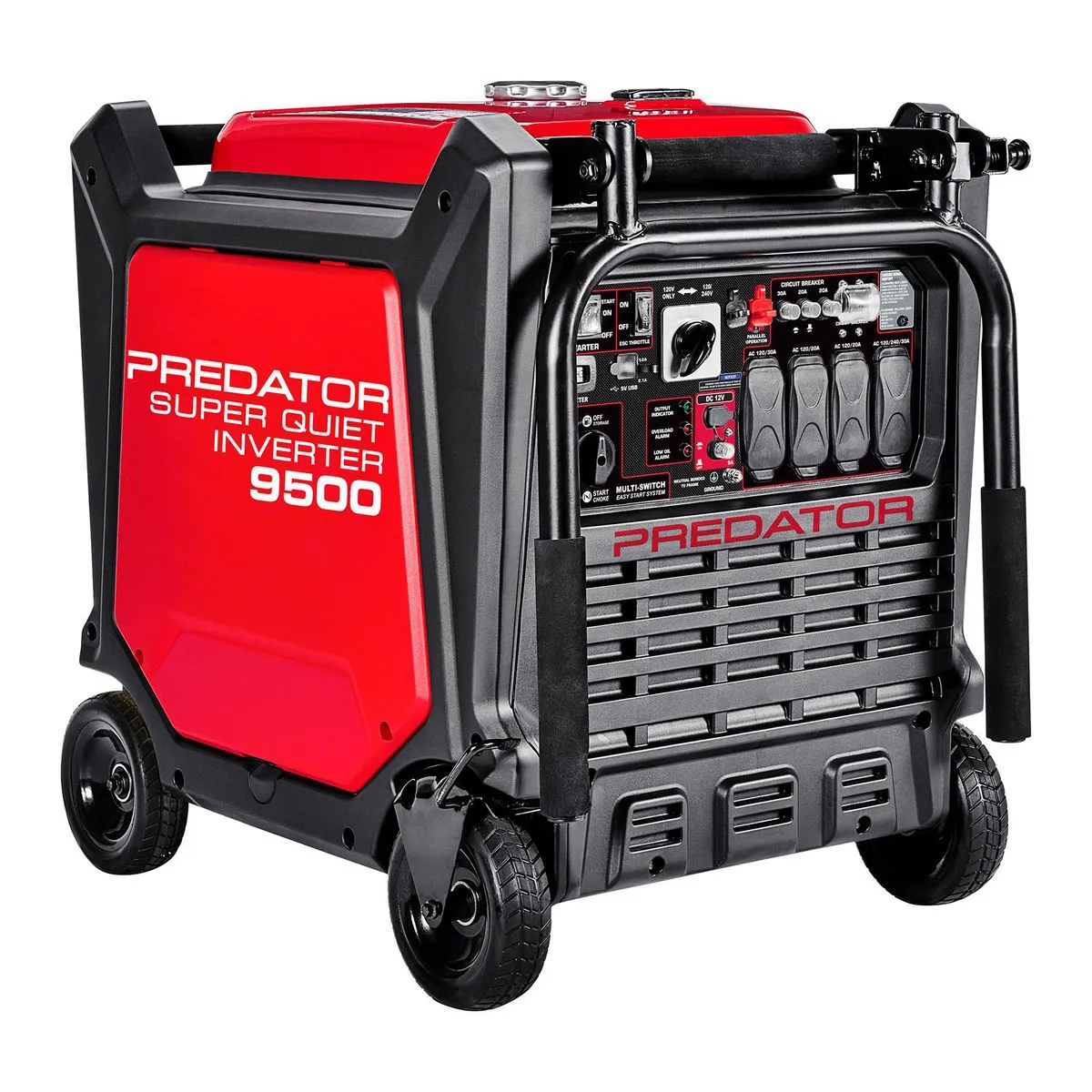
Harbor Freight's giant-killer. The Predator 9500 delivers 7,600 running watts of closed-case inverter power — EU7000iS territory plus 2,000 extra watts — at 40% of Honda's price, and the r/Generator consensus is that the hardware genuinely delivers: clean power, 67 dBA that's dramatically quieter than open frames, electric start, ESC economy mode, and 18.5-hour runtimes. Owners run whole homes through the L14-30R and an interlock. The catch everyone leads with: a 90-day warranty from a company whose service model is 'bring it to the store,' so buyers treat the extended protection plan as mandatory. Other realities from long-term threads: 257 lbs makes it the heaviest thing in its class, it's carbureted (store it dry), CO Secure occasionally false-trips in enclosed-ish spaces, and there's no dual-fuel option at this size.

Champion's answer to the EU7000iS costs a third as much and adds propane capability: 7,000 running watts of closed-frame inverter power at a claimed 61 dBA from 23 feet, with both 50A and 30A 240V outlets ready for a transfer switch. Owners running whole-home essentials during outages report it handles well pumps, furnaces, and a smaller central AC, with quiet operation that genuinely surprises people used to open-frame roar. The CO Shield sensor and electric start round out a strong package. The complaint list from owner threads: at 214 pounds it's barely 'portable' despite never-flat wheels, the propane derate takes running power to about 6,300 watts, real-world noise climbs well above 61 dB under heavy load, and a few owners report early inverter-board failures — Champion support resolves them, but shipping a 200-lb unit for service is nobody's idea of fun.

The unicorn spec r/Generator kept asking for: tri-fuel AND inverter in one machine. Hook the 201176 to your natural-gas line for unlimited runtime, and unlike every conventional tri-fuel, it feeds your house clean sub-3% THD power that's safe for furnace boards, UPSs, and electronics — through a 50-amp outlet. On gasoline it makes 7,250 running watts; NG drops it to 5,875, still enough for most homes' essentials plus a small AC. It's an open-frame design, so the 72 dBA rating is real and load-dependent — quieter than a WGen9500DF, louder than closed-case inverters. Owner threads note the winning math (it replaced separate 'quiet' and 'NG' generators for many), with the familiar caveats: NG line pressure matters, the 420cc engine drinks on gasoline at full tilt, electric-start battery upkeep, and Champion's included NG/LP hoses are short. CO Shield included.

Generac
Generac iQ3500
Generac's premium inverter was built to beat Honda's EU3000iS on paper — more starting watts, electric start, a PowerDial that combines start/run/stop in one twist, and a digital dashboard showing watts and runtime — and owner reviews suggest it largely succeeds at 50-52 dB. Job-site users like the steel enclosure; tailgaters like that it's genuinely conversation-quiet in economy mode. It starts 13.5k RV ACs and the 30A L5-30R twist-lock feeds RV adapters cleanly. The persistent owner complaints: 109 pounds with no wheels and only two handles — moving it solo is miserable and a wheel-kit is the first accessory everyone buys; the carburetor demands fuel treatment before storage; and a 2023-era recall on certain units (stator faults causing fire risk) rattled confidence, though current production is clear. At street prices near $1,250 it undercuts what the equivalent Honda cost by nearly half.