
Honda
Honda EU2200i
The default answer to 'which small generator should I buy' for going on two decades. The EU2200i's GXR120 engine, 47-lb carry weight, and 48-57 dB voice-level noise make it the campground and tailgate standard, and the current version adds Bluetooth monitoring, CO-MINDER shutdown, and a fuel shutoff valve so you can run the carb dry before storage — a direct response to the gummed-carburetor complaints that dominate owner threads for every small generator, Honda included. Owners justify the price with resale value (used units hold 70%+ of MSRP) and start-on-second-pull reliability years in. The honest knocks: it's double the cost of credible clones, 1,800 running watts won't touch most RV air conditioners without a parallel second unit, there's no fuel gauge, and the early-generation recall history (2018-19 fire risk) still comes up in threads.
Specifications
Highlights
What owners like
- ✓Start-on-first-or-second-pull reliability that owners confirm years in
- ✓48-57 dB — conversation-volume quiet
- ✓Fuel shutoff lets you run the carb dry for storage
- ✓Bluetooth app shows load and maintenance info
- ✓Holds resale value better than anything in the category
- ✓CO-MINDER auto-shutdown standard
- ✓Parallel-ready for 4,400W combined
Common complaints
- ✗Twice the price of comparable-spec competitors
- ✗1,800 running watts can't start most RV AC units alone
- ✗No fuel gauge and small 0.95-gal tank
- ✗No 30A RV outlet on the standard model — need the Companion
- ✗Past fuel-valve recalls still shadow the model's reputation
Owner Insightssummarized from Reddit and owner forums
The EU2200i is the generator other generators get compared to, and owner threads read less like reviews and more like testimonials - people post photos of 10-year-old units still starting on the second pull. Buyers are campers, tailgaters, food-truck vendors, and outage-preppers who decided once, up front, that they never want to think about their generator again. The 47-pound carry weight and voice-level noise are why it shows up at every quiet-hours campground in America.
Ownership is famously boring in the best way. Measured noise runs 53-54 dB at 25 feet in eco mode (low 60s with eco off), and quarter-load runtime tops 8 hours on the 0.95-gallon tank. The one maintenance ritual that matters: flip the fuel valve to off and let it run the carb dry before storage - owners who skip this are the ones posting gummed-carb threads, Honda badge or not. Oil changes are simple but messy thanks to an angled fill neck, and the maintenance schedule (first change at 20 hours, then every 100) is about all it asks. The recall history is real - a 2019 fuel-valve leak and a 2020 salt-water short-circuit campaign - so used buyers should check serials, but Honda handled both with free dealer fixes.
This is the right unit for anyone who values quiet and certainty over watts per dollar. At around 1,100 to 1,200 dollars it costs double a Predator 2000 or Genmax GM2200i, and forum consensus is blunt about the math: occasional users can save 500 dollars with a clone and probably never notice, while frequent users buy the Honda for resale value and second-pull starts. RVers who need air conditioning either buy two and parallel them or skip straight to a Champion 4500 or iGen4500 - the EU2200i alone is a quiet-power tool, not an AC starter.
What owners like
- +Starts on the first or second pull even years in - the single trait owners cite most
- +Measured 53-54 dB at 25 feet in eco mode; campground neighbors routinely can't tell it's running
- +Over 8 hours on 0.95 gallons at quarter load
- +The fuel shutoff position runs the carb dry before storage, and owners who use it religiously report zero spring-startup drama
- +Holds 70 percent or more of its value used - clean examples fetch 700 to 800 dollars on Craigslist
- +Pairs with a parallel kit for 30A RV power, and owners confirm it syncs fine with the older EU2000i
- +Honda dealer network means parts and warranty service are never a hunt
- +20 percent more surge than the EU2000i it replaced, so fridge and sump startup spikes that tripped the old unit sail through
Common complaints
- −Two recalls (2019 fuel-valve leak, 2020 salt-water short-circuit) mean used buyers must run serial numbers before paying Honda money
- −No 30A RV outlet on the standard model - you need the Companion variant or a parallel kit to plug in a trailer directly
- −Eco mode can bog for a beat when a microwave or compressor kicks on; owners with surgy loads leave it off
- −The angled oil fill neck makes changes a funnel-and-cardboard affair
- −1,800 running watts won't start a 13.5k BTU RV air conditioner alone, even with a soft starter in most cases
- −Recoil start only - no electric start option exists at this size
- −Small 0.95-gallon tank means overnight runs need a refill or a gravity-feed extended tank mod
- −Street price has crept toward 1,200 dollars while capable clones sell for half
Common Questions
Will the EU2200i run my RV air conditioner?
Can I parallel it with my old EU2000i?
How should I store it between uses?
What's the oil change routine?
How do I know if a used one has open recalls?
Is it really quiet enough to run at night?
Compare the Honda EU2200i
Related units
More from Honda →
Honda
Honda EU3200i
Honda's first genuinely new generator in years, and the first in this size with fuel injection — the GX130 EFI means no carburetor to gum up in storage, which eliminates the single most common failure mode in owner forums. At 59 lbs it carries like an EU2200i but delivers 2,600 running watts and a 30A locking outlet, enough to start a 13.5k BTU RV air conditioner that the smaller Honda can't touch. Owners love the concept; the execution had teething problems — Consumer Reports and retailer reviews show a visible minority of one-star reports for stalling and hard-start issues on early units, and Honda's dealer-service response has been mixed. Most current-production owners report it running flawlessly and impressively quiet at 54-58 dB. It's expensive per watt, but it's the lightest path to real RV-AC power with EFI reliability.

Honda
Honda EU7000iS
The generator hurricane-country homeowners aspire to: fuel-injected GX390 engine, 5,500 running watts with 240V output for a transfer switch, electric start, and noise levels (52-58 dB) so low that owners describe running it overnight outside bedroom windows. The EFI matters twice — no carb maintenance, and roughly 16 hours from 5.1 gallons at quarter load, which owners confirm during multi-day outages. Reliability reports are as close to unanimous as generators get; Consumer Reports ranks it at the top of the class. What owners complain about: 263 pounds is a two-person or ramp job despite the wheels, the price crossed into home-standby territory (people cross-shop it against installed Generacs), it can't run on propane or NG without third-party conversion, and replacement parts are dealer-priced. If the budget survives, nobody regrets it.

Generac
Generac iQ3500
Generac's premium inverter was built to beat Honda's EU3000iS on paper — more starting watts, electric start, a PowerDial that combines start/run/stop in one twist, and a digital dashboard showing watts and runtime — and owner reviews suggest it largely succeeds at 50-52 dB. Job-site users like the steel enclosure; tailgaters like that it's genuinely conversation-quiet in economy mode. It starts 13.5k RV ACs and the 30A L5-30R twist-lock feeds RV adapters cleanly. The persistent owner complaints: 109 pounds with no wheels and only two handles — moving it solo is miserable and a wheel-kit is the first accessory everyone buys; the carburetor demands fuel treatment before storage; and a 2023-era recall on certain units (stator faults causing fire risk) rattled confidence, though current production is clear. At street prices near $1,250 it undercuts what the equivalent Honda cost by nearly half.

The unicorn spec r/Generator kept asking for: tri-fuel AND inverter in one machine. Hook the 201176 to your natural-gas line for unlimited runtime, and unlike every conventional tri-fuel, it feeds your house clean sub-3% THD power that's safe for furnace boards, UPSs, and electronics — through a 50-amp outlet. On gasoline it makes 7,250 running watts; NG drops it to 5,875, still enough for most homes' essentials plus a small AC. It's an open-frame design, so the 72 dBA rating is real and load-dependent — quieter than a WGen9500DF, louder than closed-case inverters. Owner threads note the winning math (it replaced separate 'quiet' and 'NG' generators for many), with the familiar caveats: NG line pressure matters, the 420cc engine drinks on gasoline at full tilt, electric-start battery upkeep, and Champion's included NG/LP hoses are short. CO Shield included.
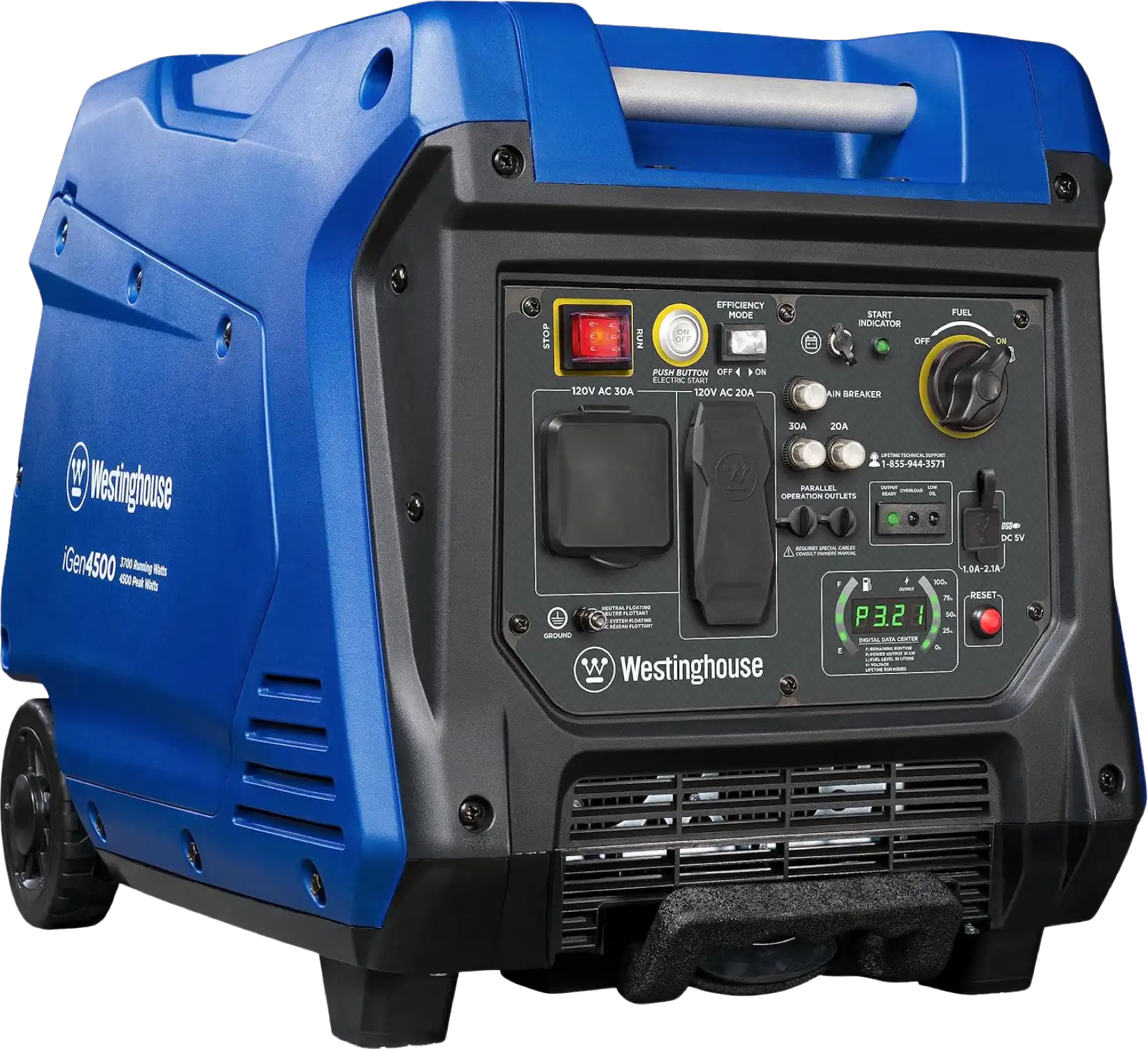
Westinghouse
Westinghouse iGen4500
The RV community's favorite non-Honda: 3,700 running watts, a genuine 52 dB at quarter load, a telescoping suitcase handle, and an 18-hour economy-mode runtime that owners verify on long weekends. The digital display with remaining-runtime readout and the remote-start fob are the features people mention unprompted, and at half the cost of Honda's discontinued EU3000 it became the default. It starts most 15k BTU RV ACs, though owners at altitude or in high heat add a soft-starter to be safe. Grievances from long-term threads: the rear wheels are small for gravel campgrounds, the recoil backup start is awkwardly placed, carb gumming after storage is the top reliability complaint (fuel shutoff use is essential), and Westinghouse's parts/support pipeline can be slow. The DF dual-fuel variant had a fuel-filter leak recall in 2020 — this gas model wasn't affected.

The people's RV generator. Champion's 200988 pairs 4,500 starting watts with dual-fuel flexibility and electric start at well under half of Honda money, and the review volume — thousands across Amazon, Walmart, and Camping World — is overwhelmingly positive. Owners confirm it starts 13.5k BTU RV air conditioners, sips propane for up to 21 hours on a 20-lb tank, and holds clean sub-3% THD power for electronics. At 61 dB it's audibly louder than a Honda or the iGen4500, more of a steady hum than a whisper, and the 103-lb body rides on small, hard wheels that owners wish were bigger. Recurring gripes: the electric-start battery dies if you don't tend it (there's a maintenance charger port for a reason), propane output derates to 3,150 running watts, and oil changes require a slight tilt-and-funnel dance.