
Kohler
Kohler 14kW RCA
Kohler's answer to the Guardian 14kW, and the one owners pick when they've read enough Generac controller threads. The commercial-grade CH740 V-twin uses hydraulic valve lifters — no break-in, no valve adjustments — and the corrosion-proof aluminum enclosure holds up in coastal salt air where painted steel rusts. It punches above its class on motor starting with 33kVA of surge capacity via PowerBoost, so a 4-ton AC is realistic. Owner sentiment is consistent: the hardware feels a grade above Generac, but the dealer network is thinner, lead times run longer, and the OnCue Plus monitoring app is dated and clunky compared to Mobile Link. Note the honest ratings: 14kW on propane but 12kW on natural gas, and 69 dB in normal operation is louder than the spec-sheet skim suggests.
Specifications
Highlights
What owners like
- ✓Hydraulic lifters mean no valve adjustments for life
- ✓Aluminum enclosure genuinely resists coastal corrosion
- ✓33kVA surge starts large AC units other 14kW units can't
- ✓5-year/2,000-hour warranty is stronger than Generac's hours-unlimited-but-vaguer terms
- ✓Owner-reported reliability record is excellent
Common complaints
- ✗12kW on natural gas is a bigger derate than Generac's 14kW
- ✗69 dB in normal operation — louder than its marketing implies
- ✗OnCue Plus app is dated and owners call it clunky
- ✗Fewer dealers means longer waits for service in some regions
- ✗Costs more than the equivalent Generac before install
Owner Insightssummarized from Reddit and owner forums
The 14RCA is the generator people buy after reading one too many Generac controller-failure threads. Its pitch is pure hardware: a commercial-grade CH740 V-twin with hydraulic lifters that never need valve adjustments and skip break-in entirely, a corrosion-proof enclosure that coastal owners hunt down specifically, and 33kVA of PowerBoost surge that starts a 4-ton AC most 14kW machines would stall on. Power quality is a real differentiator too - under 3 percent THD against the 5 percent industry norm - and owners in California's PG&E shutoff country and minus-20-degree winters both report it just starting, every time.
Ownership has a split personality. The mechanical side generates almost no complaints; the digital and service side generates most of them. Kohler retired the old OnCue Plus app, and the replacement Kohler Energy Management app arrived with its own bugs - units reporting offline while visibly connected via ethernet, address-verification dead ends - while the transition obsoleted older firmware, forcing owners to run updates from a Windows laptop or pay a dealer to do it. And the dealer network is the thin spot: coverage is far sparser than Generac's, the dealers who exist are often weak on app and connectivity issues, and Kohler's support model routes everything back through them anyway. The 5-year, 2,000-hour warranty is generous on paper; how smoothly it pays out depends on your zip code. Budget honestly - the unit streets around 5,400 to 6,000 dollars with the transfer switch separate, and complete installs typically land between 12,000 and 18,000.
Best for buyers who prioritize engine build and coastal durability over app polish and service density - and who have confirmed a competent Kohler dealer actually operates nearby, which is the single most repeated piece of owner advice. The direct rival is the Generac Guardian 14kW, which costs several hundred less, holds 14kW on natural gas where the Kohler drops to 12, and has a dealer in every town - but brings the controller and WiFi baggage the Kohler buyer is fleeing. Cross-shoppers also look at the Kohler 20RCA when the NG derate threatens their AC math, and at Briggs and Cummins units that share the premium-hardware, thin-network trade-off.
What owners like
- +Commercial-grade CH740 V-twin with hydraulic lifters - no break-in period, no valve adjustments, ever
- +Owners report reliable automatic starts down to minus 20 degrees
- +Sub-3 percent total harmonic distortion versus the 5 percent industry norm - measurably cleaner power for electronics
- +33kVA PowerBoost surge starts a 4-ton AC that would stall same-size rivals
- +Corrosion-proof enclosure that coastal owners specifically seek out after watching painted steel rivals rust
- +5-year, 2,000-hour warranty - the hour figure roughly doubles Generac's implied coverage for heavy-use owners
- +California PG&E shutoff veterans report it performing flawlessly through repeated outages
- +Web retailers ship the unit itself in about 3-7 business days, so hardware availability is better than its reputation
Common complaints
- −Kohler retired OnCue Plus and the replacement Kohler Energy Management app is also unstable - offline warnings while the controller sits connected via ethernet
- −The app transition obsoleted older firmware, leaving owners to update it themselves on a Windows laptop or pay a dealer
- −Dealer network is dramatically thinner than Generac's, and the dealers that exist often lack app and IT troubleshooting skills
- −Kohler routes technical support back through dealers, and only distributors can actually consult the factory
- −Steep NG derate: 12kW on natural gas against the 14kW propane rating
- −69 dB in normal operation - louder than the Generac 14kW's 65 and the spec-sheet skim hides it
- −Costs several hundred more than the equivalent Guardian before the install even starts
- −Typical installed projects run 12,000 to 18,000 dollars, at the high end of the size class
Common Questions
Why does it only make 12kW on natural gas?
Is the Kohler app situation really that bad?
How does the 5-year, 2,000-hour warranty compare?
Will it start in serious cold?
What will the whole project cost installed?
Can it handle my central air conditioner?
Compare the Kohler 14kW RCA
Related units
More from Kohler →
Kohler
Kohler 20kW RCA
The 20RCA is Kohler's volume whole-house unit and the direct rival to Generac's 22/24kW, built around the bigger CH1000 V-twin. Its party trick is 41kVA of motor-starting capacity — owners regularly confirm it starts a 5-ton AC without dropping the rest of the house, which smaller-surge competitors need load-shedding modules to manage. The RDC2 controller has a strong reliability reputation, and long-term owners (this platform has been around for years) report exceptionally boring, dependable service — the best compliment a standby can get. Trade-offs are the familiar Kohler ones: 18kW on natural gas, 70 dB at full-speed operation is on the loud side, OnCue Plus monitoring trails Generac's app, and you may wait longer for both the unit and a certified installer depending on your region.

Kohler
Kohler 26kW RCA
Kohler's air-cooled flagship goes head-to-head with Generac's 26kW and quietly wins the spec that matters for most buyers: 24kW on natural gas versus Generac's 22.5kW. Built on the CH1006 V-twin with PowerBoost starting, it carries large homes — dual AC compressors, well pumps, the works — and owners describe it as the 'buy once' choice in the class. The critical silencer and sound enclosure keep the tone lower and less mechanical than the raw 70 dB figure suggests, though it's still not quiet. Ownership realities: it's a 625-lb unit that needs a serious pad, Kohler/Rehlko dealer coverage is uneven so line up your servicer before you buy, and lead times can stretch after major storm seasons. The 26RCAL variant bundles a 200A transfer switch if you want one quote for everything.

Generac
Generac Guardian 18kW
The 18kW is the value pick in the Guardian range on a dollars-per-kilowatt basis — same 816cc G-Force 800 twin as the 14kW, tuned for 18kW on propane and 17kW on natural gas, at only a few hundred dollars more. Owners in hurricane and ice-storm country consistently report it carrying a whole modest home including a 3-ton AC without drama, and the G-Flex variable-speed exercise keeps the weekly test tolerable at 65 dB. The ownership caveats are pure Generac: the Evolution 2 controller is the component that fails, dealers are the only sanctioned path for warranty work, and owners recommend buying the battery and cold-weather kit up front rather than discovering they're extras on install day. If you're between the 14 and this, most owner advice says spend up.

Champion
Champion aXis 14kW
Champion's aXis system is the disruptor bid in standby: a 14kW unit with a 200-amp service-entrance transfer switch AND a 10-year warranty — double the coverage of Generac, Kohler, or Cummins — for about five grand. The clever bit is Power Line Carrier technology: the generator talks to the transfer switch over your home's existing wiring, so installs skip the extra control-wire run, and the aXis load management prioritizes up to four loads. The 754cc Milwaukee-series V-twin runs a claimed 62 dBA, quiet for the class, and it operates from -22°F to 104°F with a 24V starting system. Owner reports are mostly happy, but the honest cons: the certified installer network is young and sparse, some electricians are unfamiliar with the PLC setup, and 12.5kW on natural gas trails the LP rating.

Cummins
Cummins QuietConnect RS20A
The RS20A is what owners buy when the nightly drone of a 70 dB generator is a dealbreaker: Cummins holds it to 65 dB at 23 feet — dishwasher territory — while still starting a 5-ton air conditioner and managing four loads with its built-in intelligent load control. The same QSJ999G V-twin as the RS13A runs harder here, delivering 20kW on propane and 18kW on natural gas, and it ships cold-weather-ready to 0°F out of the box. Owner reviews read like Kohler's best: uneventful, reliable, quiet enough that neighbors ask if it's running. The trade-offs also mirror the RS13A — sparse residential dealer coverage makes pre-purchase service planning essential, stock frequently slips to pre-order, and the app is functional but bare-bones. For sound-sensitive neighborhoods it's arguably the class benchmark.
Generac
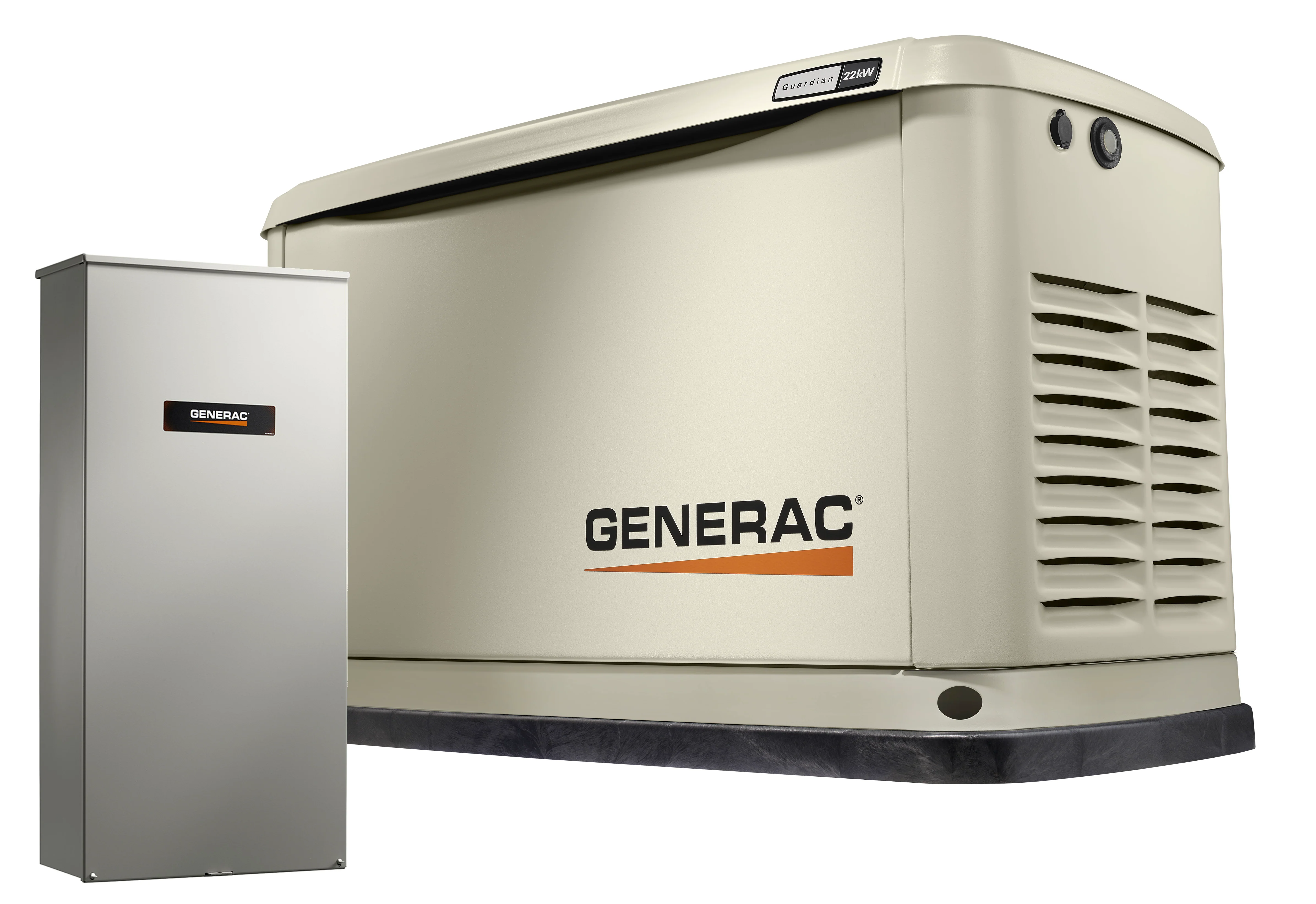
Generac Guardian 22kW
For years the best-selling home standby generator in America, and the sheer volume of owner reviews shows why: the 22kW carries most whole homes — two AC units with load management — and every electrician and gas fitter in the country has installed one. The G-Force 1000 engine and 67 dB noise level are unremarkable but proven; owners report units sailing through week-long outages after hurricanes. The flip side of ubiquity is that the complaint threads are equally deep: Evolution controller replacements, dealers backlogged after storms, and Generac support that owners describe as polite but powerless. The newer 24kW (7209/7210) has largely replaced it at similar money, but the 7042 remains widely stocked, slightly cheaper, and the known quantity — a big deal when your installer has done fifty of them.