Predator (Harbor Freight)
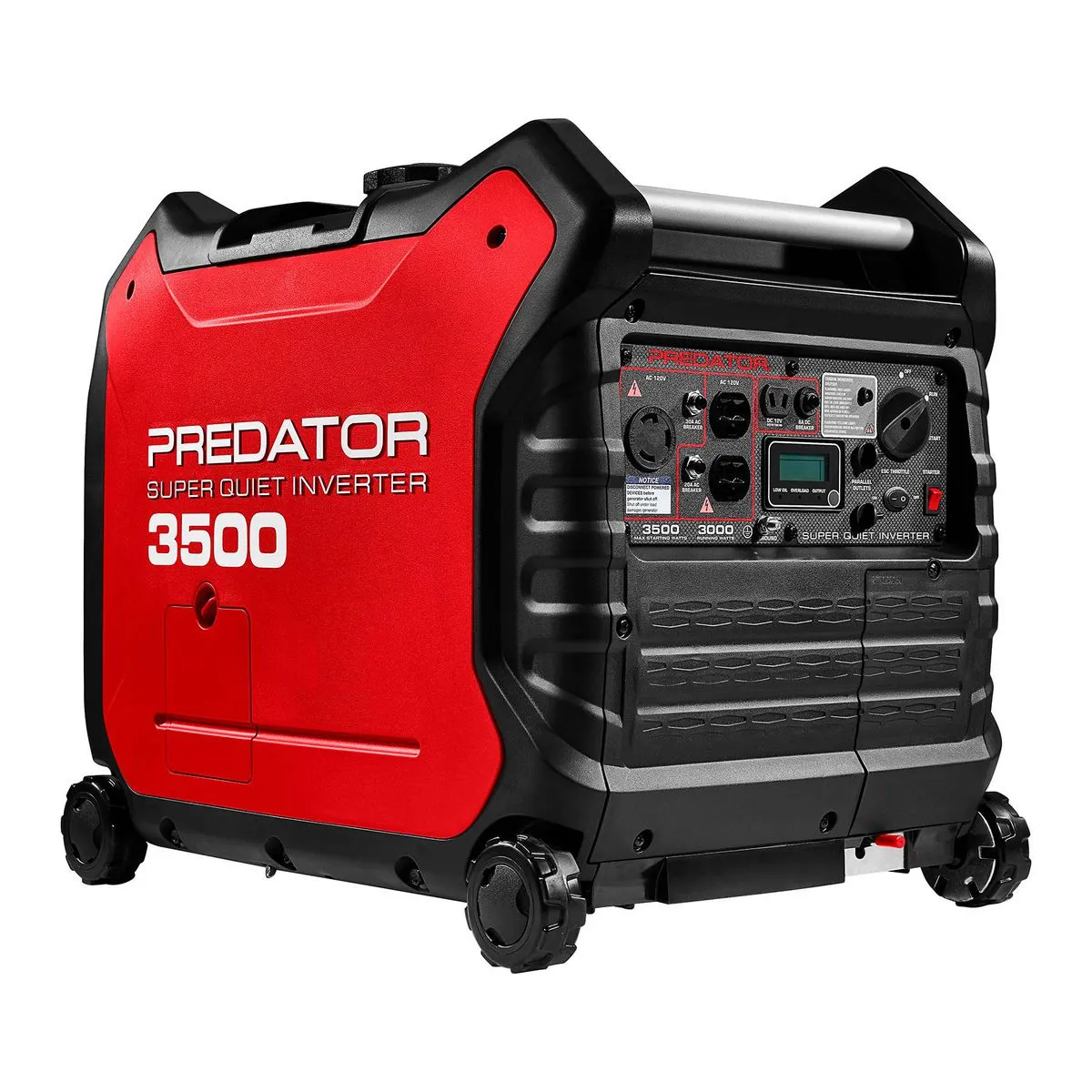
Predator 3500 Inverter
The cult classic of the RV world. The Predator 3500 has powered a decade of forum threads titled 'why pay Honda prices?' — 3,000 running watts, 57 dB super-quiet operation, electric start, and a digital readout for around $800, with periodic coupons taking it lower. Owners report five-plus-year lifespans with basic oil changes, and it starts 15k BTU RV ACs that make 2,200W units give up. Consumer Reports rates it surprisingly highly for noise and power quality. The trade-offs are well-mapped: 99 lbs with no folding handle makes truck-bed loading awkward, the oil fill is tilted and messy, carb varnish after storage is the top repair thread, the 90-day warranty is the shortest in the industry, and CARB-state buyers need the newer CO Secure version. Still the value benchmark for RV inverters.
Specifications
Highlights
What owners like
- ✓Runs 15k BTU RV air conditioners that stall smaller inverters
- ✓57 dB is legitimately quiet for 3,000 running watts
- ✓Electric start with simple controls
- ✓11-hour economy runtime
- ✓Ten years of owner-documented fixes for every known quirk
- ✓Frequent Harbor Freight coupons drop it under $600
Common complaints
- ✗90-day warranty is the shortest in the category
- ✗99 lbs with no suitcase handle or telescoping pull
- ✗Awkward tilted oil fill makes changes messy
- ✗Carburetor gumming after storage is the top complaint
- ✗No fuel gauge on older revisions; small 2.3-gal tank
Owner Insightssummarized from Reddit and owner forums
The Predator 3500 is the generator that made 'why pay Honda prices?' a whole genre of forum thread. It shows up constantly in r/GoRVing, r/Harbor_Freight, and iRV2 threads because it hits the exact spec RVers care about - enough surge to start a 15k BTU rooftop AC, conversation-level noise, electric start - at a price where owners talk about coupon codes instead of financing. The buyers are overwhelmingly travel-trailer and toy-hauler owners, tailgaters, and food-truck operators, plus a contingent of Honda owners who bought one as a 'beater' and then quietly stopped using the Honda.
Ownership reports are more positive than a $700 generator has any right to earn. Multiple owners describe three-plus trouble-free years, always starting under load with the AC running; one food-truck operator logged two years of regular commercial duty on nothing but oil changes. The maintenance rhythm matters though: the manual calls for an oil change at 8 hours (expect glittery break-in oil), again at 30, then every 100, and the digital hour meter makes tracking easy. The two failure themes that actually recur are heat - sustained high loads on hot days can trip it into overheating - and the classic gummed carburetor after winter storage, which is why aftermarket Huayi carbs are a thriving eBay category. Owners who run the carb dry and store it with treated fuel mostly never see either problem.
This is the pick for RVers who want AC-capable quiet power at the absolute floor price and are comfortable being their own service department. Against the Honda EU3000iS it gives up brand pedigree and warranty but costs roughly a third as much and weighs about 50 lbs less, and side-by-side owners say the noise gap is nearly nil. Cross-shoppers most often weigh it against the Generac iQ3500 (real 3-year warranty, similar watts, ~$450 more) and the Champion 3400 dual-fuel; the ones who buy the Predator anyway usually reason that at $549 on coupon, they could buy a spare before reaching Generac money.
What owners like
- +Runs a 15,000 BTU RV AC in extreme heat where 2,200-watt units stall
- +Coupon culture is real - owners regularly report paying $549-$700 instead of list
- +Measured noise lands right next to the Honda EU3000iS in side-by-side owner tests, and a few testers found it slightly quieter
- +Digital display shows voltage, output watts, and lifetime run hours - handy for tracking oil intervals
- +Roughly 50 lbs lighter than the Honda EU3000iS it gets compared against
- +Food-truck and full-timer owners report multi-year daily duty with just oil changes
- +11-hour quarter-load runtime covers a full night of CPAP plus fridge without a refill
- +Huge aftermarket - replacement carbs, jet kits, and covers are cheap and everywhere
Common complaints
- −Overheating at sustained high load on hot days is the most common performance complaint
- −The 90-day warranty is worse than it sounds - the extended service plan covers exactly one repair, a detail buried in the fine print
- −First oil change at 8 hours comes out full of metal glitter, then 30 hours, then every 100 - skip the break-in change at your peril
- −Carb gums up after a season of storage unless you run it dry or treat the fuel
- −Lifting 99 lbs into a truck bed is a two-person job
- −No Harbor Freight service network - a dead unit means DIY repair or a return-window fight
- −Older non-CO-Secure units can't be sold or easily serviced in CARB states
- −Eco mode can bog momentarily when a big compressor kicks on
Common Questions
Will the Predator 3500 start a 15,000 BTU RV air conditioner?
Is the 90-day warranty really as bad as people say?
What is the oil change schedule?
How does it compare to the Honda EU3000iS?
How do I keep the carburetor from gumming up in storage?
Do I need the CO Secure version?
Compare the Predator 3500 Inverter
Related units
More from Predator (Harbor Freight) →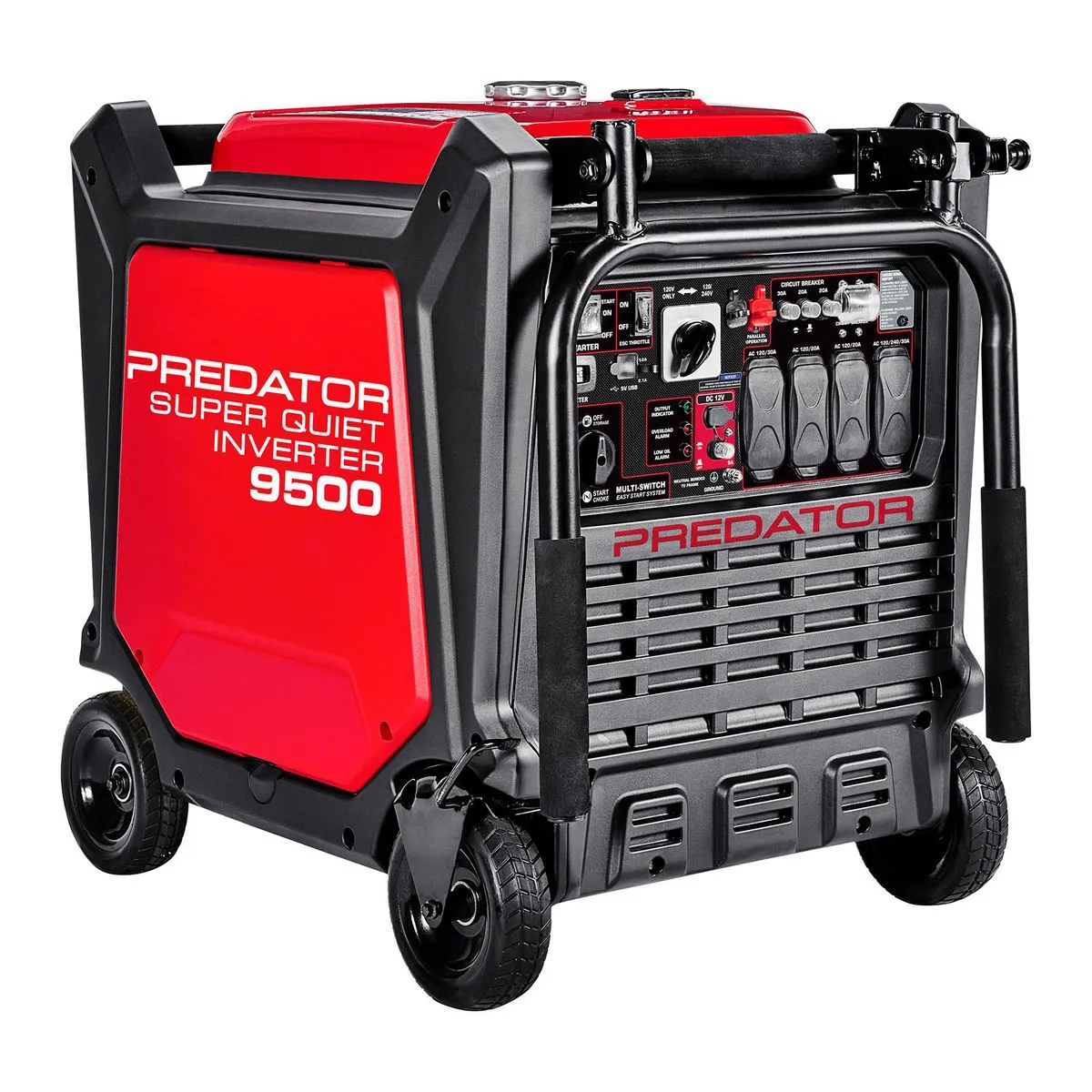
Predator (Harbor Freight)
Predator 9500 Inverter
Harbor Freight's giant-killer. The Predator 9500 delivers 7,600 running watts of closed-case inverter power — EU7000iS territory plus 2,000 extra watts — at 40% of Honda's price, and the r/Generator consensus is that the hardware genuinely delivers: clean power, 67 dBA that's dramatically quieter than open frames, electric start, ESC economy mode, and 18.5-hour runtimes. Owners run whole homes through the L14-30R and an interlock. The catch everyone leads with: a 90-day warranty from a company whose service model is 'bring it to the store,' so buyers treat the extended protection plan as mandatory. Other realities from long-term threads: 257 lbs makes it the heaviest thing in its class, it's carbureted (store it dry), CO Secure occasionally false-trips in enclosed-ish spaces, and there's no dual-fuel option at this size.

The people's RV generator. Champion's 200988 pairs 4,500 starting watts with dual-fuel flexibility and electric start at well under half of Honda money, and the review volume — thousands across Amazon, Walmart, and Camping World — is overwhelmingly positive. Owners confirm it starts 13.5k BTU RV air conditioners, sips propane for up to 21 hours on a 20-lb tank, and holds clean sub-3% THD power for electronics. At 61 dB it's audibly louder than a Honda or the iGen4500, more of a steady hum than a whisper, and the 103-lb body rides on small, hard wheels that owners wish were bigger. Recurring gripes: the electric-start battery dies if you don't tend it (there's a maintenance charger port for a reason), propane output derates to 3,150 running watts, and oil changes require a slight tilt-and-funnel dance.
Westinghouse
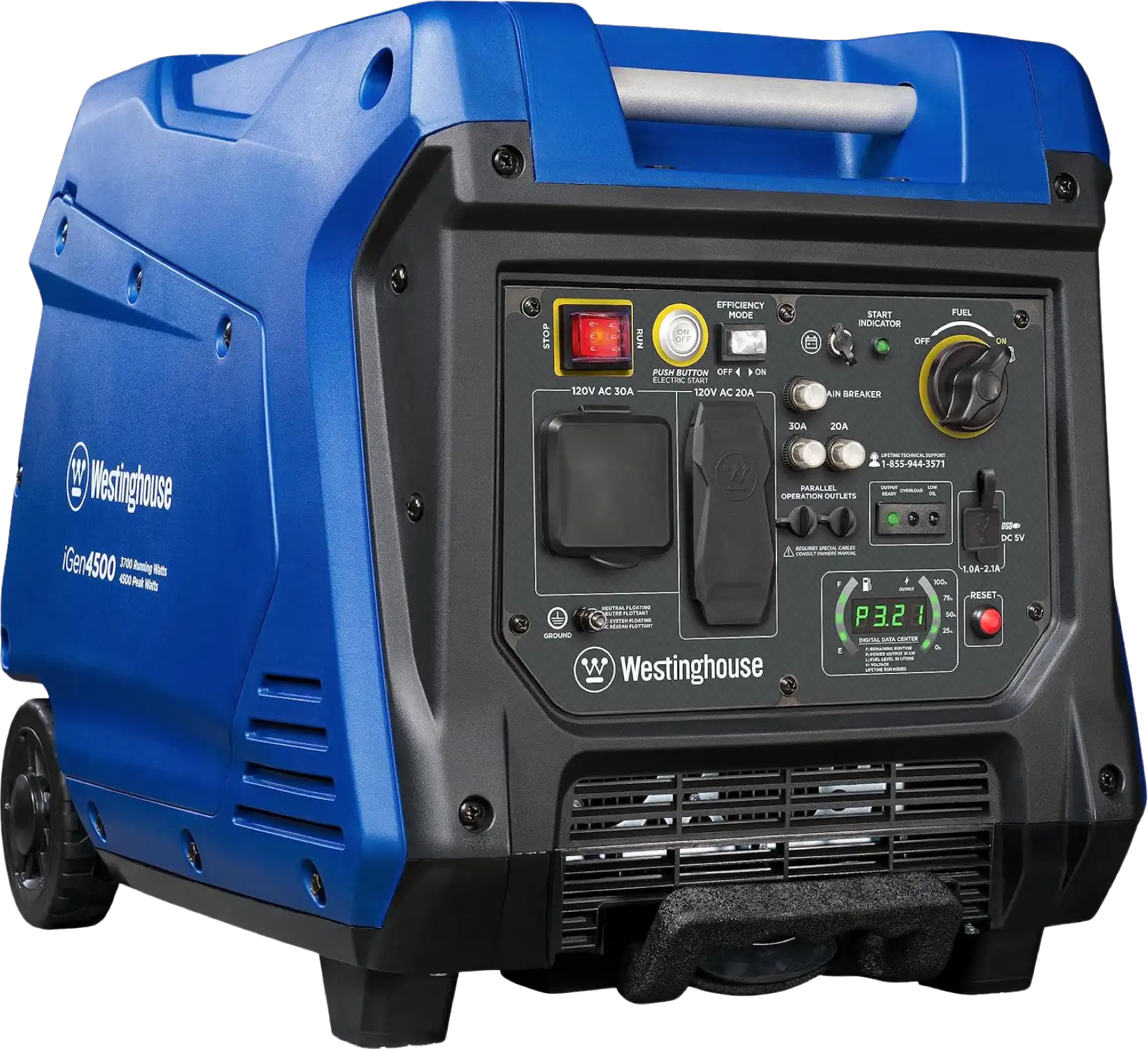
Westinghouse iGen4500
The RV community's favorite non-Honda: 3,700 running watts, a genuine 52 dB at quarter load, a telescoping suitcase handle, and an 18-hour economy-mode runtime that owners verify on long weekends. The digital display with remaining-runtime readout and the remote-start fob are the features people mention unprompted, and at half the cost of Honda's discontinued EU3000 it became the default. It starts most 15k BTU RV ACs, though owners at altitude or in high heat add a soft-starter to be safe. Grievances from long-term threads: the rear wheels are small for gravel campgrounds, the recoil backup start is awkwardly placed, carb gumming after storage is the top reliability complaint (fuel shutoff use is essential), and Westinghouse's parts/support pipeline can be slow. The DF dual-fuel variant had a fuel-filter leak recall in 2020 — this gas model wasn't affected.
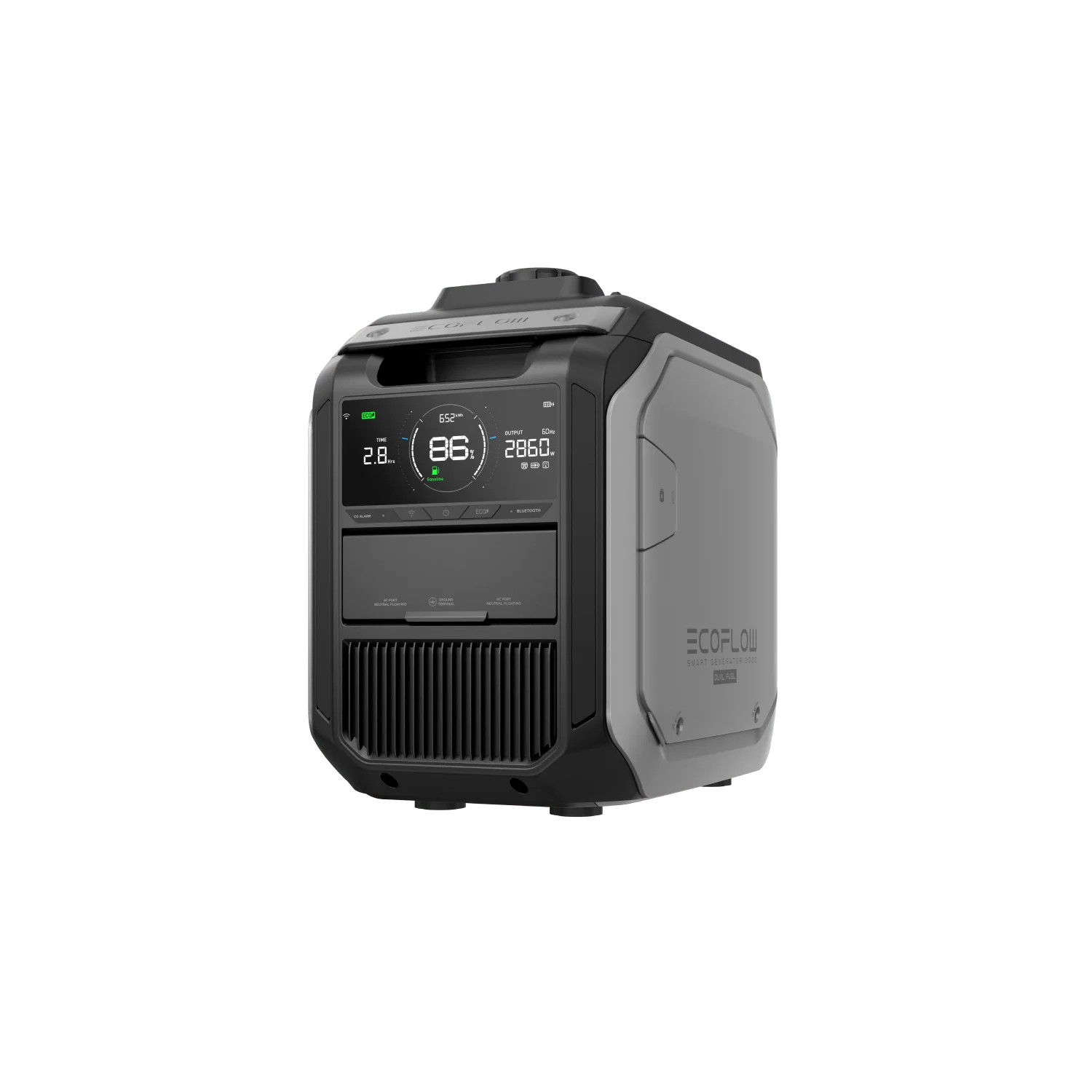
This isn't really a competitor to Honda — it's a range extender for EcoFlow's battery ecosystem, and that's exactly how owners use it. Paired with a DELTA 3 or DELTA Pro power station, it auto-starts itself when the battery drops below a threshold you set in the app, charges via high-efficiency DC (skipping the AC conversion loss), then shuts itself off — so the noisy, fuelly part of backup power runs as little as possible. It also works as a plain 2,000W dual-fuel inverter generator with app control and five start methods. Owner sentiment: brilliant inside the ecosystem, mediocre outside it — 69 dB is loud for 2,000 watts, the 1-year warranty is stingy, LPG output drops to 1,800W, and at typical pricing you can buy more raw watts elsewhere. As the automated gas backstop to a solar-battery setup, though, nothing mainstream matches it.

Generac
Generac GP3300i
Generac's play for the Honda EU2200i shopper who balks at $1,200: 2,500 running watts (700 more than the Honda), PowerRush surge tech, USB ports, and COsense CO shutdown for roughly half the money, in a 60-lb suitcase. Owners use it for camping, tailgates, and charging batteries off-grid, and reviews are broadly positive about starting behavior and the extra headroom that runs a small AC or space heater the Honda can't. What the threads flag: Generac doesn't publish a noise spec — owners measure it audibly louder than the Honda, especially outside eco mode; eco mode can hunt/surge with cycling loads like fridges; the 1-gallon tank is small; and while the 3-year warranty is real, portable warranty service goes through Generac's dealer network, which prioritizes standby customers. A rational value pick if ultimate quiet isn't the goal.

WEN
WEN 56235i
The budget-inverter benchmark and a long-running Wirecutter-class recommendation: 1,900 running watts, a class-leading 39-lb carry weight, and 51 dB at quarter load — numbers that shadow the Honda EU2200i for less than half the money. The killer feature owners cite constantly is the three-position fuel shutoff, which burns the carburetor dry before shutdown and largely prevents the gummed-carb death that plagues stored generators. Thousands of Amazon reviews describe years of camping and CPAP-backup service; several document buying a second unit to parallel. The honest limits: it's 100 watts shy of the Honda with less surge grace, the eco mode hunts with cycling loads, the 1-gallon tank needs topping during long nights, WEN's warranty is 2 years versus 3 for the majors, and long-term durability past the 500-hour mark is less documented than Honda's. Per dollar, nothing embarrasses it.