
Champion
Champion 4500W Dual Fuel Inverter
The people's RV generator. Champion's 200988 pairs 4,500 starting watts with dual-fuel flexibility and electric start at well under half of Honda money, and the review volume — thousands across Amazon, Walmart, and Camping World — is overwhelmingly positive. Owners confirm it starts 13.5k BTU RV air conditioners, sips propane for up to 21 hours on a 20-lb tank, and holds clean sub-3% THD power for electronics. At 61 dB it's audibly louder than a Honda or the iGen4500, more of a steady hum than a whisper, and the 103-lb body rides on small, hard wheels that owners wish were bigger. Recurring gripes: the electric-start battery dies if you don't tend it (there's a maintenance charger port for a reason), propane output derates to 3,150 running watts, and oil changes require a slight tilt-and-funnel dance.
Specifications
Highlights
What owners like
- ✓Starts 13.5k BTU RV ACs reliably per thousands of owner reports
- ✓Propane option stores indefinitely — no stale-gas worries
- ✓Electric start with cold-start tech works in freezing weather
- ✓Clean <3% THD power safe for electronics
- ✓21-hour propane runtime on a standard grill tank
Common complaints
- ✗61 dB is noticeably louder than Honda/Westinghouse rivals
- ✗Start battery discharges if not maintained between uses
- ✗Propane derates output about 10%
- ✗Small hard wheels struggle on gravel and grass
- ✗No 240V output
Owner Insightssummarized from Reddit and owner forums
This is the generator that shows up when someone asks an RV forum what to actually buy. The 200988's pitch is simple: air-conditioner-starting watts, push-button start, and the flexibility to run off the grill tank, all for what a Honda charges just for the badge. The review volume is staggering - thousands of largely five-star reports across Walmart, Amazon, and Camping World - and the buyers are travel-trailer owners, tailgaters, and first-time outage preppers who want maximum capability per dollar.
Day-to-day, owners describe a machine that does what the box says with a few quirks worth knowing. On gasoline it starts a 13.5k BTU AC reliably; on propane the derate to 3,150 running watts makes the same AC a coin flip, so the common pattern is gas for air conditioning, propane for everything else - and running mostly propane has the side benefit of keeping the carburetor clean between uses. The 61 dB hum is genuinely tolerable at a campsite but a class louder than a Honda or iGen4500, and it rises under compressor load. The two rituals owners learn fast: keep the starter battery on the maintenance charger (a dead battery means the pull rope), and accept that the tilt-and-funnel oil change on the half-quart sump is just part of the deal. Champion phone support gets consistent praise in warranty threads.
It is the best value in its class for RVers who want AC power without Honda money, and the default recommendation for a first serious generator. Cross-shopping is a coin flip with the Westinghouse iGen4500 - the Westinghouse is quieter with a nicer display and telescoping handle, the Champion counters with dual fuel and electric start at a lower street price. People who need 240V house backup look at the Champion 8500 or open-frame units instead, and buyers who mostly boondock quietly sometimes step down to the 2500-watt Champion to save 40 pounds.
What owners like
- +Routinely on sale for 700 to 820 dollars - owners brag about the deal as much as the machine
- +Starts a 13.5k BTU RV air conditioner on gasoline with margin to spare
- +Owners verify 20-plus hours on a single 20-lb propane tank at light load
- +Propane hose with built-in regulator comes in the box, so a grill tank works on day one
- +Native TT-30R outlet - the RV cord plugs straight in with no adapter
- +Running it mostly on propane means the carb never sees stale gas, a favorite owner strategy for storage-proofing
- +Under 3 percent THD keeps CPAPs, laptops, and residential fridge electronics happy
- +The oil drain tube and no-tool access panel take some sting out of maintenance day
Common complaints
- −Starting a 13.5k AC on propane is marginal - the derate to 3,150 running watts pushes owners to gas or a soft starter
- −61 dB is a steady hum rather than Honda whisper, and it gets noticeably louder when the AC compressor is pulling
- −The half-quart sump and tilt-to-drain oil change is every owner's least favorite chore despite the drain tube
- −Cold-weather propane starts take extended cranking and a line purge; below freezing most owners start on gasoline
- −The stock wheels are the first thing owners replace - small and hard, they fight gravel and soft ground
- −No 240V output, so it cannot feed a house transfer switch for well pumps or other 240V loads
- −Eco mode stumbles if a compressor kicks on before you remember to switch it off
- −Awkward one-person lift - 103 pounds with nowhere great to grip when hoisting it into a truck bed
Common Questions
Will it run a 30-amp RV with a 13,500 BTU air conditioner?
What changes when I run it on propane?
Does the electric-start battery need babysitting?
How do oil changes work on this thing?
Is 61 dB too loud for a campground at night?
How should I store it between outages?
Compare the Champion 4500W Dual Fuel Inverter
Related units
More from Champion →
The unicorn spec r/Generator kept asking for: tri-fuel AND inverter in one machine. Hook the 201176 to your natural-gas line for unlimited runtime, and unlike every conventional tri-fuel, it feeds your house clean sub-3% THD power that's safe for furnace boards, UPSs, and electronics — through a 50-amp outlet. On gasoline it makes 7,250 running watts; NG drops it to 5,875, still enough for most homes' essentials plus a small AC. It's an open-frame design, so the 72 dBA rating is real and load-dependent — quieter than a WGen9500DF, louder than closed-case inverters. Owner threads note the winning math (it replaced separate 'quiet' and 'NG' generators for many), with the familiar caveats: NG line pressure matters, the 420cc engine drinks on gasoline at full tilt, electric-start battery upkeep, and Champion's included NG/LP hoses are short. CO Shield included.

Champion's answer to the EU7000iS costs a third as much and adds propane capability: 7,000 running watts of closed-frame inverter power at a claimed 61 dBA from 23 feet, with both 50A and 30A 240V outlets ready for a transfer switch. Owners running whole-home essentials during outages report it handles well pumps, furnaces, and a smaller central AC, with quiet operation that genuinely surprises people used to open-frame roar. The CO Shield sensor and electric start round out a strong package. The complaint list from owner threads: at 214 pounds it's barely 'portable' despite never-flat wheels, the propane derate takes running power to about 6,300 watts, real-world noise climbs well above 61 dB under heavy load, and a few owners report early inverter-board failures — Champion support resolves them, but shipping a 200-lb unit for service is nobody's idea of fun.

Champion
Champion 76533 3800W Dual Fuel
One of the best-selling generators ever made, and the archetype of the 'good enough for everything' budget dual fuel. Electric start, RV-ready TT-30R outlet, propane capability out of the box, and nearly a decade of owner history at around $550 — the review count across Amazon and Walmart is enormous and consistently positive. Owners run travel trailers, job sites, and essential-circuit extension-cord backup, and the 224cc engine has a reputation for starting after years of neglect (on propane especially, since there's no carb to gum). Known quirks from the threads: it's a 68 dB droner that campground quiet hours won't love, output on propane drops about 10%, there's no 240V so interlock users look elsewhere, the fuel selector and petcock feel plasticky, and cold-weather propane starts sometimes need a second try. Champion's phone support gets rare-for-the-industry praise.

Champion
Champion aXis 14kW
Champion's aXis system is the disruptor bid in standby: a 14kW unit with a 200-amp service-entrance transfer switch AND a 10-year warranty — double the coverage of Generac, Kohler, or Cummins — for about five grand. The clever bit is Power Line Carrier technology: the generator talks to the transfer switch over your home's existing wiring, so installs skip the extra control-wire run, and the aXis load management prioritizes up to four loads. The 754cc Milwaukee-series V-twin runs a claimed 62 dBA, quiet for the class, and it operates from -22°F to 104°F with a 24V starting system. Owner reports are mostly happy, but the honest cons: the certified installer network is young and sparse, some electricians are unfamiliar with the PLC setup, and 12.5kW on natural gas trails the LP rating.
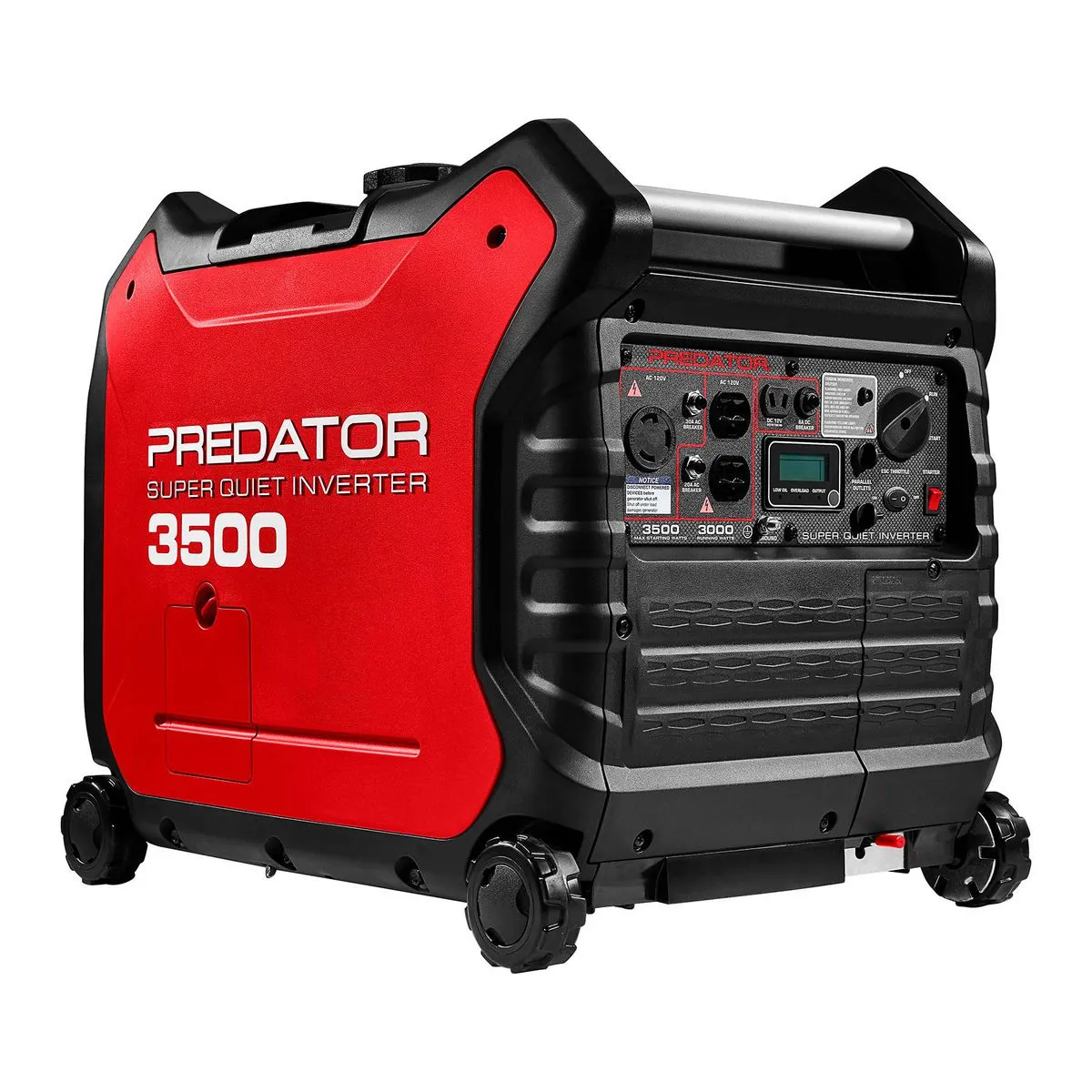
Predator (Harbor Freight)
Predator 3500 Inverter
The cult classic of the RV world. The Predator 3500 has powered a decade of forum threads titled 'why pay Honda prices?' — 3,000 running watts, 57 dB super-quiet operation, electric start, and a digital readout for around $800, with periodic coupons taking it lower. Owners report five-plus-year lifespans with basic oil changes, and it starts 15k BTU RV ACs that make 2,200W units give up. Consumer Reports rates it surprisingly highly for noise and power quality. The trade-offs are well-mapped: 99 lbs with no folding handle makes truck-bed loading awkward, the oil fill is tilted and messy, carb varnish after storage is the top repair thread, the 90-day warranty is the shortest in the industry, and CARB-state buyers need the newer CO Secure version. Still the value benchmark for RV inverters.
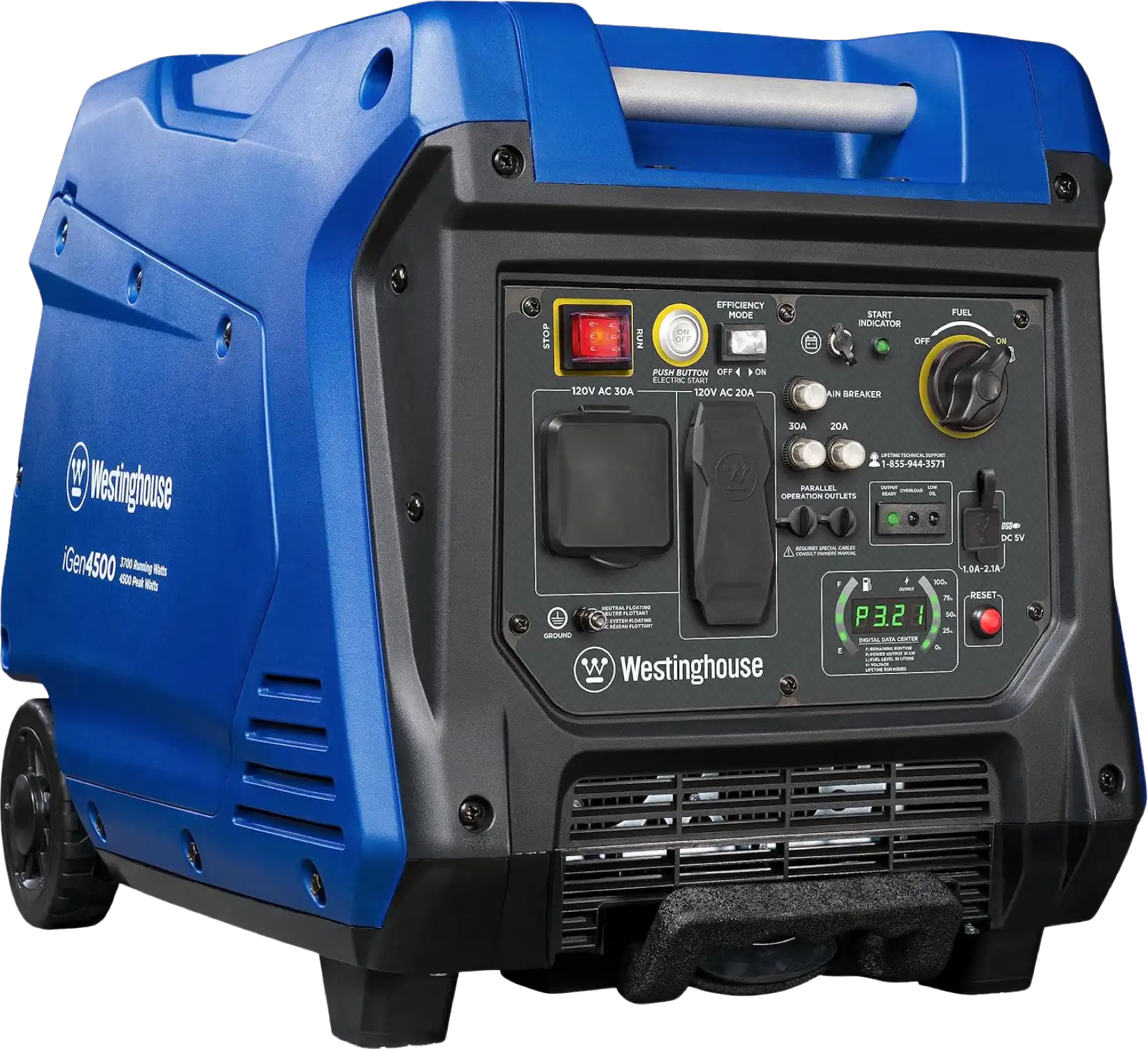
Westinghouse
Westinghouse iGen4500
The RV community's favorite non-Honda: 3,700 running watts, a genuine 52 dB at quarter load, a telescoping suitcase handle, and an 18-hour economy-mode runtime that owners verify on long weekends. The digital display with remaining-runtime readout and the remote-start fob are the features people mention unprompted, and at half the cost of Honda's discontinued EU3000 it became the default. It starts most 15k BTU RV ACs, though owners at altitude or in high heat add a soft-starter to be safe. Grievances from long-term threads: the rear wheels are small for gravel campgrounds, the recoil backup start is awkwardly placed, carb gumming after storage is the top reliability complaint (fuel shutoff use is essential), and Westinghouse's parts/support pipeline can be slow. The DF dual-fuel variant had a fuel-filter leak recall in 2020 — this gas model wasn't affected.