
Westinghouse
Westinghouse WGen11500TFc Tri-Fuel
The r/Generator power-user pick: hook it to your home's natural gas line through a quick-connect and you have effectively unlimited runtime without storing a drop of gasoline — the practical middle ground between a portable and a $12,000 standby install. On gasoline it makes a huge 11,500 running watts; the honest math is the NG derate to 9,500 running watts, still enough for most whole homes via the 50A outlet and an interlock. Remote start, CO sensor, and a 9.5-gallon tank round it out. Owner notes: NG performance depends on your line pressure — undersized gas plumbing causes surging and hard starts, the most common complaint thread — plus it's a 230-lb beast, mid-70s dB loud, and Westinghouse support remains the weak link. Registered owners report solid 3-year warranty coverage when they persist.
Specifications
Highlights
What owners like
- ✓Natural-gas hookup eliminates fuel storage and refueling runs
- ✓Massive output covers whole homes including central AC
- ✓Remote start plus push-button electric start
- ✓50A and 30A 240V outlets for any interlock/transfer setup
- ✓19-hour gasoline runtime when NG isn't available
- ✓CO sensor shutdown for safer semi-sheltered running
Common complaints
- ✗NG output drops to 9,500 running watts
- ✗Needs adequate NG line pressure — surging on undersized plumbing is the top complaint
- ✗230 lbs is genuinely hard to maneuver
- ✗Loud mid-70s dB under load
- ✗Support and parts turnaround can be slow
Owner Insightssummarized from Reddit and owner forums
This is the machine for people who did the math on a standby generator and flinched. Hook the included hose to a quick-connect on your home's natural gas line and you get effectively unlimited runtime with no fuel storage, no carb gumming, and no 4 a.m. refueling runs, for around $1,700 instead of five figures installed. That pitch made it the r/Generator power-user pick, and the Home Depot review base backs it up at 4.8 stars across about 1,900 owners. Buyers skew toward storm-belt homeowners with NG service who want whole-house capability and already have, or are planning, an interlock.
The ownership experience turns almost entirely on your gas plumbing. The spec calls for 7-9 inches of water column at the end of the supplied 25-foot hose and roughly 240 cubic feet per hour at full load, and owners who ignored that and teed off a long half-inch run got the classic symptoms: surging, hunting, and hard starts that take two or three attempts on NG. Owners with a properly sized stub off the meter report it settles into a steady 74 dB drone at 23 feet and just runs, day after day. Gasoline behavior is standard big-WGen: reliable electric and remote start, 19 hours at quarter load from the 9.5-gallon tank, and the usual advice to dump the break-in oil early. The TFc revision is marketed as low-THD, and the practical reports agree, with furnace boards and electronics running clean. Warranty service is the familiar Westinghouse weak spot, slow but ultimately honored for owners who persist.
Best for storm-prone homeowners with natural gas service who want set-and-forget runtime without a standby install. The honest comparison set: the Firman T07571 does the same trick for $700 less but tops out at 5,500 NG watts, roughly half this unit's usable output, while the cheaper WGen9500TFc splits the difference and frequently sells in the $800s. Owners cross-shopping quiet looked at tri-fuel inverters like the iGen11000TFc at nearly double the price. If your NG meter and plumbing can feed it, this is the closest thing to standby-generator living that fits in a garage; if they cannot, budget for the pipe upgrade first or the headline watts are theoretical.
What owners like
- +Ships with the NG hose and quick-connect fittings in the box, so a plumber-installed stub is the only extra cost
- +Home Depot owners rate it 4.8 stars across roughly 1,900 reviews, unusually high for a big open frame
- +Remote start works reliably from indoors, which owners love during storms
- +Even after the NG derate, 9,500 running watts still carries most whole homes through a 50A interlock
- +The current TFc revision is marketed as low-THD, and owners run furnace boards and electronics without the UPS gymnastics older WGens needed
- +9.5-gallon tank stretches to 19 hours at quarter load on gasoline
- +One tested unit held a 10,000-watt load for over 8 hours with minimal frequency wobble
- +Three fuels means your storm plan survives a gas-station run, an empty grill tank, or both
Common complaints
- −Needs roughly 240 cubic feet of natural gas per hour at full load; a long 1/2-inch pipe run simply cannot deliver it
- −NG spec demands 7-9 inches of water column at the end of the supplied 25-foot hose, and marginal pressure shows up as surging
- −Hard starting on natural gas is a recurring forum thread, with some owners needing 2-3 attempts
- −At 230 lbs it is a two-person lift into a truck bed, wheels or not
- −About 74 dB at 23 feet, enough to be clearly heard through closed windows at night
- −Westinghouse parts and warranty response remain slow, days to weeks in owner accounts
- −NG output drops to 9,500 running watts, a real 17 percent haircut off the gasoline number
- −The fuel selector sequence between NG and gasoline confuses new owners and mis-selection causes no-starts
Common Questions
What does my natural gas line need to supply for full output?
How much power do I actually get on natural gas?
Why does it surge or start hard on natural gas?
Can it run my whole house including electronics?
How loud is it for a residential neighborhood?
Is it worth $700 more than the Firman T07571 tri-fuel?
Related units
More from Westinghouse →
Westinghouse
Westinghouse WGen9500DF
Probably the most-reviewed big portable on the internet — 24,000+ ratings averaging 4.7 — and the default r/Generator answer for 'cheap whole-house backup through an interlock.' 9,500 running watts on gasoline (8,500 on propane), a 50-amp outlet, remote-start key fob, and a 12-hour tank for around a grand is a spec sheet nothing else matches. Owners routinely run entire homes including central AC during hurricanes. It is not subtle: expect 75+ real-world dB, a 211-lb frame, and open-frame vibration. The complaint file is proportionate to the sales volume: occasional oil leaks and QC escapes out of the box, a Westinghouse support line that owners describe as slow to days-long, and carb gumming if stored wet. The current 'DFc' revision adds a CO sensor. Buy it, change the skimpy break-in oil early, and store it dry.
Westinghouse
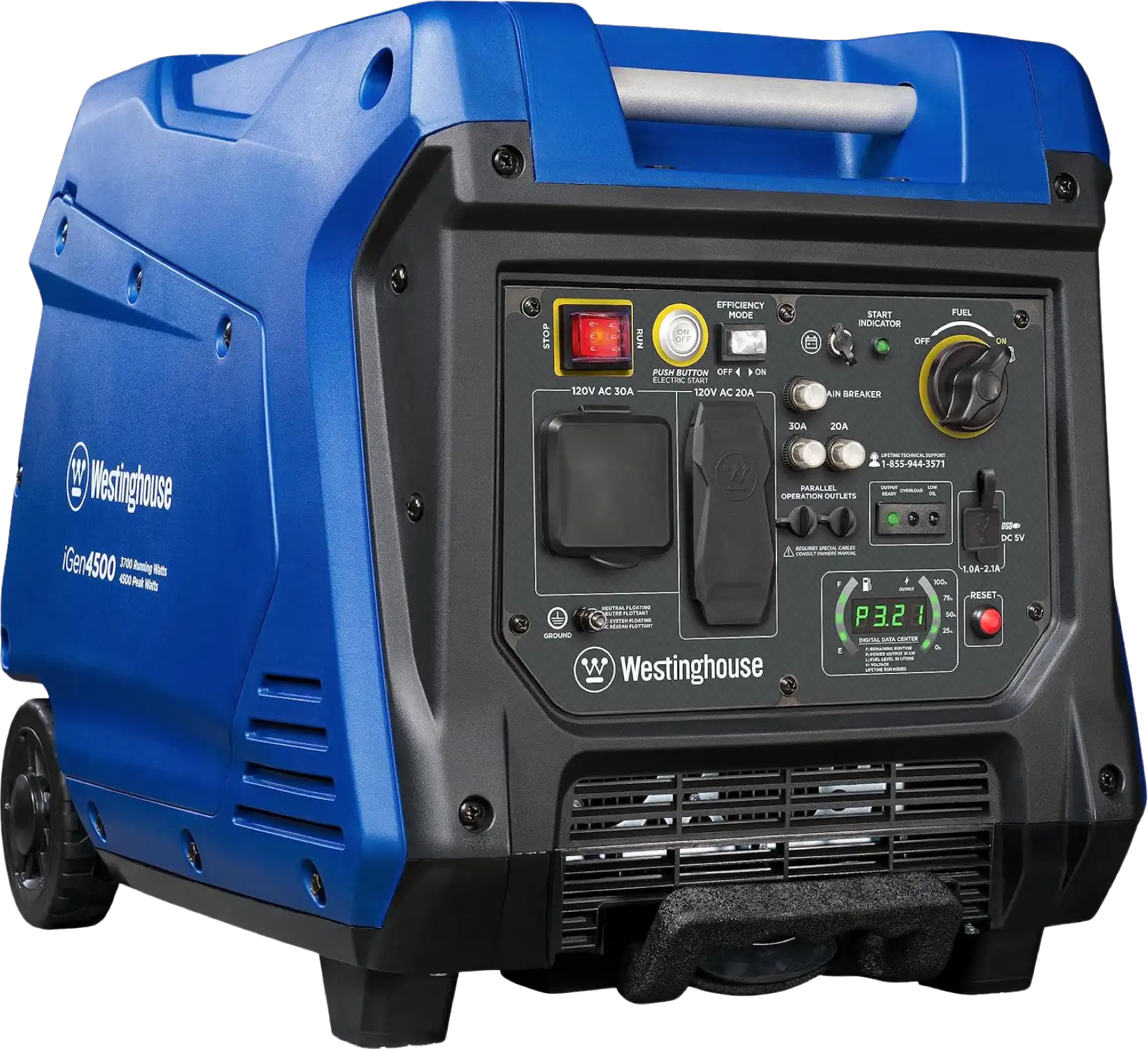
Westinghouse iGen4500
The RV community's favorite non-Honda: 3,700 running watts, a genuine 52 dB at quarter load, a telescoping suitcase handle, and an 18-hour economy-mode runtime that owners verify on long weekends. The digital display with remaining-runtime readout and the remote-start fob are the features people mention unprompted, and at half the cost of Honda's discontinued EU3000 it became the default. It starts most 15k BTU RV ACs, though owners at altitude or in high heat add a soft-starter to be safe. Grievances from long-term threads: the rear wheels are small for gravel campgrounds, the recoil backup start is awkwardly placed, carb gumming after storage is the top reliability complaint (fuel shutoff use is essential), and Westinghouse's parts/support pipeline can be slow. The DF dual-fuel variant had a fuel-filter leak recall in 2020 — this gas model wasn't affected.

DuroMax
DuroMax XP13000EH
The 'Beast': 13,000 starting watts, a 500cc V-twin, all-metal construction, and a 50-amp outlet for around $1,300 makes this the biggest-hammer option in portable backup. Owners with heat pumps and well pumps buy it specifically because the MX2 switch lets you dedicate full power to 120V or split 120/240V, and thousands of reviews confirm it starts loads that stall 8kW units. DuroMax support actually gets better marks than Westinghouse's in forum comparisons. What the fans concede: it's LOUD (mid-to-high 70s dB real world), 234 lbs of steel, drinks propane fast (about 3 hours on a grill tank), and its non-inverter power has high enough THD that owners with sensitive electronics run a UPS or interlock only non-critical circuits. Fit-and-finish complaints — sticky chokes, cheap petcocks — appear but are usually solved with basic wrenching.
Firman
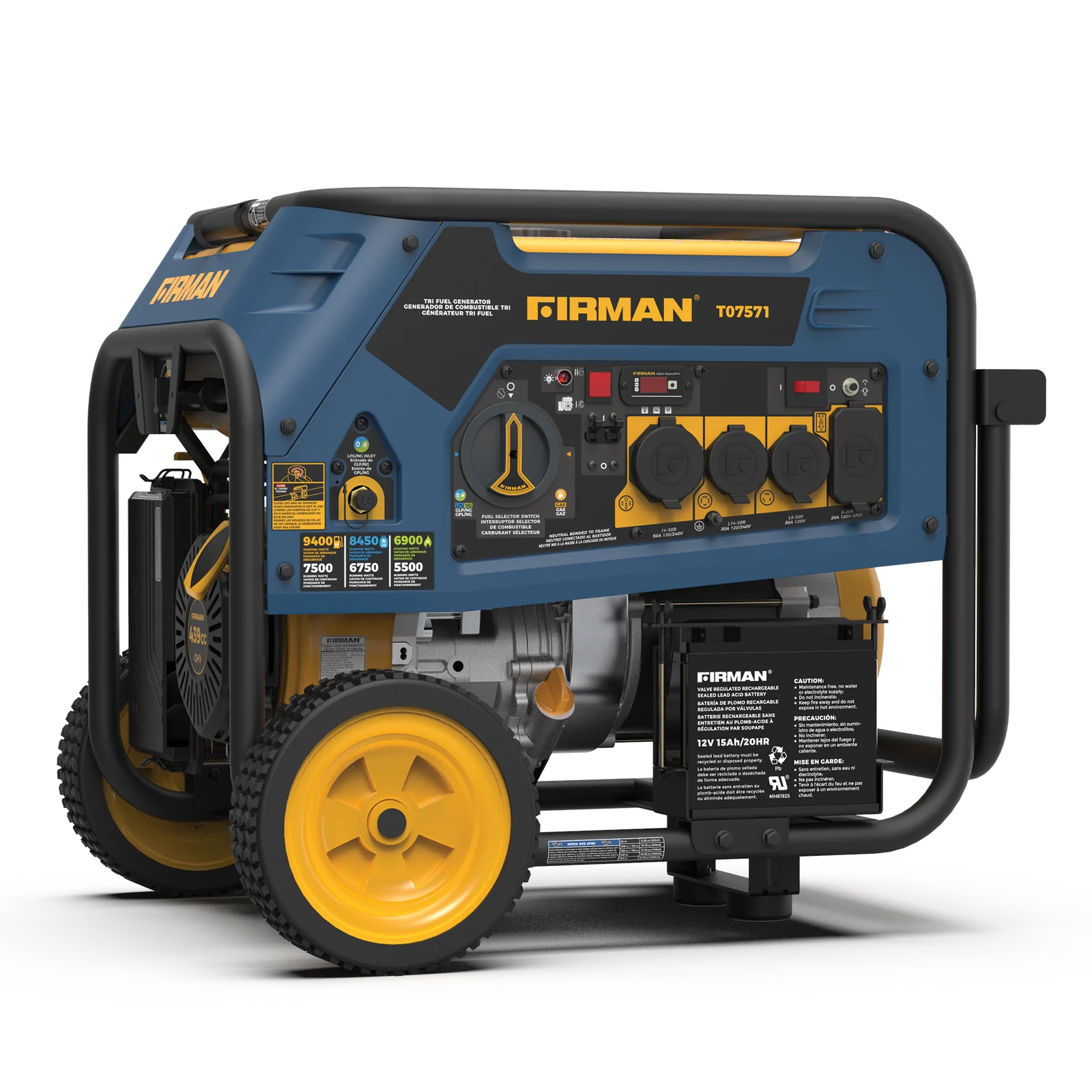
Firman T07571 Tri-Fuel
The Costco tri-fuel that made natural-gas backup a thousand-dollar proposition. The T07571 runs 7,500 watts on gasoline, 6,750 on propane, and 5,500 on natural gas, ships with both LP and NG hoses in the box, and has a 50-amp outlet — which is why r/Generator treats it as the default budget answer to 'I want to hook a portable to my gas meter.' Owners praise the honest hardware: electric start, 8-gallon tank, sturdy 213-lb frame, and a 3-year warranty that beats Predator's 90 days. The recurring complaints: Firman customer service is slow — weeks-long waits for warranty parts are the most common thread — NG output is a real 27% derate, it's a loud 74 dB open frame, and low NG line pressure causes surging just like every NG portable. Costco's return policy is frequently cited as the real warranty.
Generac
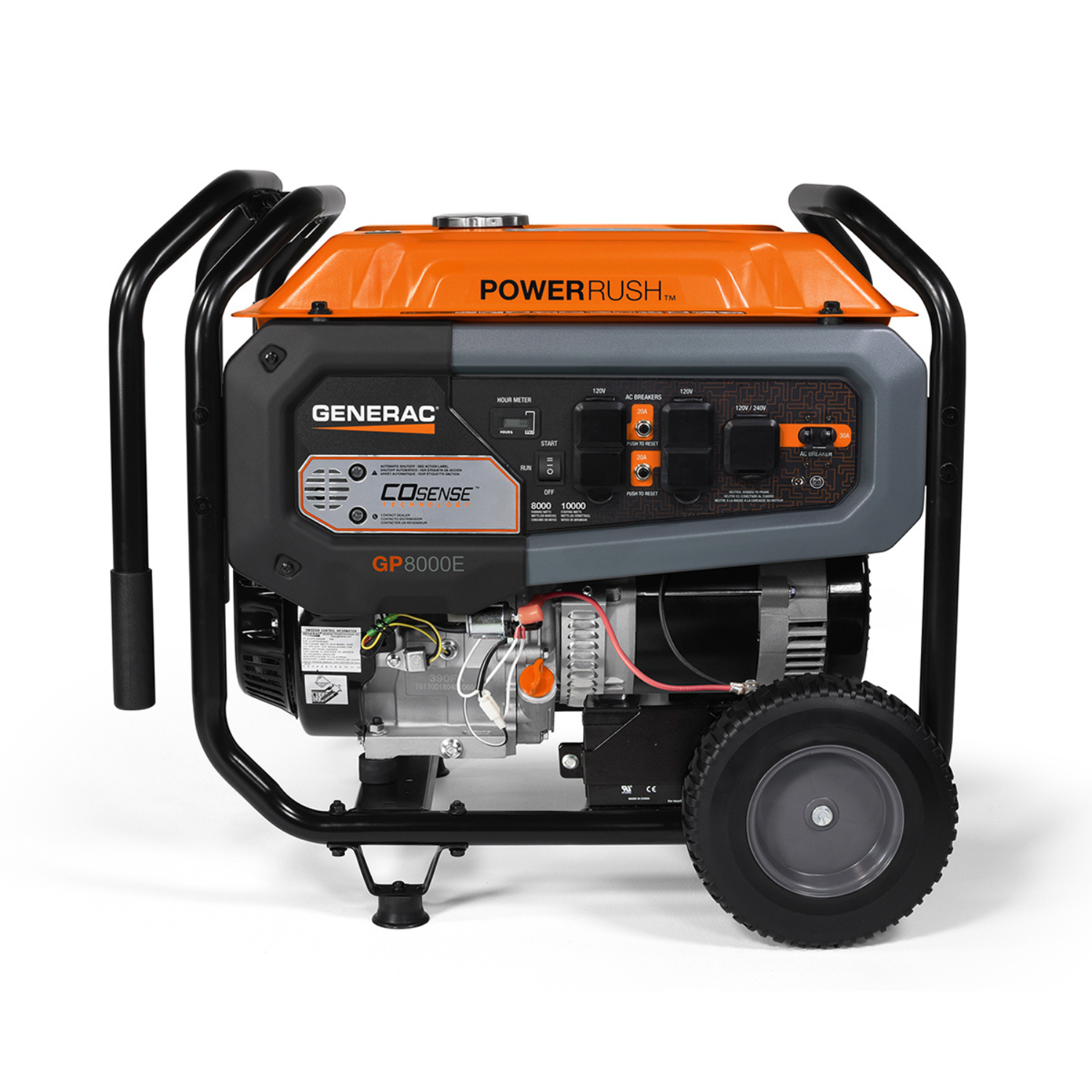
Generac GP8000E COsense
The big-box storm generator: when a hurricane is three days out, this is what's stacked on pallets at Home Depot, and that availability is genuinely part of its value. 8,000 running watts, 10,000 starting via PowerRush, electric start, COsense shutdown, and an L14-30R for interlock feeding — a complete storm kit under $1,000 from a brand every service shop knows. Owner reports are solid on power delivery: it carries fridges, window ACs, well pumps, and furnace blowers simultaneously. The honest ledger: it's an open-frame roarer (Generac publishes no dB figure; owners report it's loud), non-inverter power means owners keep sensitive electronics on a UPS, it's gasoline-only with a thirsty 420cc engine, and Generac portables were hit by recalls (2022 handle pinch; an April 2026 carburetor fuel-leak recall on certain GP units) — check your serial. Runs forever with oil changes, per multi-year owners.

Champion
Champion 76533 3800W Dual Fuel
One of the best-selling generators ever made, and the archetype of the 'good enough for everything' budget dual fuel. Electric start, RV-ready TT-30R outlet, propane capability out of the box, and nearly a decade of owner history at around $550 — the review count across Amazon and Walmart is enormous and consistently positive. Owners run travel trailers, job sites, and essential-circuit extension-cord backup, and the 224cc engine has a reputation for starting after years of neglect (on propane especially, since there's no carb to gum). Known quirks from the threads: it's a 68 dB droner that campground quiet hours won't love, output on propane drops about 10%, there's no 240V so interlock users look elsewhere, the fuel selector and petcock feel plasticky, and cold-weather propane starts sometimes need a second try. Champion's phone support gets rare-for-the-industry praise.