Can a Battery Replace a Gas Generator? The Honest Tradeoffs
It's the question all over r/Generator and r/preppers since LiFePO4 prices fell: why put up with engines, gas cans, and carbon monoxide at all? For a growing set of households the battery really is the better answer — but the physics of energy storage still draws a hard line, and it's worth knowing exactly where that line sits before you spend.
What batteries genuinely do better
Everything about the user experience. A power station is silent — 30 dB of fan noise versus 60-70 dB of engine. It's instant: press a button (or nothing at all, with a UPS mode) instead of hauling a machine outside in the rain and yanking a cord. It's indoor-safe, which means no carbon monoxide risk, no extension cords pinched in window sashes, and backup power that works in an apartment. And it's maintenance-free: no oil changes, no carburetors gummed by stale fuel, no monthly test runs. A LiFePO4 unit rated for 3,000-4,000 cycles will sit at 100 percent charge for years and still work the night you need it.
Batteries also do something generators can't: they time-shift. Charge from solar or cheap overnight rates, run the expensive hours, and the same box that covers outages quietly trims your bill or powers a campsite. A generator only ever does one job.
The energy math nobody prints on the box
Here's the uncomfortable arithmetic. A gallon of gasoline contains about 33 kWh of thermal energy; after a small generator's inefficiency you net roughly 4-6 kWh of electricity per gallon. That means a five-gallon jerry can — $20 of fuel — carries about as much usable electricity as $6,000-$8,000 worth of lithium battery. A 4,096Wh flagship power station stores what a 2kW inverter generator produces on about one gallon.
For an outage measured in hours, that gap doesn't matter; 4kWh runs a fridge, lights, internet, and a CPAP overnight with room to spare. For an outage measured in days, it's everything. The generator owner walks to the shed for another gallon; the battery owner watches a percentage tick down and starts triaging loads.
Where batteries still lose
Sustained heavy loads are the clearest case. Electric heat, a central A/C, a well pump cycling all day — loads in the multi-kilowatt range drain even a 12kWh expanded system in hours. Running a 3,500W central air conditioner from a 4kWh battery gives you roughly one hour of cooling. Nobody sizes batteries for that; they size generators for it.
The recharge problem is the second. When a generator runs dry you refill it in ninety seconds. When a battery runs flat mid-outage, the grid that normally refills it is the thing that's broken. Your options are solar (weather-dependent, slow through storm clouds), a car inverter (slow), or a gas generator — at which point you own both machines anyway.
And dollars-per-watt still favor engines by a wide margin: $500 of dual-fuel portable generator delivers more sustained power than $3,000 of battery. If your budget is tight and your outages are long, the engine is still the rational buy.
Solar changes the equation — slowly
Add enough solar input and a battery stops being a bucket and becomes a system: 800-1,600W of panels can put 3-8 kWh back into the box on a decent day, which genuinely covers fridge-and-essentials indefinitely. But be honest about the assumptions — that's panels you've actually deployed and aimed, in weather that cooperates, in daylight hours. The storm that caused your outage is often the same one parked over your panels. Solar makes a battery a legitimate multi-day solution for small loads; it does not make it a generator.
The hybrid setup most people actually want
The strongest answer for most homes isn't either/or — it's a small inverter generator plus a mid-size power station, bought together for less than a big standby install. The battery handles the first hours silently (and every short blip without any setup), runs the bedroom overnight with zero noise, and lives indoors. If the outage stretches, the generator comes out in the morning, recharges the battery at its efficient full-load sweet spot in an hour or two, then shuts off. You burn a fraction of the fuel of running the engine continuously, your nights are silent, and each machine covers the other's weakness.
The honest answer
Can a battery replace a gas generator? For short outages, small loads, apartments, and anyone who values silence and zero maintenance over raw endurance: yes, genuinely — buy the battery and never think about carburetors again. For multi-day outages, well pumps, electric heat, or whole-home coverage: no, not yet; the energy density and recharge economics aren't there. For everyone in between, the battery-plus-small-generator hybrid quietly beats both pure answers, and it's what an awful lot of the enthusiasts who've lived through real outages end up running.
Units mentioned in this guide
EcoFlow
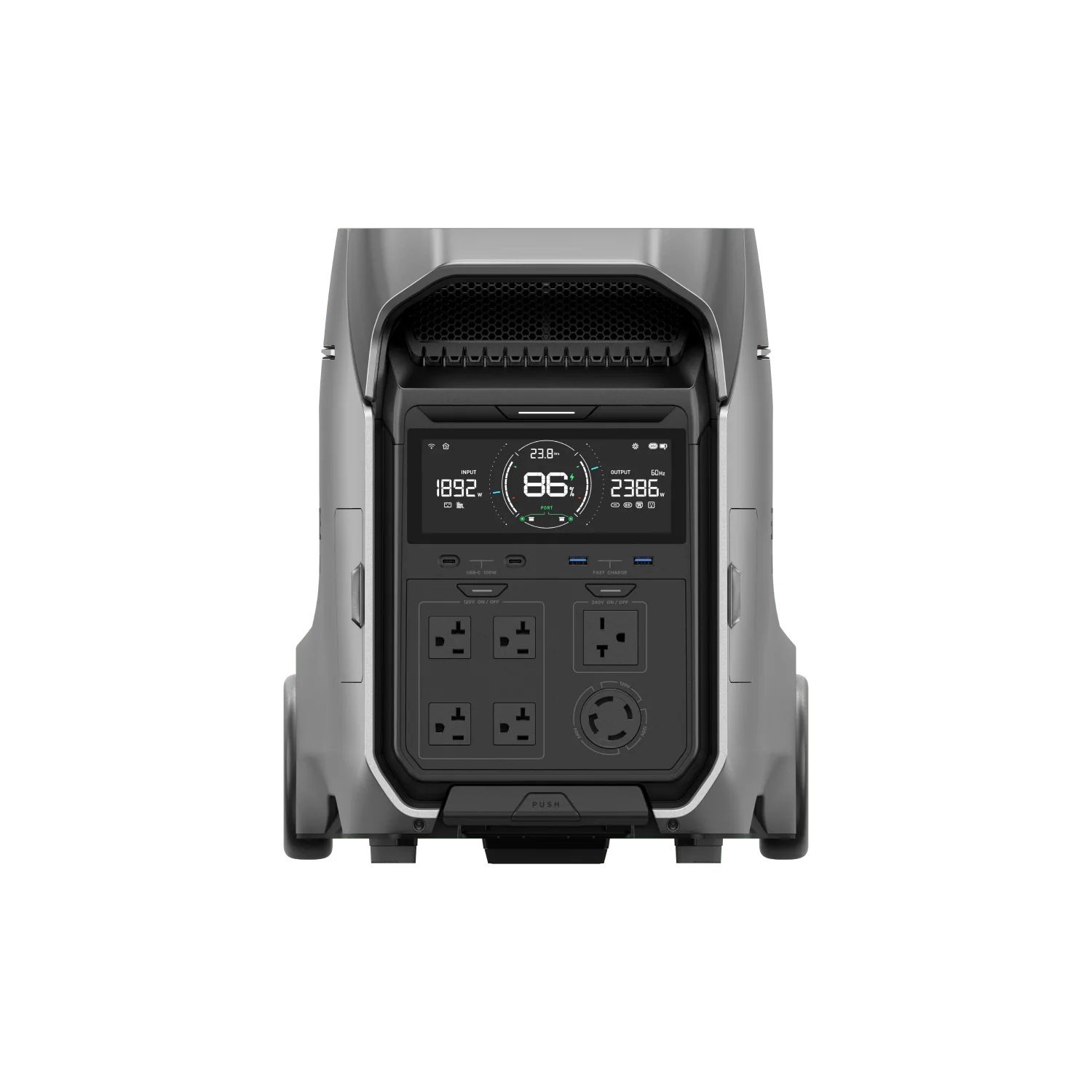
EcoFlow DELTA Pro 3
The single most-recommended whole-home-capable unit that still rolls on wheels. What sells it: 4000W with real 120/240V split-phase from one box, so it backfeeds a transfer switch and runs a well pump or mini-split without pairing two units. Owners consistently praise how quiet it stays at partial load (30dB claimed) and the 10ms UPS. The recurring complaint thread is idle drain - leaving AC output on burns tens of watts, so a 4kWh charge quietly evaporates over days if you use it as a dumb UPS without tweaking settings. It is 113 lbs; the wheels and handle work on pavement, not stairs. A few owners report warranty friction outside the mainland US, and early-firmware horror stories still circulate on Reddit, so update before first use. Street price has fallen from $3,699 to low-$2,000s, which changed the calculus versus F3800 Plus.

Honda
Honda EU2200i
The default answer to 'which small generator should I buy' for going on two decades. The EU2200i's GXR120 engine, 47-lb carry weight, and 48-57 dB voice-level noise make it the campground and tailgate standard, and the current version adds Bluetooth monitoring, CO-MINDER shutdown, and a fuel shutoff valve so you can run the carb dry before storage — a direct response to the gummed-carburetor complaints that dominate owner threads for every small generator, Honda included. Owners justify the price with resale value (used units hold 70%+ of MSRP) and start-on-second-pull reliability years in. The honest knocks: it's double the cost of credible clones, 1,800 running watts won't touch most RV air conditioners without a parallel second unit, there's no fuel gauge, and the early-generation recall history (2018-19 fire risk) still comes up in threads.