Generator Safety: CO, Transfer Switches, and Backfeeding
Generators are involved in more storm-related deaths in the US than the storms themselves, and nearly all of those deaths follow one of two mistakes: running the engine somewhere its exhaust can reach people, or connecting it to the house in a way that was never safe. Both are completely preventable. This is the guide we wish came stapled to every generator box.
Carbon monoxide is the thing that kills people
A portable generator produces as much carbon monoxide as hundreds of idling cars. CO is colorless, odorless, and it doesn't warn you — it makes you sleepy, then it kills you, which is why so many victims are found in bed. The CPSC attributes roughly 80-100 deaths a year to generator CO, spiking after every major hurricane and ice storm, and 'we only ran it in the garage with the door open' appears in those reports over and over. There is no safe amount of enclosed or semi-enclosed generator operation. None.
Two layers of protection are non-negotiable: battery-powered CO alarms on every sleeping level of the house, and — if you're buying a new generator — a model with an automatic CO shutoff (Honda's CO-Minder, Generac's CO-Sense, or the 'PGMA G300' certification on the box). The sensor is a backstop, not a license to bend the placement rules.
The placement rules
Run the generator outdoors only, at least 20 feet from the house, with the exhaust pointed away from windows, doors, and vents — and away from your neighbor's, too. Not in the garage (open door or not), not on the porch, not on a balcony, not in a shed, not under an open window, not in a window well. Wind pools exhaust against walls and pulls it through soffits and gaps you can't see, which is why the distance rule exists even for 'outside' spots that feel safe.
Rain is the objection everyone raises against the 20-foot rule. The answer is a generator tent or canopy (purpose-built, ventilated, ~$50-$150) or a simple elevated cover — never a closed structure. A wet extension cord is a solvable problem; a running engine near the house is not.
Never plug a generator into a wall outlet
The infamous 'suicide cord' — male plugs on both ends, generator into a wall outlet or dryer outlet — energizes your house by feeding a branch circuit backwards. It is illegal essentially everywhere, and the name is not a joke. With the main breaker still closed, your generator's output also flows backwards out of the house and into the utility transformer, which steps your 240 volts up to thousands of volts on the street lines. The lineman working to restore your power is now handling a line he verified dead from the substation side, energized by your generator.
Backfeeding also skips every protection your panel normally provides: no breaker sized for the cord, both conductors hot at the male plug the moment it slips out of the wall, and when the grid comes back, out-of-phase utility power meets your generator head-on — the best case is a destroyed generator, the worst is a fire. There is no careful way to do this. The entire category of 'I always flip the main first' folklore fails the first time someone forgets once.
Transfer switches and interlocks: the right way to power your house
A transfer switch is a small panel wired beside your main panel that physically disconnects your house (or a set of chosen circuits) from the grid before connecting the generator — making backfeed mechanically impossible. Manual transfer switches for 6-10 circuits run $300-$500 plus a few hours of electrician time; you plug the generator into an outdoor inlet box, flip the switch, and your furnace, well pump, and kitchen run off their normal wiring. No cords through windows.
An interlock kit is the budget version of the same guarantee: a sliding metal plate on your main panel that makes it physically impossible to close the generator breaker until the main breaker is open. Panel-specific, code-listed kits cost $50-$150 plus a generator inlet and breaker — for most homes it's the best safety-per-dollar upgrade in this entire hobby. Standby generators bake this in with an automatic transfer switch, which is a large part of what their installed price buys. Whichever route you take: permits and a licensed electrician are not bureaucracy here, they're the mechanism that catches the mistake you can't see.
Cords, rain, and refueling
Extension cords cause their own quiet failures. Use outdoor-rated cords sized to the load — 12-gauge or heavier for anything serious — and short runs; a long thin cord drops voltage, which burns out motor appliances trying to start. Check that cords aren't pinched by window sashes or doors, protect connections from standing water, and use the generator's GFCI outlets where fitted.
Refueling is the other routine that goes wrong: gasoline on a hot muffler ignites. Shut the generator down and let it cool for 15-20 minutes before refueling — plan fuel stops around meals so the wait doesn't hurt. Store fuel in proper containers, outside living spaces, with stabilizer if it sits more than a month; stale fuel is the number-one reason generators fail to start the night they're needed. Run the carburetor dry before long storage, and test-run the machine under load for ten minutes every month or two — a generator that hasn't run since last winter is a hypothesis, not a plan.
The five-minute safety checklist
Before the storm: CO alarms tested, generator test-run under load, fuel fresh and stabilized, heavy outdoor cords staged, canopy ready, interlock or transfer switch installed — or an honest plan that uses cords only. During the outage: generator 20+ feet out with exhaust pointed away, cool before every refuel, loads within rating, nobody sleeping until the CO alarms are confirmed live. And the one rule that covers half of everything on this page: the generator connects to the house through a transfer switch, an interlock, or individual extension cords — never, under any circumstances, through a wall outlet.
Units mentioned in this guide
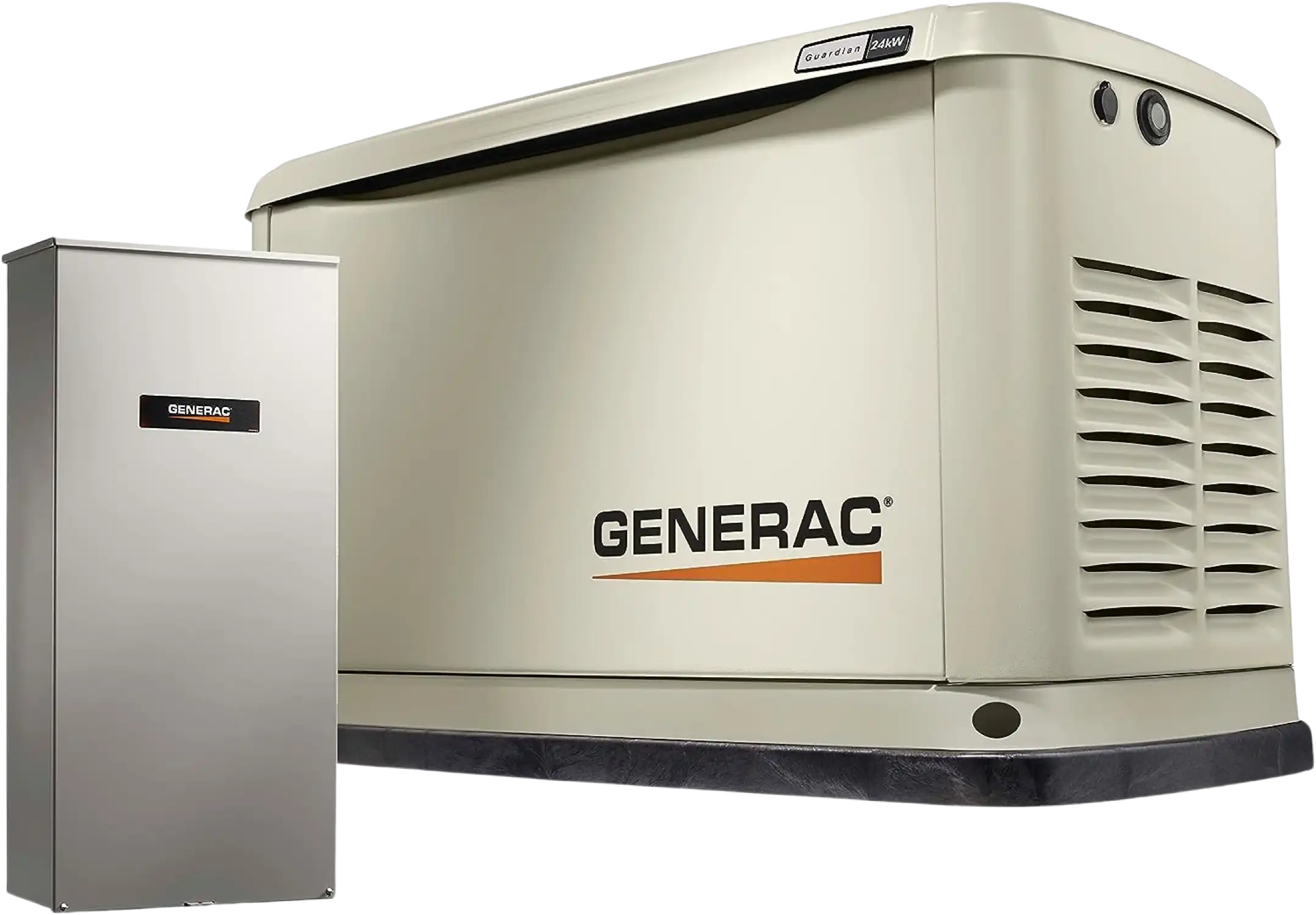
Generac
Generac Guardian 24kW
Generac's current volume flagship: 24kW on propane and 21kW on natural gas from the G-Force 1000 platform, bundled here with a 200-amp service-entrance transfer switch with PWRview energy monitoring. It's pitched as the 22kW's replacement, squeezing 2.6x the power of the baseline air-cooled units from the same-size enclosure, and owners like that it fits the same pad footprint. Real-world reports are strong — seamless transfers, two-AC homes handled with smart load modules — with noise at 67 dB under load and a much quieter 57 dB Quiet-Test. The complaints are familiar: owners report Wi-Fi Mobile Link dropouts, controller boards replaced under warranty, and dealer-network variability that makes your installer choice as important as the machine. Ships as a complete package, which simplifies quotes compared to the à-la-carte SKUs.

Honda
Honda EU2200i
The default answer to 'which small generator should I buy' for going on two decades. The EU2200i's GXR120 engine, 47-lb carry weight, and 48-57 dB voice-level noise make it the campground and tailgate standard, and the current version adds Bluetooth monitoring, CO-MINDER shutdown, and a fuel shutoff valve so you can run the carb dry before storage — a direct response to the gummed-carburetor complaints that dominate owner threads for every small generator, Honda included. Owners justify the price with resale value (used units hold 70%+ of MSRP) and start-on-second-pull reliability years in. The honest knocks: it's double the cost of credible clones, 1,800 running watts won't touch most RV air conditioners without a parallel second unit, there's no fuel gauge, and the early-generation recall history (2018-19 fire risk) still comes up in threads.