The Outage Week Playbook: Fuel, Rain, Run Shifts, and the Hardwired Loads
Buying the generator is the easy half. The week the grid is actually down runs on logistics: how much fuel you really have, what happens when it rains on day two, whether to run around the clock or in shifts, and the discovery that your furnace and well pump don't have plugs. Here's the playbook the manual assumes you already know, tuned for hurricane season because that's when everyone learns it.
Fuel math and the stale-gas problem
Start with the burn rate nobody calculates until day two: a mid-size portable under real load drinks 8-15 gallons of gasoline per day running continuously — a weeklong outage is a 60-100 gallon problem, and the gas stations are down too (no power, no pumps). The practical storage target from hurricane-country consensus: 15-25 gallons in proper cans, which covers three to five days of run-in-shifts operation (below), refreshed through your car's tank so it never sits long enough to matter. Ethanol gasoline starts degrading in weeks and gums carburetors in months; stabilizer (PRI-G, Sta-Bil) honestly extends that to a year-plus, and ethanol-free gas plus stabilizer is the two-year shelf answer for the set-and-forget crowd.
The deeper fix is stepping off gasoline entirely: propane stores indefinitely — the 20-lb grill cylinders in your shed right now are pre-staged outage fuel with zero maintenance — and dual-fuel or tri-fuel generators turn that shelf stability into the whole strategy. The tradeoffs are honest and small: roughly 10% less output on propane and cylinders that hate deep cold, against fuel that is literally incapable of going stale and never touches your carburetor. For anyone who runs a generator twice a year, propane-primary with gasoline as the surge fuel is the configuration the maintenance section of every forum quietly converges on. Natural-gas tri-fuel goes one further — unlimited runtime from the house meter — with the caveat that the same storm that drops your power occasionally interrupts gas service too.
Rain: the generator can handle weather, the outlets can't
Hurricanes deliver outages and rain in the same box, so this question is a when, not an if. The engine itself shrugs at drizzle; the danger is water in the outlets and connections — GFCI trips at best, shock hazard at worst. The answer is cover without enclosure: a purpose-built generator tent (GenTent-style canopies clamp to the frame, $150-ish, engineered for this exact job), a canopy or tarp rigged high enough to breathe, or an open-sided structure like a carport. What the cover must never do is trap exhaust or heat — a generator in a closed box is a CO factory and an overheating engine, which rules out the improvised dog-house enclosure unless it's built with real intake and exhaust openings per the many tested designs online. Position the outlets and cord connections on the leeward side, get cords' plug junctions off the wet ground (a plastic tote with cord notches is the redneck-engineering standard), and the setup runs through a tropical storm without drama.
Run in shifts: the strategy that halves your fuel
The refrigerator that drives the whole outage panic only needs power a fraction of the day: a modern fridge holds safe temperatures for 4+ hours unopened, a full freezer for 24-48. The shift strategy — run the generator 2-3 hours in the morning and 2-3 in the evening, fridge and freezer cold-soaked each cycle, everything charged, water pumped if you're on a well — cuts fuel burn 50-70% against around-the-clock running, halves the hours you're making noise at the neighbors, and doubles the life of your stored fuel. Tape the fridge shut between shifts if the household needs the reminder, drop a $10 thermometer inside to replace anxiety with data, and freeze water jugs during run windows to turn the freezer into an icebox between them. Around-the-clock running earns its fuel bill in three cases: medical equipment, brutal heat where the AC or fans are the mission, and sump pumps in an actively flooding storm.
The quiet upgrade to the shift strategy is a mid-size power station bridging the gaps: the generator's run windows recharge it, and it silently carries the router, phones, CPAP, and a fan overnight — no 3 a.m. refueling, no overnight noise complaint, and the generator works at efficient load while it runs instead of idling at 10% for a wifi router. This generator-plus-battery pattern is where the whole portable-power market has been heading, and it's the honest answer to most 'which do I buy' threads: eventually, both — the battery for the quiet 90% of loads, the engine for the heavy lifting.
Cords, and the loads that don't have plugs
Extension-cord truth in one paragraph: the orange 16-gauge cord from the garage is fine for a lamp and dangerous under a refrigerator's load across 50 feet — undersized cords drop voltage, and low voltage is what actually kills compressor motors during outages. The rule: 12-gauge minimum for anything with a motor, 10-gauge past 50 feet, as few cords as possible doing as little distance as possible. Buy two good cords before the storm; they sell out with the generators.
Then the day-two discovery: the furnace blower, the well pump, and the water heater are hardwired — no plug, no cord solution. The furnace blower is the classic (a gas furnace needs only a few hundred watts to run its fan and controls, but it's wired into the wall), and the legitimate answers are an interlock or transfer switch feeding the panel (the real fix, covered in our safety guide) or an electrician-installed furnace plug transfer device that converts the furnace to a cord-and-plug appliance for exactly this purpose. The well pump raises the stakes: typically 240V and a hard-starting motor, it needs the panel-level connection AND a generator with real 240V output and starting headroom — this single load is why rural buyers should size and shop differently (our sizing guide covers the math). What is never the answer, for the furnace, the well, or anything else, is the double-male 'suicide cord' into a dryer outlet — the safety guide explains why it can kill a lineman down the street, and there is no outage bad enough to make it reasonable.
Units mentioned in this guide

The unicorn spec r/Generator kept asking for: tri-fuel AND inverter in one machine. Hook the 201176 to your natural-gas line for unlimited runtime, and unlike every conventional tri-fuel, it feeds your house clean sub-3% THD power that's safe for furnace boards, UPSs, and electronics — through a 50-amp outlet. On gasoline it makes 7,250 running watts; NG drops it to 5,875, still enough for most homes' essentials plus a small AC. It's an open-frame design, so the 72 dBA rating is real and load-dependent — quieter than a WGen9500DF, louder than closed-case inverters. Owner threads note the winning math (it replaced separate 'quiet' and 'NG' generators for many), with the familiar caveats: NG line pressure matters, the 420cc engine drinks on gasoline at full tilt, electric-start battery upkeep, and Champion's included NG/LP hoses are short. CO Shield included.

DuroMax
DuroMax XP13000EH
The 'Beast': 13,000 starting watts, a 500cc V-twin, all-metal construction, and a 50-amp outlet for around $1,300 makes this the biggest-hammer option in portable backup. Owners with heat pumps and well pumps buy it specifically because the MX2 switch lets you dedicate full power to 120V or split 120/240V, and thousands of reviews confirm it starts loads that stall 8kW units. DuroMax support actually gets better marks than Westinghouse's in forum comparisons. What the fans concede: it's LOUD (mid-to-high 70s dB real world), 234 lbs of steel, drinks propane fast (about 3 hours on a grill tank), and its non-inverter power has high enough THD that owners with sensitive electronics run a UPS or interlock only non-critical circuits. Fit-and-finish complaints — sticky chokes, cheap petcocks — appear but are usually solved with basic wrenching.
EcoFlow
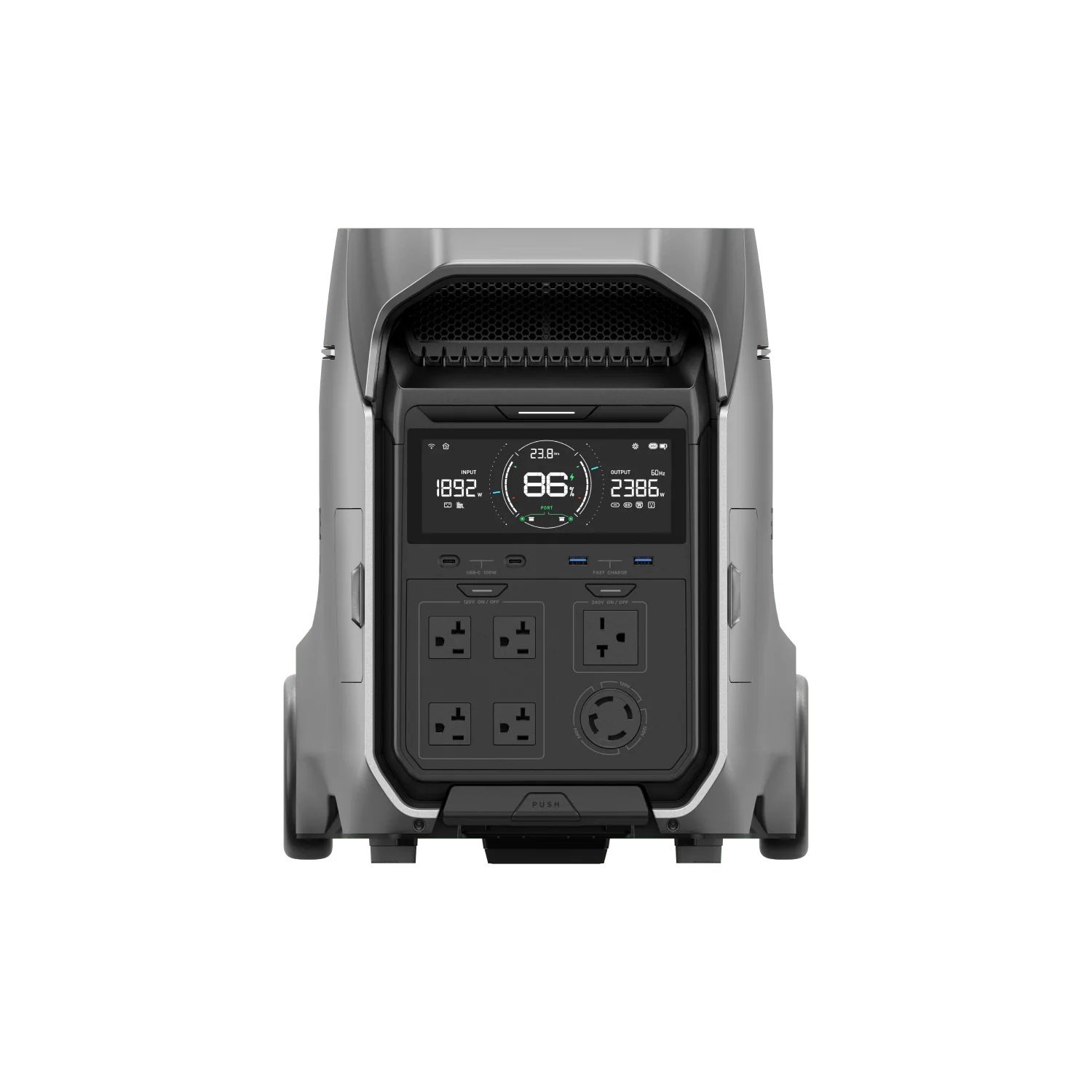
EcoFlow DELTA Pro 3
The single most-recommended whole-home-capable unit that still rolls on wheels. What sells it: 4000W with real 120/240V split-phase from one box, so it backfeeds a transfer switch and runs a well pump or mini-split without pairing two units. Owners consistently praise how quiet it stays at partial load (30dB claimed) and the 10ms UPS. The recurring complaint thread is idle drain - leaving AC output on burns tens of watts, so a 4kWh charge quietly evaporates over days if you use it as a dumb UPS without tweaking settings. It is 113 lbs; the wheels and handle work on pavement, not stairs. A few owners report warranty friction outside the mainland US, and early-firmware horror stories still circulate on Reddit, so update before first use. Street price has fallen from $3,699 to low-$2,000s, which changed the calculus versus F3800 Plus.