Standby vs Portable vs Battery: Which Type of Backup Power Do You Need?
Backup power comes in three fundamentally different flavors, and picking the wrong one is the most expensive mistake in this hobby. The right answer depends less on specs than on what your outages actually look like: how long they last, what you genuinely need to keep running, and whether anyone will be home to start a machine.
The three flavors of backup power
A home standby generator is a permanently installed appliance — think of a big air-conditioner cabinet beside your house — wired into your electrical panel through an automatic transfer switch and plumbed into natural gas or a propane tank. When the grid drops, it starts itself and picks up the whole house in ten to thirty seconds, whether you're home or on vacation.
A portable generator is an engine on a frame that you roll out, fuel up, and start when the power dies. It makes the most watts per dollar of anything on this page, and the inverter subtype adds clean, electronics-safe power and dramatically lower noise. The tradeoff is that everything is manual: you store the fuel, you start it, you run the cords, and it lives outside — always outside — while running.
A power station (and its permanently installed cousin, the home battery) is a big lithium battery with outlets. No engine, no fuel, no exhaust, no noise. It works indoors, starts instantly, and doubles as everyday gear for camping or job sites. Its weakness is written right on the label: a battery stores energy rather than making it, so when the watt-hours run out, you need the grid, the sun, or a generator to refill it.
Home standby: power you never think about
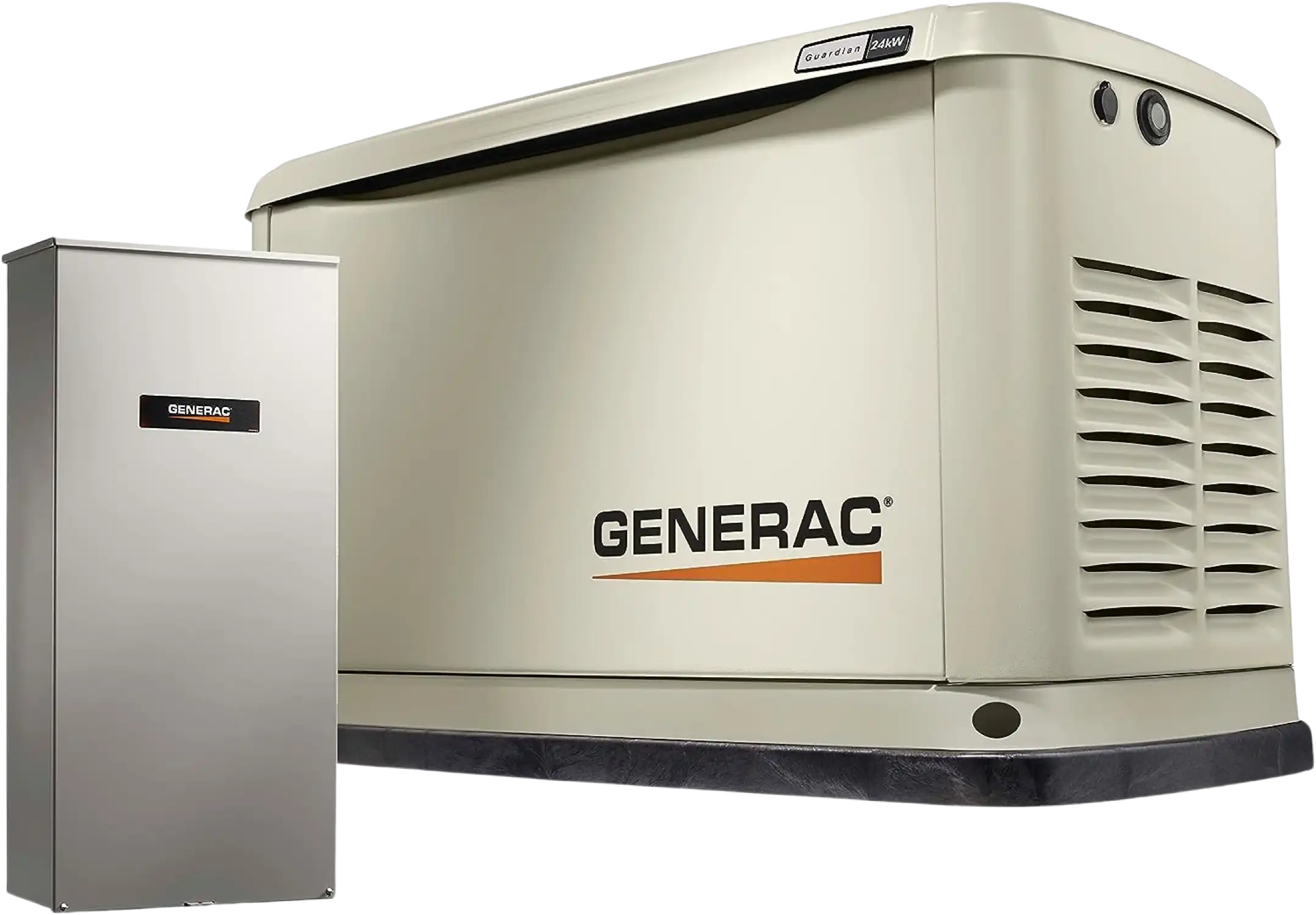
Standby units like the Generac Guardian series are the set-and-forget answer. They self-test weekly, run on fuel you don't store, and carry heavy loads — a 24kW unit will run most homes including central air without anyone lifting a finger. If outages in your area last days rather than hours, or if the people at home during an outage can't wrestle a 200-lb machine and a can of gasoline, this is the category to price out.
The catch is the check you write. The machine is only half the cost — installation (concrete pad, gas line, transfer switch, permits) typically doubles it, and a whole-home install commonly lands between $11,000 and $16,000 all-in. Add annual oil-and-filter maintenance, because it's an engine. You're buying an outcome — the lights just stay on — and outcomes cost more than hardware.
Portable and inverter generators: the most watts per dollar
For a few hundred to a couple thousand dollars, a portable generator delivers more usable power than anything else. A $500 open-frame unit runs a fridge, freezer, furnace blower, and lights. A $1,100 inverter like the Honda EU2200i does the essentials almost silently, with power clean enough for laptops and CPAP machines. Pair a portable with a $500-$1,000 interlock or transfer-switch install and you can safely feed your actual house circuits instead of running extension cords through windows.
The honest downsides: someone has to be home to set it up, gasoline goes stale and is the first thing to vanish before a storm, and an engine running in the wrong place can kill you — carbon monoxide from portable generators kills more people than the storms that caused the outage. Dual-fuel models that also burn propane solve the stale-gas problem, and modern CO-shutoff sensors help, but this category demands respect and a long extension cord.
Power stations and home batteries: silent, indoor, instant
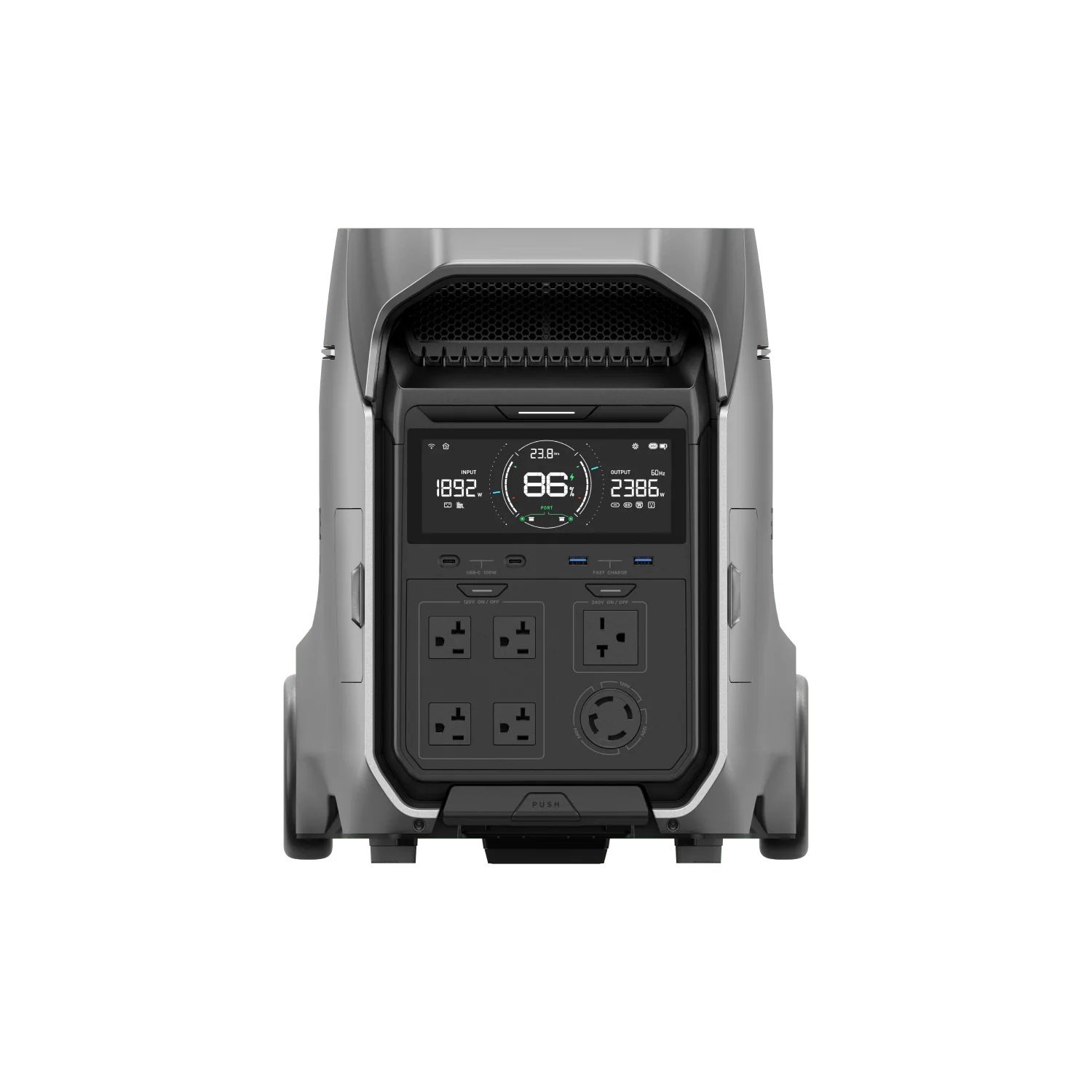
Batteries flipped the backup-power conversation in the last few years. A unit like the EcoFlow Delta Pro 3 sits in a closet fully charged, and during an outage it runs the fridge, internet, lights, and a fan from inside your living room — no cords out the window, no engine noise at 2 a.m., no CO detector anxiety. For apartments and condos, where running any engine is a non-starter, batteries aren't just the best option; they're the only one.
The limitation is capacity. Four kilowatt-hours is roughly what a small generator produces on a single gallon of gasoline, and a battery that size costs ten times as much as that generator. Batteries are superb for outages measured in hours and for keeping low-draw essentials alive for a day or two. For heavy loads over multiple days, you'll need expansion batteries, serious solar input, or — more practically — a small generator to recharge the battery in the morning.
Match the machine to your outages
Short, rare outages (a few hours, a few times a year): a power station wins. Zero maintenance, zero fuel storage, instant power, and it earns its keep on camping trips between outages.
Regular multi-hour outages with warning (storm country): a portable inverter generator plus an interlock is the value pick. You get real wattage, indefinite runtime on stored fuel, and safe connection to house circuits for a fraction of a standby install.
Multi-day outages, medical equipment, well pumps, sump pumps, or a house that must not go dark when nobody's home: this is standby-generator territory. Nothing else starts itself at 3 a.m. and runs for a week on the gas line.
No outdoor space at all: battery. Full stop — never run any engine indoors, in a garage, or on a balcony.
The bottom line
Most homeowners are best served from the middle: a quality inverter generator sized to their real loads, connected through a proper interlock, with fresh-ish fuel in the shed. Add a mid-size power station if silent overnight power or indoor use matters to you — the generator-charges-battery combo covers nearly every outage scenario for a quarter the price of a standby install. Reserve the standby generator for long outages, critical loads, and homes that need to protect themselves. Whatever you choose, size it with our wattage guide before you spend a dollar.
Units mentioned in this guide
Generac
Generac Guardian 24kW
Generac's current volume flagship: 24kW on propane and 21kW on natural gas from the G-Force 1000 platform, bundled here with a 200-amp service-entrance transfer switch with PWRview energy monitoring. It's pitched as the 22kW's replacement, squeezing 2.6x the power of the baseline air-cooled units from the same-size enclosure, and owners like that it fits the same pad footprint. Real-world reports are strong — seamless transfers, two-AC homes handled with smart load modules — with noise at 67 dB under load and a much quieter 57 dB Quiet-Test. The complaints are familiar: owners report Wi-Fi Mobile Link dropouts, controller boards replaced under warranty, and dealer-network variability that makes your installer choice as important as the machine. Ships as a complete package, which simplifies quotes compared to the à-la-carte SKUs.

Honda
Honda EU2200i
The default answer to 'which small generator should I buy' for going on two decades. The EU2200i's GXR120 engine, 47-lb carry weight, and 48-57 dB voice-level noise make it the campground and tailgate standard, and the current version adds Bluetooth monitoring, CO-MINDER shutdown, and a fuel shutoff valve so you can run the carb dry before storage — a direct response to the gummed-carburetor complaints that dominate owner threads for every small generator, Honda included. Owners justify the price with resale value (used units hold 70%+ of MSRP) and start-on-second-pull reliability years in. The honest knocks: it's double the cost of credible clones, 1,800 running watts won't touch most RV air conditioners without a parallel second unit, there's no fuel gauge, and the early-generation recall history (2018-19 fire risk) still comes up in threads.
EcoFlow
EcoFlow DELTA Pro 3
The single most-recommended whole-home-capable unit that still rolls on wheels. What sells it: 4000W with real 120/240V split-phase from one box, so it backfeeds a transfer switch and runs a well pump or mini-split without pairing two units. Owners consistently praise how quiet it stays at partial load (30dB claimed) and the 10ms UPS. The recurring complaint thread is idle drain - leaving AC output on burns tens of watts, so a 4kWh charge quietly evaporates over days if you use it as a dumb UPS without tweaking settings. It is 113 lbs; the wheels and handle work on pavement, not stairs. A few owners report warranty friction outside the mainland US, and early-firmware horror stories still circulate on Reddit, so update before first use. Street price has fallen from $3,699 to low-$2,000s, which changed the calculus versus F3800 Plus.