What Size Generator Do I Need? A Wattage Sizing Walkthrough
Generator sizing looks like a physics exam from the outside, but it reduces to two additions: add up the running watts of everything you want on at the same time, then add the single biggest starting surge on top. Get those two numbers and the right generator class falls out automatically.
Running watts vs starting watts — the number that trips everyone up
Every generator wears two numbers: running (rated) watts it can supply continuously, and starting (surge) watts it can deliver for a few seconds. Appliances have the same split. Anything with a motor or compressor — fridge, sump pump, well pump, A/C — draws two to four times its running wattage for the second or two it takes the motor to spin up. Resistive loads like lights, space heaters, and electronics draw the same watts starting and running.
This is why a '2,200-watt' generator can run a 700-watt fridge with room to spare but stall trying to start a 1,200-watt well pump: the pump wants 4,000 watts for the first second. Size for the surge, not just the steady state, and you'll never be surprised.
Step 1: list what actually has to stay on
Skip the fantasy of powering the whole house and write down what an outage actually threatens. For most homes the real list is short: refrigerator, freezer, some lights, phone and laptop charging, internet, and the furnace blower in winter or a window A/C in summer. Households on a well or with a basement add the well pump and sump pump — usually the two biggest surges on the list. Everything else (dishwasher, dryer, oven) can wait a few hours.
Check the nameplate sticker on anything you're unsure about — it lists watts, or amps you can multiply by 120 volts. Where the nameplate only gives running amps, assume motors surge two to three times higher.
What common appliances really draw
| Appliance | Running watts | Starting watts |
|---|---|---|
| Refrigerator / freezer | 200 | 1,200 |
| Sump pump (1/2 HP) | 1,050 | 2,200 |
| Well pump (1 HP) | 2,000 | 4,000 |
| Furnace blower (gas heat) | 800 | 2,350 |
| Window A/C (10,000 BTU) | 1,200 | 3,600 |
| Central A/C (3-ton) | 3,500 | 9,000 |
| Space heater | 1,500 | 1,500 |
| Microwave | 1,000 | 1,000 |
| Electric water heater | 4,500 | 4,500 |
| Lights + phone/laptop charging | 150 | 150 |
| Wi-Fi router + modem | 20 | 20 |
| CPAP machine | 60 | 60 |
| TV | 100 | 100 |
These are typical figures — your nameplate wins any disagreement. Notice the pattern: electronics are rounding errors, resistive heat is a steady hog, and motors are cheap to run but expensive to start.
Step 2: do the math (it's two additions)
First addition: sum the running watts of everything on your must-run list — that's the continuous load your generator carries all day. Second addition: find the single item with the largest gap between its starting and running watts, and add that gap on top. Motors don't all start at the same instant (and you can stagger big ones by a few seconds yourself), so you only budget surge for the worst one.
Then add 20 percent headroom. Generators are happiest — quietest, most fuel-efficient, longest-lived — loaded to 50-80 percent of rating, and you'll inevitably plug in one thing you forgot.
A worked example
A winter outage kit: refrigerator (200W running), gas furnace blower (800W), sump pump (1,050W), lights and charging (150W), internet (20W). Running total: 2,220 watts.
Largest surge gap: the furnace blower needs 2,350W to start — 1,550W above its running draw (the sump pump's gap is 1,150W, so the furnace wins). Peak requirement: 2,220 + 1,550 = 3,770 watts.
With 20 percent headroom you're shopping for roughly 4,500 starting watts — a midsize 3,500-4,000 running-watt inverter generator, not the 2,200W suitcase and not a 10kW monster. That one calculation just saved you either a stalled generator or a thousand wasted dollars.
What each generator class actually runs
2,000-2,400W inverter (the Honda EU2200i class): fridge, lights, internet, charging, CPAP, a fan or small microwave — the essentials, quietly. Not enough to start a well pump or any A/C bigger than a small window unit.
3,500-5,000W: the sweet spot for most storm kits. Everything above plus the furnace blower, sump pump, and a window A/C, with surge to spare.
7,500-12,000W: adds a well pump, a small central A/C (with a soft-starter), or an electric water heater — this is 'the house mostly works' territory, usually fed through a transfer switch or interlock.
18-26kW standby: the whole house, automatically, including central air — no load list required, which is exactly what you're paying for.
Why bigger isn't better
An oversized generator burns meaningfully more fuel at idle loads, runs louder, costs more to buy and maintain, and — for open-frame units — can even carbon-foul running long hours at 10 percent load. Fuel is the real constraint in a long outage: a right-sized 4,000W unit sipping half a gallon an hour outlasts a thirsty 10kW unit on the same stored fuel. Buy the size your load list says, not the one the storm panic suggests.
Units mentioned in this guide

Honda
Honda EU2200i
The default answer to 'which small generator should I buy' for going on two decades. The EU2200i's GXR120 engine, 47-lb carry weight, and 48-57 dB voice-level noise make it the campground and tailgate standard, and the current version adds Bluetooth monitoring, CO-MINDER shutdown, and a fuel shutoff valve so you can run the carb dry before storage — a direct response to the gummed-carburetor complaints that dominate owner threads for every small generator, Honda included. Owners justify the price with resale value (used units hold 70%+ of MSRP) and start-on-second-pull reliability years in. The honest knocks: it's double the cost of credible clones, 1,800 running watts won't touch most RV air conditioners without a parallel second unit, there's no fuel gauge, and the early-generation recall history (2018-19 fire risk) still comes up in threads.
Generac
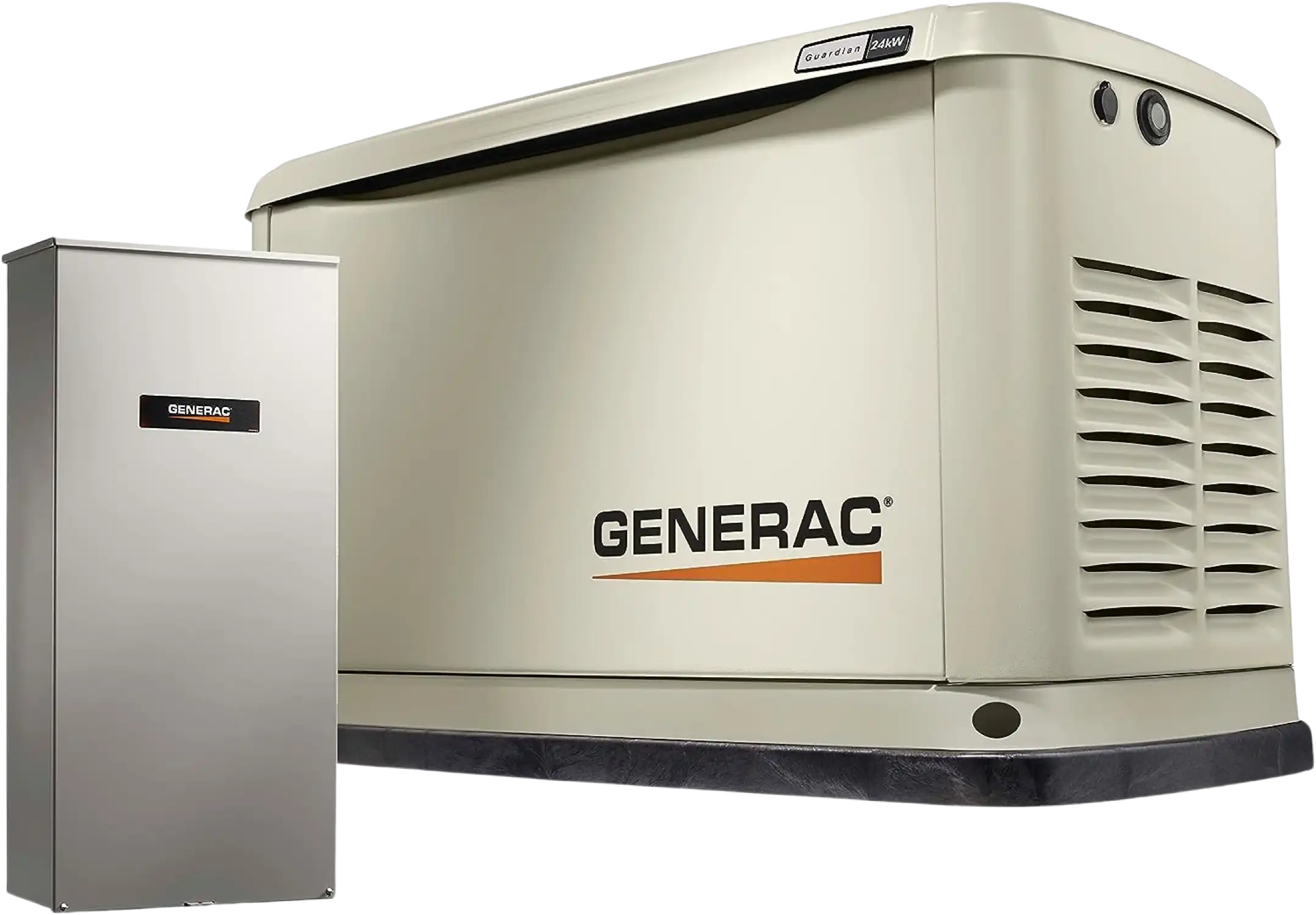
Generac Guardian 24kW
Generac's current volume flagship: 24kW on propane and 21kW on natural gas from the G-Force 1000 platform, bundled here with a 200-amp service-entrance transfer switch with PWRview energy monitoring. It's pitched as the 22kW's replacement, squeezing 2.6x the power of the baseline air-cooled units from the same-size enclosure, and owners like that it fits the same pad footprint. Real-world reports are strong — seamless transfers, two-AC homes handled with smart load modules — with noise at 67 dB under load and a much quieter 57 dB Quiet-Test. The complaints are familiar: owners report Wi-Fi Mobile Link dropouts, controller boards replaced under warranty, and dealer-network variability that makes your installer choice as important as the machine. Ships as a complete package, which simplifies quotes compared to the à-la-carte SKUs.