
Champion
Champion 8500W Dual Fuel Inverter
Champion's answer to the EU7000iS costs a third as much and adds propane capability: 7,000 running watts of closed-frame inverter power at a claimed 61 dBA from 23 feet, with both 50A and 30A 240V outlets ready for a transfer switch. Owners running whole-home essentials during outages report it handles well pumps, furnaces, and a smaller central AC, with quiet operation that genuinely surprises people used to open-frame roar. The CO Shield sensor and electric start round out a strong package. The complaint list from owner threads: at 214 pounds it's barely 'portable' despite never-flat wheels, the propane derate takes running power to about 6,300 watts, real-world noise climbs well above 61 dB under heavy load, and a few owners report early inverter-board failures — Champion support resolves them, but shipping a 200-lb unit for service is nobody's idea of fun.
Specifications
Highlights
What owners like
- ✓61 dBA claim holds at light load — dramatically quieter than open frames
- ✓50-amp 14-50R outlet feeds larger transfer switches
- ✓Propane option avoids stale-fuel problems for storm storage
- ✓Clean inverter power safe for HVAC boards and electronics
- ✓Massive value against the EU7000iS
Common complaints
- ✗214 lbs — moving it over any obstacle is a two-person job
- ✗Noise rises sharply under heavy load
- ✗Propane derates output roughly 10%
- ✗Scattered owner reports of early inverter-board failures
- ✗Warranty service on a unit this heavy is logistically painful
Owner Insightssummarized from Reddit and owner forums
The 201175 is Champion swinging directly at the EU7000iS: 7,000 running watts of closed-case inverter power with 240V outlets, electric start, and a propane hose, for roughly a third of Honda money. The buyers in owner threads are almost uniformly home-backup people - hurricane and ice-storm country, well pumps and furnaces - who priced a standby install, flinched, and found this instead. The repeated surprise in reviews is the noise: people expecting open-frame roar describe conversations next to a running unit.
Ownership reports are strong with predictable Champion caveats. Real outage logs show a 2-ton central AC, well pump, and kitchen loads coexisting on gasoline, about 12 hours of essentials on a 20-lb propane tank, and the Intelligauge making hour-based maintenance easy to track. The smart-owner pattern is propane for storage cleanliness and grill-tank convenience, gasoline when every watt matters, since propane shaves output to about 6,300 running watts. The battery wants a maintenance charger, the 420cc carb wants to be run dry before storage if it saw gasoline, and the 214-pound reality means you should solve the how-do-I-move-it problem on a sunny day, not during the storm. Champion phone support gets good marks in the threads where something went wrong.
Best for whole-home-essentials backup through an interlock or transfer switch, where its 50A and 30A 240V outlets plug in without adapter drama. At 1,400 to 1,800 dollars it undercuts the EU7000iS by more than 3,000 while out-powering it, and the serious cross-shop is the Predator 9500 - 600 more watts for similar money, but gas-only with a 90-day warranty against Champion's 3 years. Owners who went Champion cite the dual fuel and warranty; owners who went Honda cite refinement and resale. Nobody in either camp seems to regret skipping the standby install.
What owners like
- +Verified outage reports of a 2-ton central AC, well pump, refrigerator, and lights running simultaneously
- +Quiet enough that one owner jokes you can sit on it and hold a conversation
- +12 owner-verified hours on a single 20-lb grill tank at essentials load
- +Both 50A and 30A 240V twist-lock outlets connect to nearly any transfer switch or interlock without adapters
- +Intelligauge tracks volts, frequency, and engine hours, so maintenance timing is never a guess
- +Propane-mostly operation keeps the carburetor clean between outages - the dual-fuel storage cheat code
- +Sale pricing dips under 1,400 dollars, a fraction of any installed standby with similar output
- +Eco mode drops to a low murmur on overnight fridge-and-furnace loads, stretching both fuel and neighborly goodwill
Common complaints
- −Moving 214 pounds up any slope is a two-person job even with never-flat wheels - owners buy ramps before the first outage
- −Propane running power falls to roughly 6,300 watts, which bites if you sized the purchase around a central AC
- −The 61 dBA rating is a quarter-load number from 23 feet; at half-house load it becomes a clearly audible drone
- −Still carbureted, so gasoline users inherit the run-it-dry storage ritual that fuel-injected rivals skip
- −The starter battery self-discharges in storage and there is no graceful fallback if it is dead
- −Scattered early inverter-board failures meant freight-shipping a 200-pound unit for service - rare, but the worst-case warranty story
- −Standard model is 49-state emissions, so California buyers have to hunt down the CARB variant
- −CO Shield is aggressive about semi-enclosed spaces - a generator shed needs genuine airflow or it shuts down mid-outage
Common Questions
Can it back up my whole house?
How does it hook up to a transfer switch?
What is the real propane story - derate and runtime?
How loud is it during an overnight outage?
Does the electric start work after months of storage?
This or the Honda EU7000iS?
Compare the Champion 8500W Dual Fuel Inverter
Related units
More from Champion →
The unicorn spec r/Generator kept asking for: tri-fuel AND inverter in one machine. Hook the 201176 to your natural-gas line for unlimited runtime, and unlike every conventional tri-fuel, it feeds your house clean sub-3% THD power that's safe for furnace boards, UPSs, and electronics — through a 50-amp outlet. On gasoline it makes 7,250 running watts; NG drops it to 5,875, still enough for most homes' essentials plus a small AC. It's an open-frame design, so the 72 dBA rating is real and load-dependent — quieter than a WGen9500DF, louder than closed-case inverters. Owner threads note the winning math (it replaced separate 'quiet' and 'NG' generators for many), with the familiar caveats: NG line pressure matters, the 420cc engine drinks on gasoline at full tilt, electric-start battery upkeep, and Champion's included NG/LP hoses are short. CO Shield included.

The people's RV generator. Champion's 200988 pairs 4,500 starting watts with dual-fuel flexibility and electric start at well under half of Honda money, and the review volume — thousands across Amazon, Walmart, and Camping World — is overwhelmingly positive. Owners confirm it starts 13.5k BTU RV air conditioners, sips propane for up to 21 hours on a 20-lb tank, and holds clean sub-3% THD power for electronics. At 61 dB it's audibly louder than a Honda or the iGen4500, more of a steady hum than a whisper, and the 103-lb body rides on small, hard wheels that owners wish were bigger. Recurring gripes: the electric-start battery dies if you don't tend it (there's a maintenance charger port for a reason), propane output derates to 3,150 running watts, and oil changes require a slight tilt-and-funnel dance.

Champion
Champion 76533 3800W Dual Fuel
One of the best-selling generators ever made, and the archetype of the 'good enough for everything' budget dual fuel. Electric start, RV-ready TT-30R outlet, propane capability out of the box, and nearly a decade of owner history at around $550 — the review count across Amazon and Walmart is enormous and consistently positive. Owners run travel trailers, job sites, and essential-circuit extension-cord backup, and the 224cc engine has a reputation for starting after years of neglect (on propane especially, since there's no carb to gum). Known quirks from the threads: it's a 68 dB droner that campground quiet hours won't love, output on propane drops about 10%, there's no 240V so interlock users look elsewhere, the fuel selector and petcock feel plasticky, and cold-weather propane starts sometimes need a second try. Champion's phone support gets rare-for-the-industry praise.

Champion
Champion aXis 14kW
Champion's aXis system is the disruptor bid in standby: a 14kW unit with a 200-amp service-entrance transfer switch AND a 10-year warranty — double the coverage of Generac, Kohler, or Cummins — for about five grand. The clever bit is Power Line Carrier technology: the generator talks to the transfer switch over your home's existing wiring, so installs skip the extra control-wire run, and the aXis load management prioritizes up to four loads. The 754cc Milwaukee-series V-twin runs a claimed 62 dBA, quiet for the class, and it operates from -22°F to 104°F with a 24V starting system. Owner reports are mostly happy, but the honest cons: the certified installer network is young and sparse, some electricians are unfamiliar with the PLC setup, and 12.5kW on natural gas trails the LP rating.
Predator (Harbor Freight)
Predator 9500 Inverter
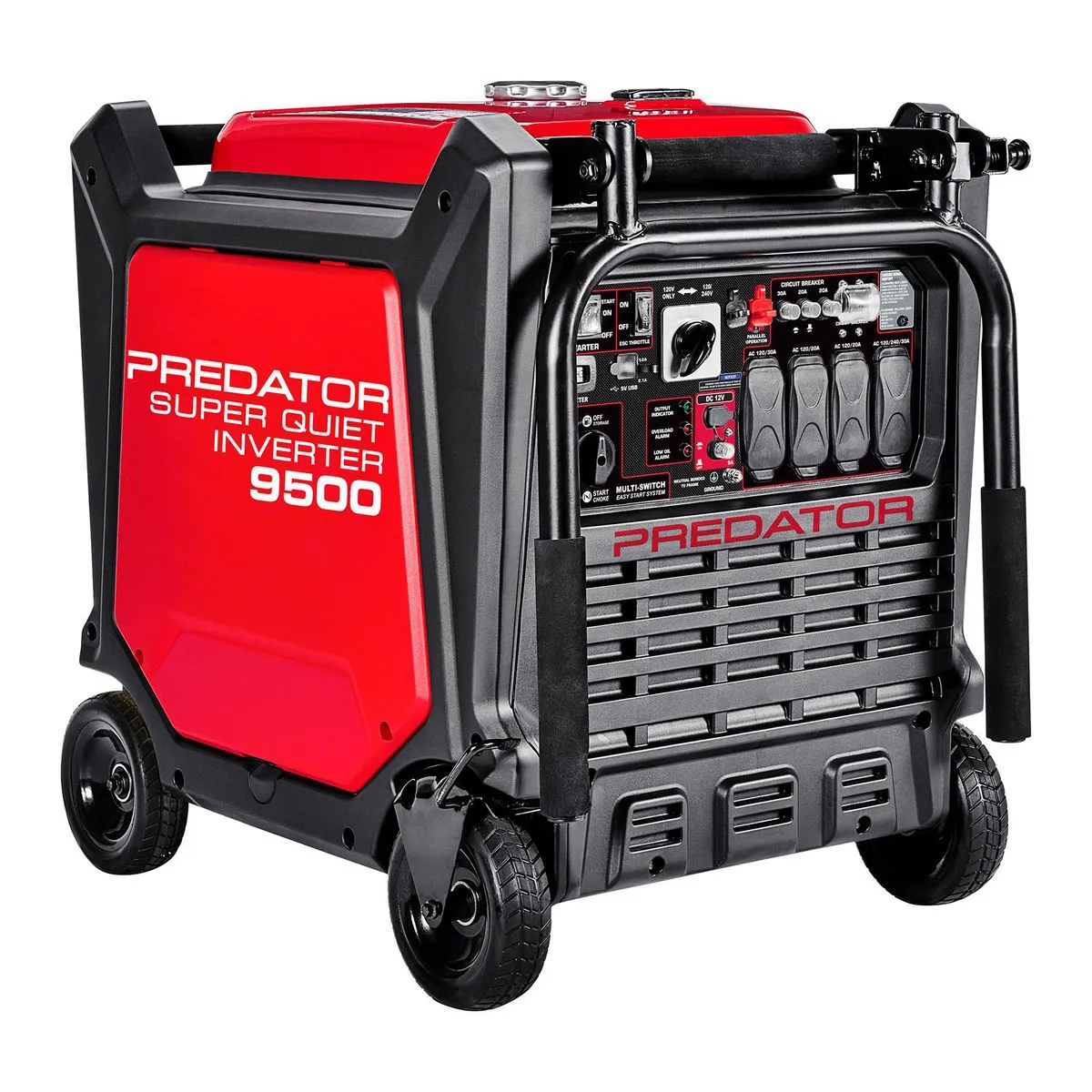
Harbor Freight's giant-killer. The Predator 9500 delivers 7,600 running watts of closed-case inverter power — EU7000iS territory plus 2,000 extra watts — at 40% of Honda's price, and the r/Generator consensus is that the hardware genuinely delivers: clean power, 67 dBA that's dramatically quieter than open frames, electric start, ESC economy mode, and 18.5-hour runtimes. Owners run whole homes through the L14-30R and an interlock. The catch everyone leads with: a 90-day warranty from a company whose service model is 'bring it to the store,' so buyers treat the extended protection plan as mandatory. Other realities from long-term threads: 257 lbs makes it the heaviest thing in its class, it's carbureted (store it dry), CO Secure occasionally false-trips in enclosed-ish spaces, and there's no dual-fuel option at this size.

Generac
Generac iQ3500
Generac's premium inverter was built to beat Honda's EU3000iS on paper — more starting watts, electric start, a PowerDial that combines start/run/stop in one twist, and a digital dashboard showing watts and runtime — and owner reviews suggest it largely succeeds at 50-52 dB. Job-site users like the steel enclosure; tailgaters like that it's genuinely conversation-quiet in economy mode. It starts 13.5k RV ACs and the 30A L5-30R twist-lock feeds RV adapters cleanly. The persistent owner complaints: 109 pounds with no wheels and only two handles — moving it solo is miserable and a wheel-kit is the first accessory everyone buys; the carburetor demands fuel treatment before storage; and a 2023-era recall on certain units (stator faults causing fire risk) rattled confidence, though current production is clear. At street prices near $1,250 it undercuts what the equivalent Honda cost by nearly half.