
Honda
Honda EU7000iS
The generator hurricane-country homeowners aspire to: fuel-injected GX390 engine, 5,500 running watts with 240V output for a transfer switch, electric start, and noise levels (52-58 dB) so low that owners describe running it overnight outside bedroom windows. The EFI matters twice — no carb maintenance, and roughly 16 hours from 5.1 gallons at quarter load, which owners confirm during multi-day outages. Reliability reports are as close to unanimous as generators get; Consumer Reports ranks it at the top of the class. What owners complain about: 263 pounds is a two-person or ramp job despite the wheels, the price crossed into home-standby territory (people cross-shop it against installed Generacs), it can't run on propane or NG without third-party conversion, and replacement parts are dealer-priced. If the budget survives, nobody regrets it.
Specifications
Highlights
What owners like
- ✓Quietest generator in the 5,500W class by a wide margin
- ✓Fuel injection means reliable cold starts and no carb service
- ✓16-hour quarter-load runtime covers a full night and day
- ✓240V L14-30R feeds a manual transfer switch properly
- ✓Top-of-class reliability record across owner reports and CR testing
Common complaints
- ✗$5,000 — cross-shops against installed home standby units
- ✗263 lbs; moving it up steps takes two people
- ✗Gasoline-only without aftermarket tri-fuel conversion
- ✗Honda parts and dealer service are expensive
- ✗No 50A outlet for larger transfer switch setups
Owner Insightssummarized from Reddit and owner forums
The EU7000iS is the endgame purchase of the portable-backup world - the unit hurricane-belt homeowners save up for after wearing out something cheaper. What sets it apart in owner threads is the combination nothing else quite matches: fuel-injected reliability, true 240V transfer-switch power, and noise so low that neighbors during a blackout come ask what brand it is. Buyers are almost always coming off a louder open-frame unit or deciding against a permanently installed standby.
Living with it is about as low-drama as generators get. The EFI GX390 starts on the button after months of sitting, there is no carburetor to gum, and the maintenance schedule is one oil change at 20 hours and then every 100 - owners with 1,400-plus hours report clean oil and nothing on the magnetic filler plug. Real outage logs confirm about 16 hours from 5.1 gallons at light load, or roughly 0.32 gallons per hour, which matters enormously when gas stations are down too. The two ownership taxes: keep the starter battery on a tender (there is a recoil backup when you forget), and figure out how you will move 263 pounds before the storm - the little solid wheels are fine on a driveway and hopeless on wet grass.
It is best for homeowners running essentials - well pump, furnace, fridges, and maybe a small central AC with load management - through a transfer switch or interlock. At around 5,000 dollars it sits in an awkward spot: a Predator 9500 delivers 2,100 more watts for 2,000, a Champion 8500 dual-fuel does 7,000 watts for 1,800, and an installed Generac standby starts around 8,000 all-in. Owners who chose the Honda anyway say the same thing: the quiet, the fuel sipping, and the certainty it starts are what you are paying for, and nobody in the threads regrets it.
What owners like
- +Owner logs show 1,400-plus hours on original internals with nothing but oil changes - the durability stories are real
- +Conversation-quiet in eco mode; owners talk at normal volume standing beside it
- +Starts a 1.5 HP well pump on top of existing household loads without flinching
- +Sips roughly 0.32 gallons per hour at quarter load - the most fuel-efficient unit in the big-inverter class
- +Drops onto a Reliance Pro/Tran transfer switch cleanly, and the 240V L14-30 makes interlock setups simple
- +Electric start with a recoil backup, so a flat battery never strands you in an outage
- +Magnetic oil filler plug and a 100-hour oil interval make DIY service a ten-minute job
- +Third-party propane and natural-gas conversion kits exist for owners who want endless runtime off a house line
Common complaints
- −263 pounds means ramps, engine cranes, or a second person - the wheels only help on hard flat ground
- −Those small solid wheels are useless in mud, gravel, or grass, exactly where it needs to go in a storm
- −The starter battery self-discharges in storage; owners treat a battery tender as a required accessory
- −5,500 running watts is 2,100 fewer than a Predator 9500 that costs 3,000 dollars less
- −Gasoline-only from the factory - propane or NG means a third-party kit that modifies the fuel-injected engine
- −Dealer-only parts run double aftermarket prices, and some items sit on backorder
- −The 20-hour break-in oil change catches owners off guard when the first real use is a multi-day outage
- −It is a known theft target during regional outages; owners chain it to anchors and add GPS trackers
Common Questions
Can it run my whole house?
What transfer switch setup do owners use?
What is the oil change interval?
Can I convert it to propane or natural gas?
Does the electric-start battery die in storage?
Is it really quiet enough to run overnight?
Compare the Honda EU7000iS
Related units
More from Honda →
Honda
Honda EU3200i
Honda's first genuinely new generator in years, and the first in this size with fuel injection — the GX130 EFI means no carburetor to gum up in storage, which eliminates the single most common failure mode in owner forums. At 59 lbs it carries like an EU2200i but delivers 2,600 running watts and a 30A locking outlet, enough to start a 13.5k BTU RV air conditioner that the smaller Honda can't touch. Owners love the concept; the execution had teething problems — Consumer Reports and retailer reviews show a visible minority of one-star reports for stalling and hard-start issues on early units, and Honda's dealer-service response has been mixed. Most current-production owners report it running flawlessly and impressively quiet at 54-58 dB. It's expensive per watt, but it's the lightest path to real RV-AC power with EFI reliability.

Honda
Honda EU2200i
The default answer to 'which small generator should I buy' for going on two decades. The EU2200i's GXR120 engine, 47-lb carry weight, and 48-57 dB voice-level noise make it the campground and tailgate standard, and the current version adds Bluetooth monitoring, CO-MINDER shutdown, and a fuel shutoff valve so you can run the carb dry before storage — a direct response to the gummed-carburetor complaints that dominate owner threads for every small generator, Honda included. Owners justify the price with resale value (used units hold 70%+ of MSRP) and start-on-second-pull reliability years in. The honest knocks: it's double the cost of credible clones, 1,800 running watts won't touch most RV air conditioners without a parallel second unit, there's no fuel gauge, and the early-generation recall history (2018-19 fire risk) still comes up in threads.
Predator (Harbor Freight)
Predator 9500 Inverter
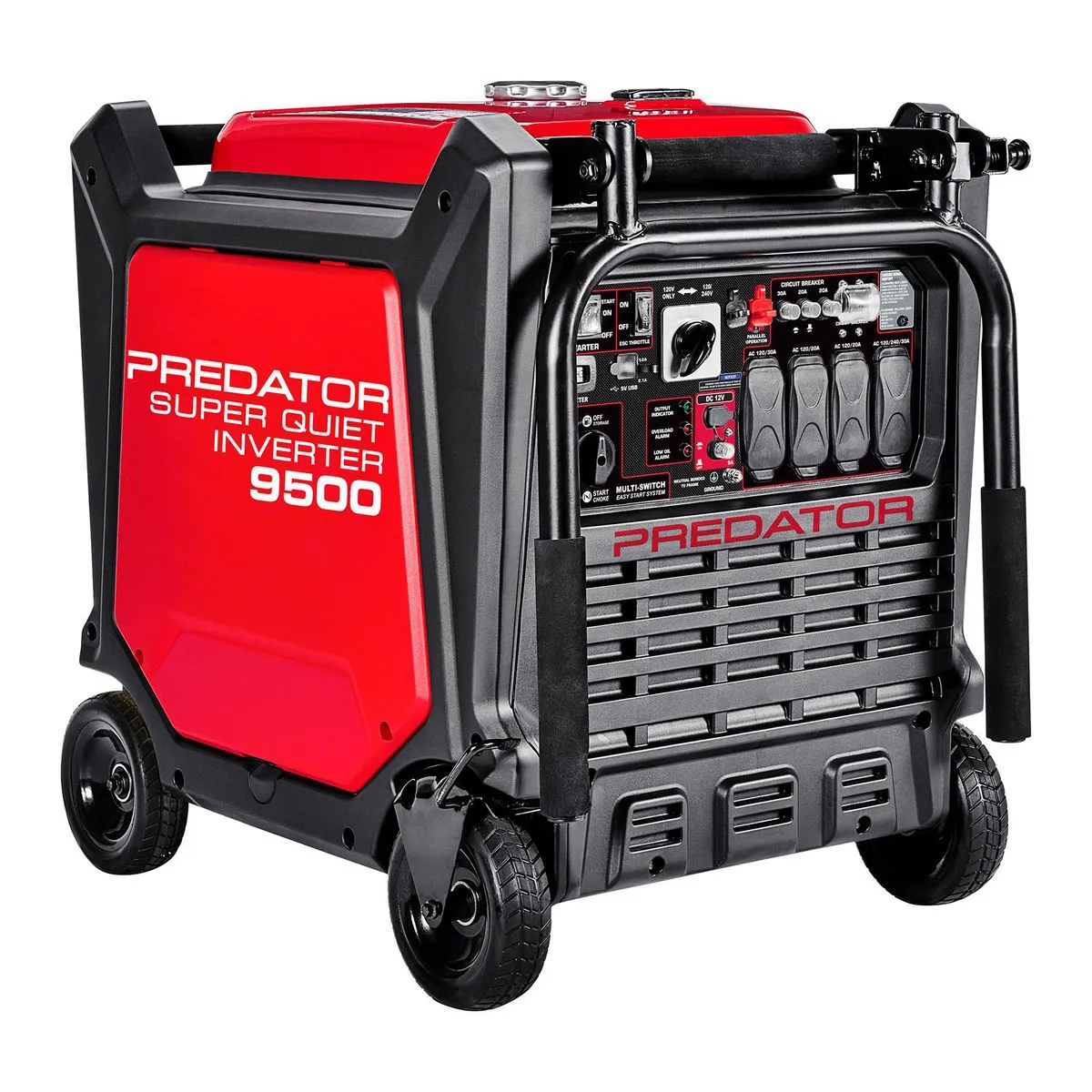
Harbor Freight's giant-killer. The Predator 9500 delivers 7,600 running watts of closed-case inverter power — EU7000iS territory plus 2,000 extra watts — at 40% of Honda's price, and the r/Generator consensus is that the hardware genuinely delivers: clean power, 67 dBA that's dramatically quieter than open frames, electric start, ESC economy mode, and 18.5-hour runtimes. Owners run whole homes through the L14-30R and an interlock. The catch everyone leads with: a 90-day warranty from a company whose service model is 'bring it to the store,' so buyers treat the extended protection plan as mandatory. Other realities from long-term threads: 257 lbs makes it the heaviest thing in its class, it's carbureted (store it dry), CO Secure occasionally false-trips in enclosed-ish spaces, and there's no dual-fuel option at this size.

Champion's answer to the EU7000iS costs a third as much and adds propane capability: 7,000 running watts of closed-frame inverter power at a claimed 61 dBA from 23 feet, with both 50A and 30A 240V outlets ready for a transfer switch. Owners running whole-home essentials during outages report it handles well pumps, furnaces, and a smaller central AC, with quiet operation that genuinely surprises people used to open-frame roar. The CO Shield sensor and electric start round out a strong package. The complaint list from owner threads: at 214 pounds it's barely 'portable' despite never-flat wheels, the propane derate takes running power to about 6,300 watts, real-world noise climbs well above 61 dB under heavy load, and a few owners report early inverter-board failures — Champion support resolves them, but shipping a 200-lb unit for service is nobody's idea of fun.

The unicorn spec r/Generator kept asking for: tri-fuel AND inverter in one machine. Hook the 201176 to your natural-gas line for unlimited runtime, and unlike every conventional tri-fuel, it feeds your house clean sub-3% THD power that's safe for furnace boards, UPSs, and electronics — through a 50-amp outlet. On gasoline it makes 7,250 running watts; NG drops it to 5,875, still enough for most homes' essentials plus a small AC. It's an open-frame design, so the 72 dBA rating is real and load-dependent — quieter than a WGen9500DF, louder than closed-case inverters. Owner threads note the winning math (it replaced separate 'quiet' and 'NG' generators for many), with the familiar caveats: NG line pressure matters, the 420cc engine drinks on gasoline at full tilt, electric-start battery upkeep, and Champion's included NG/LP hoses are short. CO Shield included.

Generac
Generac iQ3500
Generac's premium inverter was built to beat Honda's EU3000iS on paper — more starting watts, electric start, a PowerDial that combines start/run/stop in one twist, and a digital dashboard showing watts and runtime — and owner reviews suggest it largely succeeds at 50-52 dB. Job-site users like the steel enclosure; tailgaters like that it's genuinely conversation-quiet in economy mode. It starts 13.5k RV ACs and the 30A L5-30R twist-lock feeds RV adapters cleanly. The persistent owner complaints: 109 pounds with no wheels and only two handles — moving it solo is miserable and a wheel-kit is the first accessory everyone buys; the carburetor demands fuel treatment before storage; and a 2023-era recall on certain units (stator faults causing fire risk) rattled confidence, though current production is clear. At street prices near $1,250 it undercuts what the equivalent Honda cost by nearly half.